
Home › Services › Lawn Care Services
Lawn Sprayers
The sprayer matters less than knowing how much you’re actually putting down. Almost every product failure and every burnt lawn traces back to the same missing step.
Advertising disclosure: calls are routed to an independent local provider. We’re paid a referral fee for the call. You pay the provider, never us.
The short answer
Label rates are given per unit area, so applying correctly requires knowing how much liquid your sprayer puts on that area at your walking speed. Without calibrating, you’re guessing — and guessing high burns turf while guessing low wastes product and breeds resistance. Calibration takes fifteen minutes with water and a bucket, and it is the difference between a product working and not.
The missing step
Calibration
Takes
Fifteen minutes, with water
Never share
Herbicide and other sprayers
Rate errors
Burn, or breed resistance
Which sprayer for what
Four types, matched to area rather than preference.
Small areas
Handheld pump
A litre or two. Fine for spot-treating weeds and small beds. Impractical past a small lawn because you’ll refill constantly and consistency suffers.
Most lawns
Backpack sprayer
Fifteen litres or so, with a wand. The sensible default for a domestic lawn. Consistent pressure models are worth the extra because output doesn’t vary with how hard you pump.
Convenient, imprecise
Hose-end sprayer
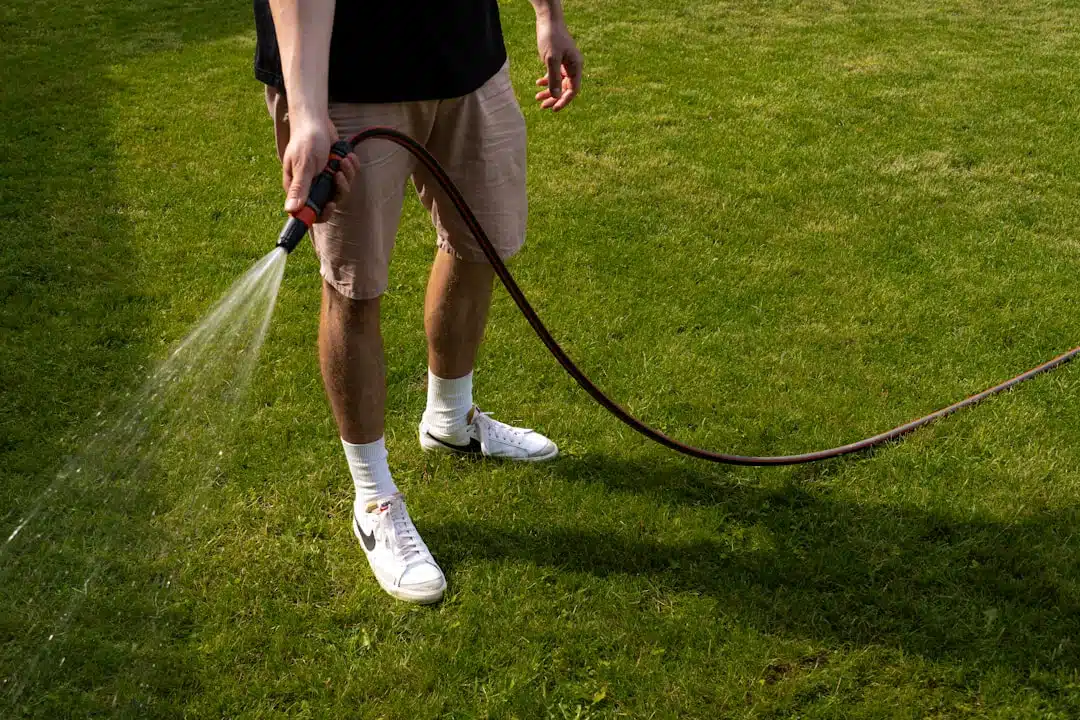
Dilutes concentrate into the hose stream. Easy, and rate accuracy depends on water pressure, which varies. Acceptable for forgiving products, poor for anything where rate matters.
Large areas
Tow-behind or push
Boom sprayers for half an acre and up. At that point you’re into equipment that needs storing and maintaining, and the arithmetic often favours hiring.
How to calibrate, in fifteen minutes
Mark out a known area — a square of a few metres a side is fine. Fill the sprayer with plain water, spray that area at your normal walking pace and normal pressure, exactly as you would with product. Then measure how much water you used, by refilling to the mark with a measuring jug.
That gives you litres per unit area at your pace. Now you can work backwards from the label rate to how much concentrate goes in the tank. Do it once for each nozzle you use, and once more if you change your pace.
Why herbicide sprayers stay separate
Some herbicide residues survive rinsing and persist in seals and hoses. A sprayer that has held broadleaf herbicide can damage plants weeks later even after washing.
Label them, keep them apart, and never use the herbicide sprayer for anything else. It’s the cheapest mistake to avoid and one of the more upsetting ones to make on a vegetable bed.
Applying properly
Calibrate first. Everything else is straightforward.
Calibrate with water
Known area, normal pace, measure what you used. Fifteen minutes, once, and it makes every application afterwards accurate.
Read the label rate
Per unit area. Then calculate the concentrate for your tank from your calibrated output.
Check the conditions
Not in wind, not before rain, not in heat. Drift and wash-off waste product and damage what you didn’t intend to treat.
Overlap slightly, don’t double
Consistent pace, slight overlap at the edges. Doubling back over a strip doubles the rate on it.
Rinse three times
Tank, hose and nozzle, with the rinse water applied to the treated area rather than tipped down a drain.
Keep the herbicide sprayer separate
Labelled and never used for anything else. Residues persist in seals.
Sprayer by area
Where this stops being a DIY job
Anything requiring a restricted-use product. Almost nothing a home lawn needs falls into that category. If a company says otherwise, ask which product and check the label — labels are public.
Applying near water. Setbacks from streams, ponds and storm drains are regulated and some products are restricted regardless of distance.
Large areas where consistency matters. Fertiliser and herbicide applied unevenly over an acre shows up as stripes for a season.
Advertising disclosure: calls are routed to an independent local provider. We’re paid a referral fee for the call. You pay the provider, never us.
What a professional applicator does
Calibrates
Knows the output
Per unit area, for the equipment and the operator. It’s the basis of every rate.
Conditions
Won’t spray in wind
Drift wastes product and damages what wasn’t meant to be treated.
Records
Notes what was applied
Product, rate, date, area. Required commercially and useful domestically.
Common questions
How do I calibrate a lawn sprayer?
Spray a marked area with plain water at your normal pace, then measure how much you used. That gives you output per unit area, which is what label rates are based on.
What’s the best sprayer for a lawn?
A backpack sprayer for most domestic lawns, ideally a constant-pressure model so output doesn’t vary with pumping. Handheld for spot treatment.
Can I use the same sprayer for herbicide and fertiliser?
No. Some herbicide residues survive rinsing and persist in seals and hoses, and can damage plants weeks later. Keep a separate, labelled sprayer.
Are hose-end sprayers accurate?
Not very. The dilution depends on water pressure, which varies. Acceptable for forgiving products, poor for anything where rate matters.
Large area, or stripes from an uneven application?
Calibrating with water takes fifteen minutes and it’s the difference between a product working and burning the lawn. Large areas where consistency matters, and anything near water, are where this needs someone equipped for it.
Call (877) 360-4657