
Home › Services › Pest Control
Wolf Spiders
Large, fast, hairy and indoors in autumn — which is why they get searched for. They are also harmless hunters that eat the insects you’d rather not have, and they are not the species most people are actually worried about.
Advertising disclosure: calls are routed to an independent local provider. We’re paid a referral fee for the call. You pay the provider, never us.
The gist
Wolf spiders hunt on the ground and don’t build webs, so web-based treatments and web removal miss them completely. They come indoors in autumn following prey and warmth, not to nest. If what you want is fewer of them, the lever is the insects they’re eating and the gaps they’re walking through — not a spray.
Web
None — they hunt on foot
Indoors when
Autumn, following prey
Risk to people
Bites rare, medically minor
What actually reduces them
Lighting and gaps
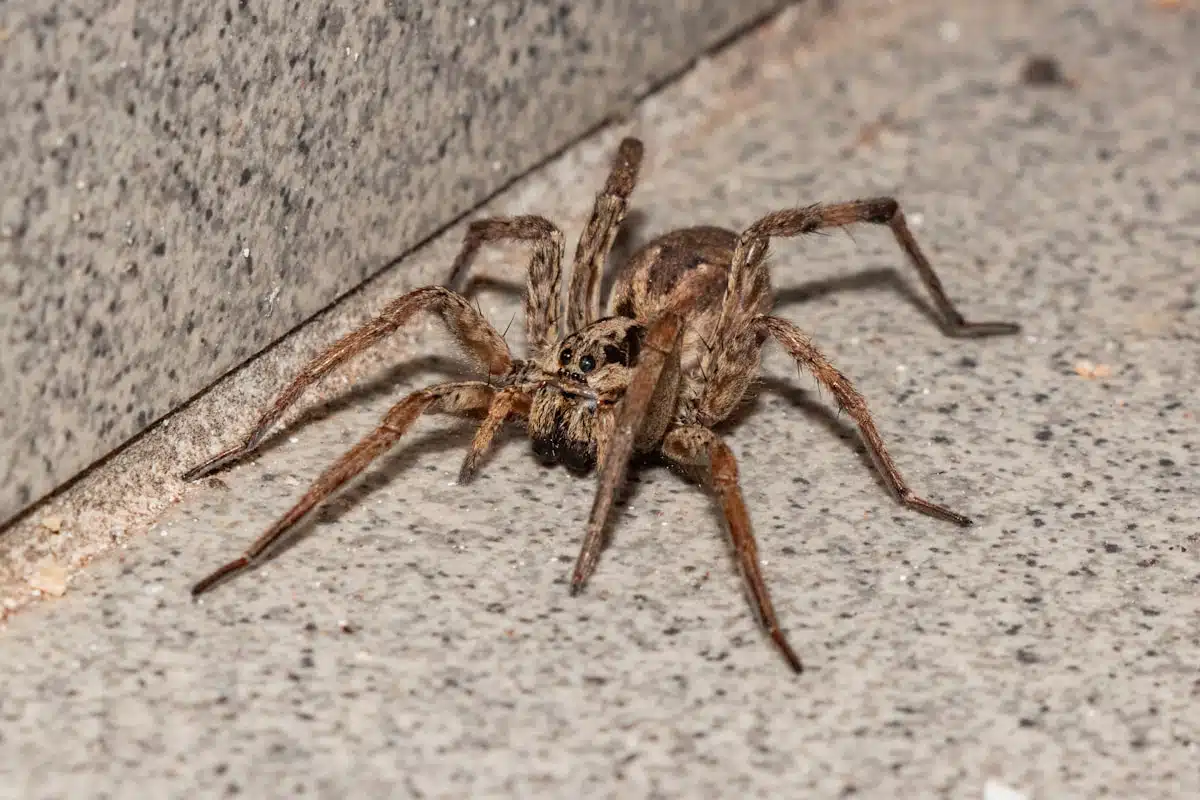
Wolf spider or something else?
The species people are actually worried about looks nothing like this one, and telling them apart takes about five seconds.
Almost certainly this
Wolf spider
Stocky, hairy, brown-grey and patterned. Moves in fast bursts across open floor. Two large forward-facing eyes that reflect a torch beam back at you outdoors.
Also this
Female with young
Carrying an egg sac at the spinnerets, or spiderlings riding on her back. Startling to come across, and a completely reliable identification.
Rarely this
Brown recluse
Small, uniformly tan, smooth rather than hairy, long thin legs, violin mark behind the eyes. Retiring, regional, and far more often reported than found.
Identifying them, and what they aren’t
Wolf spiders are stocky and hairy, brown to grey with darker markings, and they move in fast bursts across the floor rather than hanging in a web. Their eye arrangement is distinctive if you get close enough: two large forward-facing eyes with smaller ones around them, and they reflect a torch beam back at you at ground level outdoors.
Females carry an egg sac attached to the spinnerets, and later carry the spiderlings on their back — which is startling to come across and is also a reliable identification.
The species people are usually worried about when they search this is the brown recluse, and it looks quite different: small, uniformly tan, smooth rather than hairy, long thin legs, and a violin-shaped mark behind the eyes. Recluses are regional, uncommon outside their range, and are not fast open-floor hunters. If it is large, hairy and sprinting, it is not a recluse.
Why sprays underperform on them specifically
Two reasons. Residual barrier treatments rely on an insect dragging its body across a treated surface; a spider walks on the very tips of its legs and holds its body clear, so it picks up a fraction of what the product was designed around. And a wolf spider is a wanderer rather than a resident — it isn’t sitting in a treated zone, it is passing through from outside.
What does work is closing the route and removing the reason. Door sweeps, gaps at ground level, torn screens, the garage door seal. Then the food: a bright exterior light near a door pulls in flying insects all night, and the hunters follow the food.
The honest recommendation
For most households the answer is to catch and release the individuals you meet and change the lighting. Wolf spiders are among the more useful things in a garden — they eat a lot of pest insects and are eaten by a lot of birds. Broad-spectrum spraying to remove them takes out the beneficial insects too, and the population it removes is replaced from outside within weeks.
A glass and a piece of card handles the one on the wall. It takes ten seconds and costs nothing.
If you want fewer of them
None of this needs a technician, and all of it works better than a spray.
Catch and release the one you met
A glass and a piece of card. Ten seconds, costs nothing, and the spider eats things you’d rather not have.
Change the exterior light
Warm-toned or motion-triggered near doors. The food supply is the lever; the spiders are downstream of it.
Fit door sweeps
Plus the gap under the garage door. They’re wanderers coming in from outside, not residents you can treat.
Repair torn screens
And seal gaps at ground level where pipes and cables enter.
Move stored items
Firewood and boxes off the ground and away from the wall. Cut ground cover back from the foundation.
Wolf spider or something else
The point to hand it over
A bite followed by an expanding sore, spreading discolouration, or an area that keeps worsening over days is a medical question. See a doctor rather than a pest company. Worth knowing beforehand: bacterial skin infections are very commonly mistaken for spider bites, including by people certain they saw a spider, and the treatments are entirely different.
A suspected recluse population inside a structure is regional and genuinely uncommon outside its range. It needs an inspection that establishes whether you have one before anyone treats anything — because most people who believe they do, don’t.
Crawl spaces and roof voids. If that’s where you’d have to work, the spiders are not the reason to be cautious.
Where a professional genuinely helps
Identification
Confirms the species
The only place a professional adds much here. Most suspected recluses aren’t.
Cause
Looks at the lighting
The food supply is the lever. The spiders are downstream of it.
Exclusion
Seals at ground level
They’re wanderers coming in from outside, not residents.
If you want fewer of them
- Warm-toned or motion-triggered exterior lights near doors
- Door sweeps, and the gap under the garage door
- Repair torn screens
- Move firewood and stored items off the ground and away from the wall
- Cut ground cover back from the foundation
That list is the whole treatment plan, and none of it needs a technician. What it removes is the reason they’re coming in, which a spray does not.
Frequently asked
Are wolf spiders dangerous?
Not meaningfully. Bites are rare and medically minor. They’re ground hunters that eat pest insects and are themselves eaten by birds.
Why are wolf spiders coming inside?
Autumn, following prey and warmth. They’re not nesting — they’re passing through, which is why sprays aimed at residents underperform.
How do I tell a wolf spider from a brown recluse?
Wolf spiders are stocky, hairy, patterned and fast across open floor. Recluses are small, smooth, uniformly tan with thin legs, and retiring. If it’s sprinting, it isn’t a recluse.
Do I need pest control for wolf spiders?
Almost never. A glass and a piece of card handles the one on the wall, and changing the exterior light does more than any treatment.
Not sure what you’re looking at?
For a wolf spider, a glass and a piece of card is the correct response and this page would rather you used it. Identification is the one place a professional adds something — if you genuinely cannot tell what a species is, that is worth an inspection before anybody treats anything.
Call (720) 389-2293