
Home › Services › Tree Service
Tree Fungus
A fungal bracket on a trunk is not the beginning of a problem. It’s the visible fruiting body of decay that has been progressing internally for years.
Advertising disclosure: calls are routed to an independent local provider. We’re paid a referral fee for the call. You pay the provider, never us.
The short answer
Fungi that produce brackets on a living tree are decaying wood inside it, and the bracket appears only once that decay is well established. Where it appears matters more than its size: at the base or on the root flare suggests root and butt decay, which is the failure mode that brings whole trees down. Fungicide does not reverse internal decay, so the real question is what the remaining sound wood can support.
A bracket means
Decay already advanced
Location
Matters more than size
At the base
Root and butt decay
Fungicide
Doesn’t reverse it
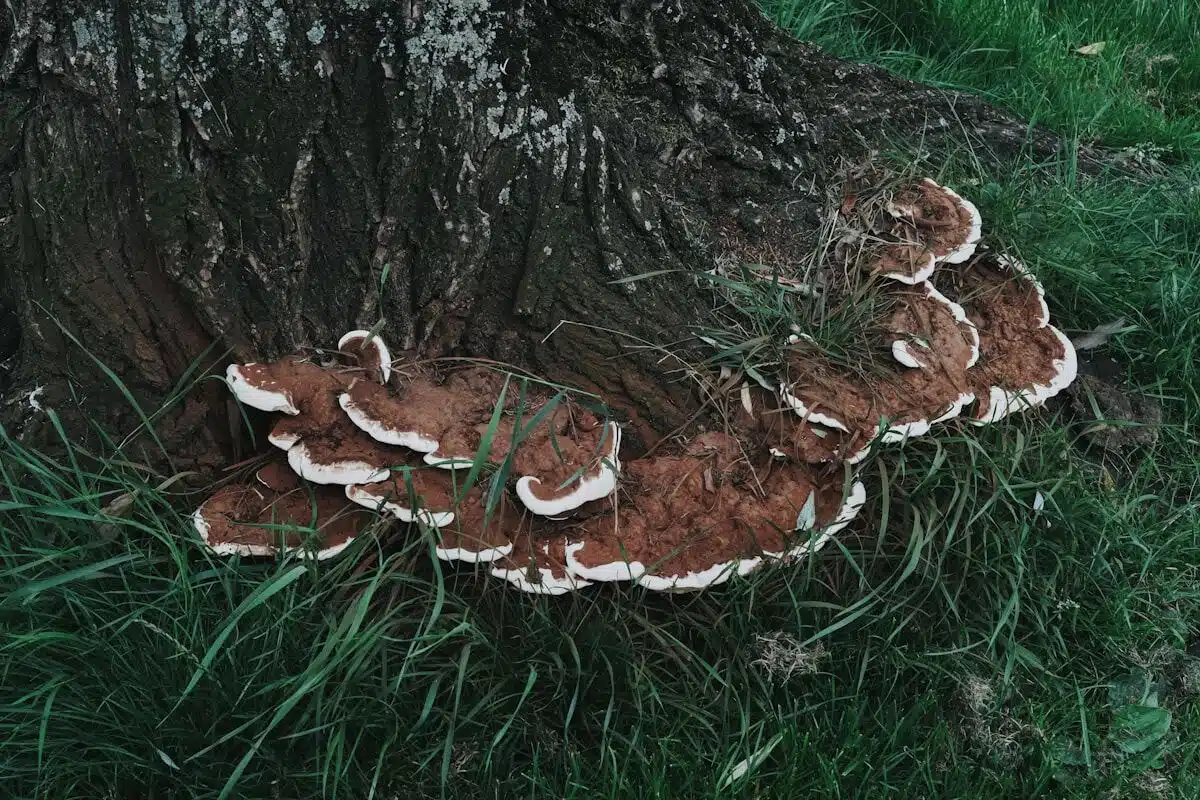
Where it is decides the concern
Four locations, in descending order of what they imply.
Most serious
At the base or on the root flare
Suggests decay in the roots and butt — the part that holds the tree upright. This is associated with whole-tree failure, often without warning and often in wind.
Serious
On the main trunk
Indicates a decay column in the stem. How much matters depends on how much sound wood remains around it, which needs assessing rather than guessing.
Manageable
At a pruning wound or branch union
Localised decay entering through a wound. Often manageable by removing the affected limb, depending on how far it has progressed.
Not a concern
On dead wood or a stump
Fungi decomposing already-dead material are doing their job. A bracket on a stump or a dead branch says nothing about the living tree.
Why fungicide isn’t the answer
By the time a bracket forms, the fungus is established throughout a column of wood inside the tree. Nothing applied to the surface reaches it, and removing the bracket removes a fruiting body while leaving the decay entirely intact.
What can be managed is the consequence: reducing the weight and sail area the compromised wood has to support, or removing the tree if the decay is too far advanced. That’s an assessment rather than a treatment.
What assessment involves
An arborist looks at the species of fungus, its location, the proportion of sound wood remaining, the tree’s lean and weight distribution, and what’s beneath it. Some tools measure decay extent internally without felling the tree.
The outcome is usually one of three: monitor with a defined interval, reduce the crown to lower the load, or remove. Which one depends on the remaining wall of sound wood, not on the size of the bracket.
What you can establish yourself
Observation, and it tells you how urgently to get an opinion.
Note exactly where it is
Base, flare, trunk, branch union, or dead wood. This single detail changes the level of concern more than anything else.
Photograph it
Clearly, with something for scale, and note the date. Useful for identification and for tracking change.
Check the base for other signs
Soil cracking, a raised lip, exposed roots. Root decay plus root plate movement is the serious combination.
Sound the trunk
Tap with a mallet. A hollow note over an area suggests decay behind it — crude, but indicative.
Note what’s beneath
A decayed tree over open lawn and one over a house are the same tree and different problems.
Don’t remove the bracket
It changes nothing about the decay and removes the evidence an arborist would want to identify.
What the location suggests
Where this stops being a DIY job
Brackets at the base of any tree near a structure. Root and butt decay is associated with whole-tree failure, often in wind and often without other warning. That needs assessing rather than watching.
Any assessment of remaining sound wood. Judging what a decayed stem can still support isn’t something to estimate from outside, and there are tools for it.
Removal of a decayed tree. Decayed wood behaves unpredictably when cut and can’t be safely climbed, which is the category where experienced people get hurt.
Advertising disclosure: calls are routed to an independent local provider. We’re paid a referral fee for the call. You pay the provider, never us.
What an arborist assesses
Identifies
The fungus species
Different fungi decay different tissue at different rates. It changes the prognosis.
Measures
Remaining sound wood
Decay extent internally, rather than judging from the bracket.
Options
Reduce before removing
Lowering the load is often viable where the decay is contained.
Common questions
Does a fungus on my tree mean it’s dying?
Not necessarily, but it means decay is already advanced — brackets appear well after the fungus is established internally. Where it appears matters more than its size.
Should I remove fungus from a tree?
No. Removing the bracket changes nothing about the decay inside and removes the evidence an arborist would use to identify it.
Will fungicide save my tree?
No. By the time a bracket forms the fungus is established through a column of wood inside the tree, and nothing applied to the surface reaches it.
Which fungus location is most serious?
At the base or on the root flare. That suggests decay in the part holding the tree upright, and it’s associated with whole-tree failure in wind.
Brackets at the base, or over a structure?
Noting the location, photographing it and checking the base for movement tells you how urgently to act, and costs nothing. Judging what the remaining sound wood can support is the part that genuinely needs an arborist.
Call (877) 360-4657