
Home › Services › Tree Service
Tree Pruning
Pruning is for the tree’s structure. Trimming is for your clearance. The distinction sounds academic until you understand that structural pruning on a young tree is the cheapest work in the whole trade.
Advertising disclosure: calls are routed to an independent local provider. We’re paid a referral fee for the call. You pay the provider, never us.
The short answer
On a young tree, half an hour of correct pruning establishes a single dominant leader and removes competing stems before they become structural problems. That prevents the co-dominant fork that splits in a storm two decades later — which is the failure that takes out roofs and costs thousands to clear. Almost nobody markets it, because the value is invisible for twenty years.
Best value
Young tree, structural
Prevents
Co-dominant stem failure
Payback
Fifteen to twenty-five years
Rarely sold
Because it’s cheap
Pruning for what?
Three purposes, and they run in descending order of value for money.
Best value
Structural, on a young tree
Establishing one dominant leader, removing competing stems and narrow forks while they’re small. Cheap now, and it prevents the failure mode that ruins mature trees.
Worth doing
Corrective, on a mature tree
Removing dead, damaged, diseased or crossing branches. Limited in what it can fix — a bad fork at forty feet can be reduced but not undone.
Cosmetic
Clearance and appearance
Lifting a canopy off a drive, opening a view. Legitimate, but it’s trimming rather than pruning and it does nothing for the tree.
Never
Topping
Not pruning at any age. Forces weak regrowth from the cut points and opens the trunk to decay.
The fork that fails
When two stems of similar size grow from the same point, bark gets trapped in the join rather than the wood knitting together. It looks solid for decades and it is structurally a crack waiting for a storm.
On a young tree this is corrected by shortening one stem so the other becomes dominant — minutes of work with hand tools. On a mature tree the same defect can only be managed: reduce the weight, sometimes brace it, and inspect it. The window for the cheap fix closes early and quietly.
If you have young trees, this is the highest-return work available and almost nobody will suggest it to you.
Structural pruning you can do yourself
On a young tree, from the ground, with hand tools. This is genuinely worth an afternoon.
Find the leader
The single main upward stem. If two are competing for the role, that’s the thing to fix and it’s the whole point of the exercise.
Shorten the competitor
Don’t remove it outright — cut it back so the chosen leader clearly wins. The tree adjusts over a season or two.
Remove narrow forks
Any join at a tight angle, especially with bark trapped in it. On a small stem this is one cut.
Take out crossing branches
Anything rubbing will wound and let decay in. Remove the weaker of the pair.
Cut at the collar
Just outside the swollen ring at the base of the branch. Not flush, not a stub.
Stop early
A quarter of the live crown at most, and less on a young tree that needs its leaves. Come back next year.
When pruning pays
Where this stops being a DIY job
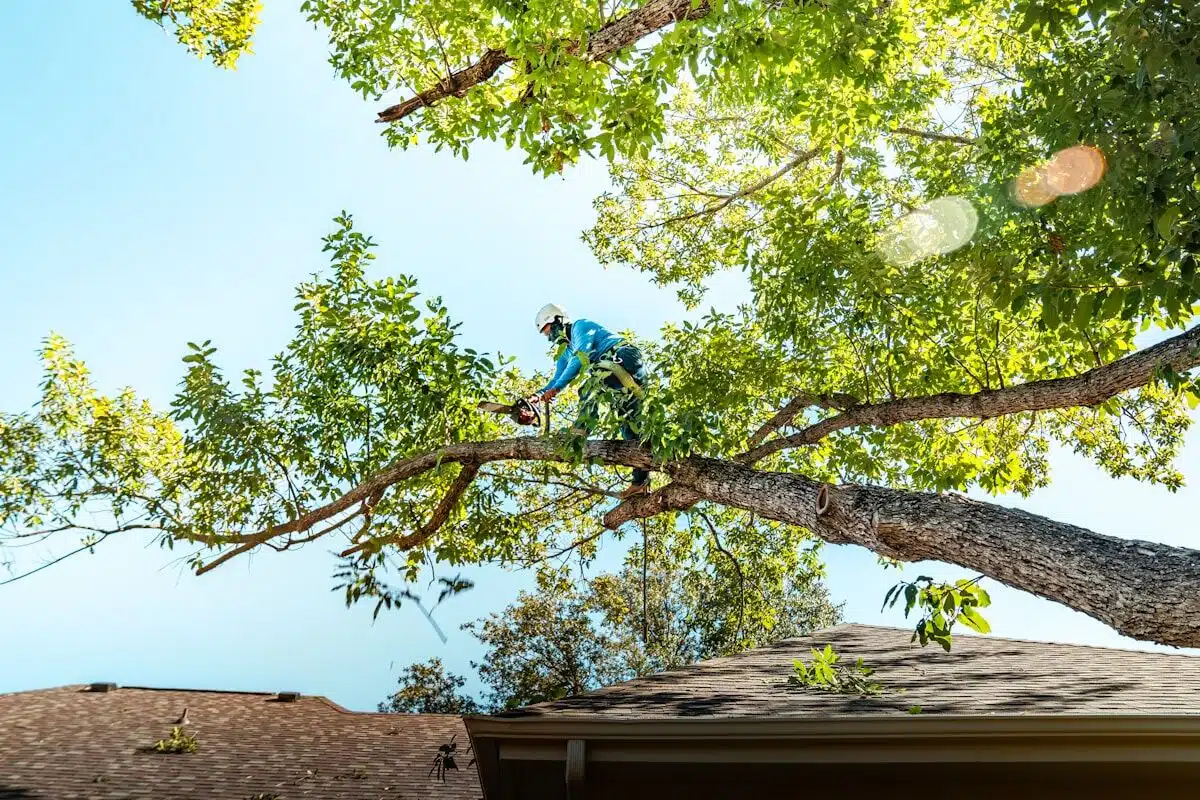
Anything you can’t reach standing on the ground. The value of structural pruning is in small trees. Once it needs a ladder or a climber, it’s a different job with different equipment.
A mature tree with a visible split or included bark at a major fork. That’s an assessment, not a pruning job — someone needs to judge whether it’s reducible, braceable, or neither.
Anything within reach of a power line. The utility, at any tree size.
What a good arborist looks at
Structure
Checks the unions
Forks and attachment angles before anything cosmetic. That’s where trees actually fail.
Restraint
Removes less than you expect
Good pruning looks like almost nothing was done. Dramatic results are a warning.
Timing
Explains the season
Species-specific, and a reason for doing it now rather than a slot in the diary.
Common questions
What’s the difference between pruning and trimming?
Pruning is done for the tree — structure, health, removing defects. Trimming is done for you — clearance, sightlines, appearance. Companies use the words interchangeably, so ask which the quote covers.
When should you prune a young tree?
Within the first few years, and it’s the highest-value work available. Establishing a single dominant leader early prevents the co-dominant fork that fails in storms decades later.
Can pruning fix a badly shaped mature tree?
Only partly. A poor union at height can be reduced or braced but not undone. The cheap fix window closes while the tree is young.
How much should be pruned at once?
No more than about a quarter of the live crown in a season, and less on young or stressed trees. Leaves are how a tree feeds itself.
Mature tree, and you don’t like the look of that fork?
Structural pruning on a young tree is an afternoon with hand tools and it’s the best-value work in this whole section. A mature tree with a suspect union is an assessment — whether it can be reduced, braced, or neither.
Call (804) 488 3350