
Advertising disclosure: calls are routed to an independent local provider. We’re paid a referral fee for the call. You pay the provider, never us.
The short answer
Mulched in place leaves everything chipped and spread where it stood. Cut and hauled leaves stumps. Stumps ground leaves ground level and a root system underground. Graded flat is earthworks. Those are four jobs at four prices, and a quote that just says “clear the lot” is being interpreted by the contractor rather than specified by you.
Four end states
Define which one
Scales badly
4× area > 4× cost
Often required
Permits and setbacks
Watch for
Protected trees
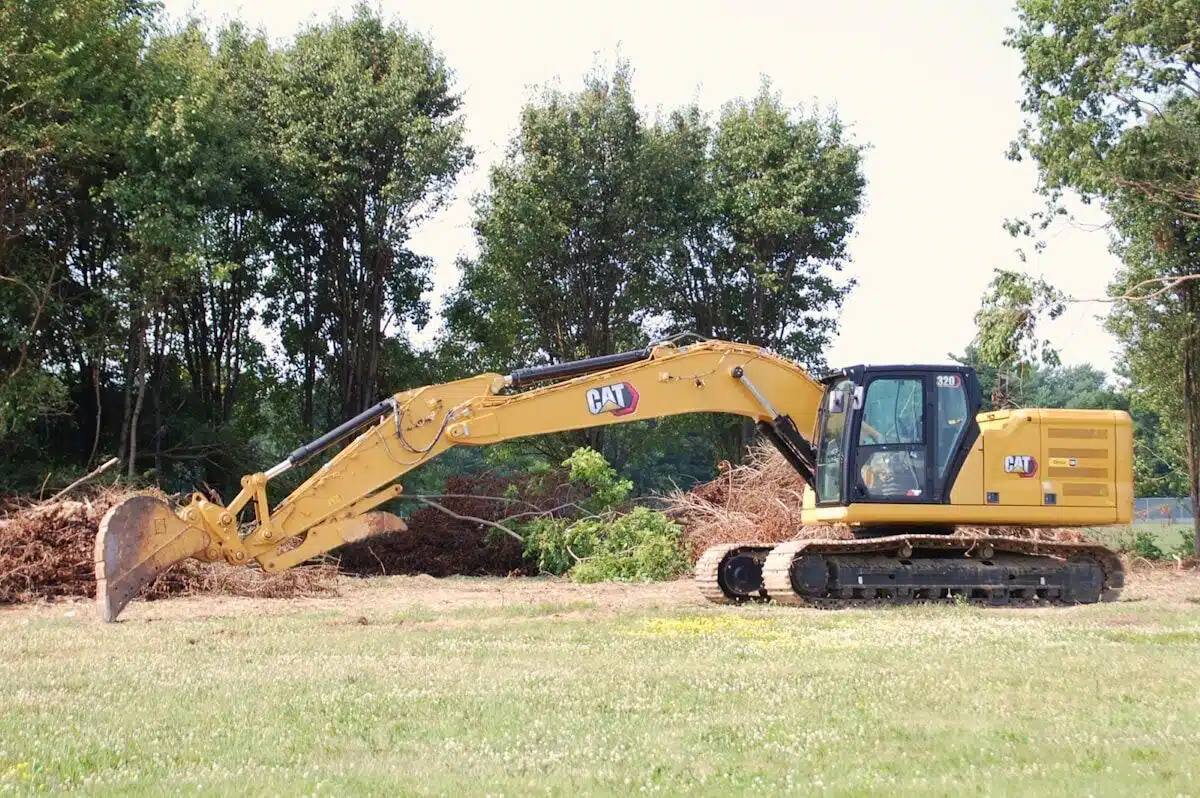
What does “cleared” mean to you?
Cheapest to dearest. Pick one and put it in writing.
Cheapest
Mulched in place
A forestry mulcher grinds standing vegetation where it stands and leaves the chip on the ground. Fast, no haulage, and the site is covered in mulch afterwards. Fine for reclaiming overgrowth, not for building.
Middle
Cut and hauled
Material removed from site, stumps left at ground level. Usable land, and you still have stumps.
Dearer
Stumps ground
Adds a grinder pass. Roots remain and decay underground for years, which causes settling — fine for lawn, not for a foundation.
Dearest
Graded and cleared
Organic material excavated out and the site levelled. This is groundworks rather than clearing, and it’s what building actually requires.
Why it scales badly
Four times the area is not four times the price, and beyond roughly a quarter of an acre the method changes entirely — from hand tools and a chipper to a skid steer with a mulching head. That’s a machine-hire threshold, and crossing it moves the cost curve rather than extending it.
Below the threshold, price tracks hours. Above it, price tracks machine days plus mobilisation to get the machine to site, which is a fixed cost regardless of how small the job is once you need one.
The permission problem
Clearing is one of the few yard jobs with genuine regulatory exposure. Depending where you are, there may be protected species, mature-tree preservation rules, wetland setbacks, watercourse buffers, or slope and erosion controls. Some apply to land you own outright.
Any contractor working at this scale locally should know what applies, and a company that dismisses the question is one to be careful with — enforcement lands on the landowner, not the machine operator.
Specifying the job
Five things to settle before a single quote.
Define the end state
Mulched, hauled, stumps ground, or graded. Write it down. This is the single biggest price variable.
Check what’s protected
Mature trees, species, watercourses, slopes. Before, not after — enforcement lands on you.
Mark the boundaries
Actual survey lines, not where you think they are. Clearing across a boundary is an expensive mistake to undo.
Locate the services
Overhead and buried. A mulcher takes no notice of either.
Ask about site access
Machinery has to get in. Where it can’t, the method reverts to hand work and the price changes completely.
What each end state gives you
Where this stops being a DIY job
All of it, past about a quarter acre. This is machine work — skid steers, mulching heads, sometimes excavators. Hiring the machine without the training is how people roll them on slopes.
Anything near overhead lines. Machines with raised attachments and overhead conductors are a fatal combination. That’s a call to your electricity utility before anyone starts, not a tree service question.
Anything you haven’t checked the rules on. Protected trees, wetland buffers and erosion controls all carry penalties, and they fall on the landowner regardless of who was driving.
What a competent clearing contractor asks
Defines
What ‘cleared’ means here
Four end states, four prices. Anyone quoting without settling it is guessing.
Checks
Permits and protections
A contractor who waves the question away is one to avoid.
Walks
The boundaries with you
Before the machine arrives. Clearing across a line is expensive to undo.
Common questions
How much does land clearing cost per acre?
There’s no useful per-acre figure, because the end state changes the price several-fold. Mulching in place and grading to bare soil are entirely different jobs on the same ground.
What does ‘cleared’ actually include?
Ask, because it varies. It may mean mulched where it stood, cut and hauled with stumps left, stumps ground, or excavated and graded. Put the answer in writing.
Do I need a permit to clear my own land?
Often, yes. Protected trees, wetland setbacks, watercourse buffers and slope controls all apply to privately owned land in many places, and enforcement falls on the owner.
Can I clear land myself?
Up to about a quarter of an acre with hand tools and a chipper, yes. Beyond that it’s machine work, and hiring the machine without the training is where people get hurt.
Past a quarter acre, or unsure what needs permission?
Defining the end state, marking boundaries and checking what’s protected are all yours, and they’re what stop this going wrong. The clearing itself is machine work past any real scale, and permits are the part that lands on you rather than the contractor.
Call (804) 488 3350