
Home › Services › Tree Service
Stump Grinding
Grinding removes the stump, not the root system. What you’re actually buying is a depth — and the right depth depends entirely on what goes there next.
Advertising disclosure: calls are routed to an independent local provider. We’re paid a referral fee for the call. You pay the provider, never us.
The short answer
Standard grinding takes the stump a few inches below grade — enough to turf over and forget. If you’re replanting in the same spot, laying a patio, or putting a foundation there, that isn’t enough and you need to say so before the quote. Either way the roots remain in the soil and decay over several years, which causes gradual settling wherever they ran.
Access decides most of it
Before depth, before diameter — whether the machine can reach the stump at all.
Standard depth
A few inches below grade
For replanting
Considerably deeper
Roots
Stay in the ground
You’re left with
A large pile of chips
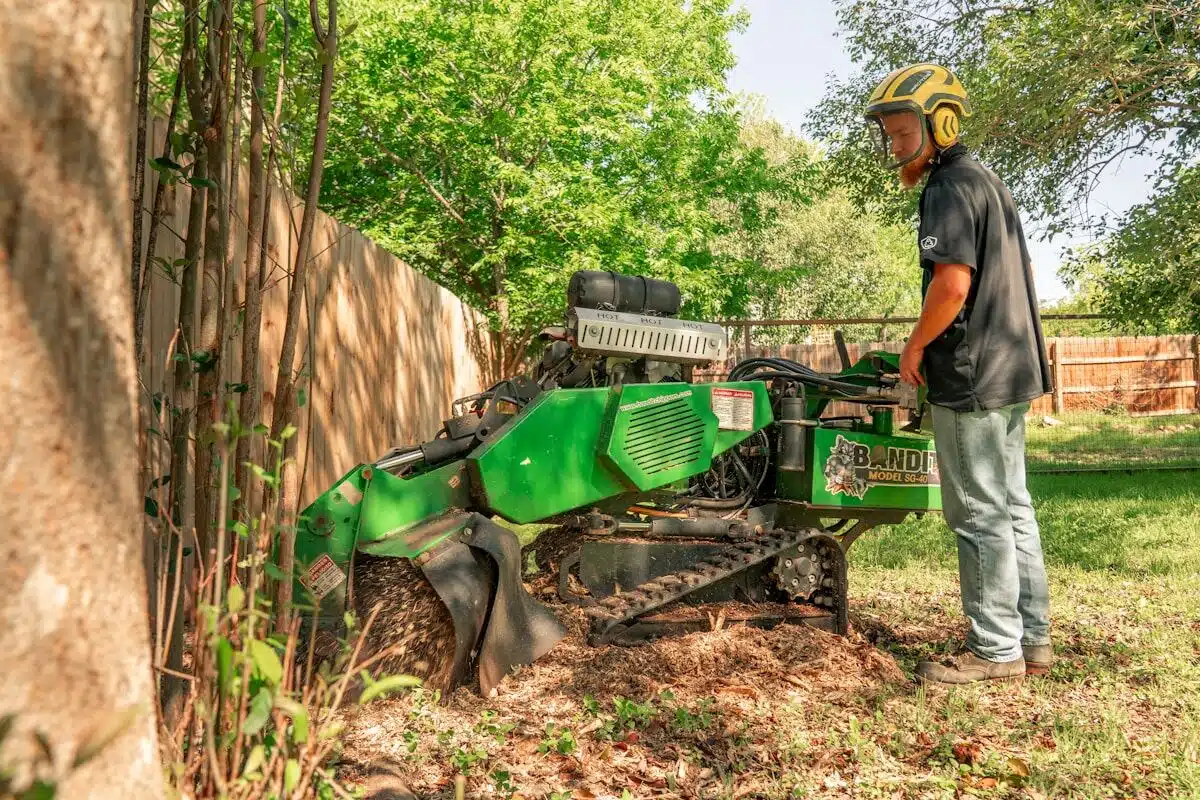
What’s going there afterwards?
This determines the depth, and the depth determines the price. Decide before you call.
Standard
Lawn
A few inches below grade is fine. Backfill with soil, seed over, done. The cheapest and most common specification.
Deeper
Replanting a tree
A new tree can’t root through old stump material. It needs the ground opened up considerably deeper, or the new tree planted a good distance away instead.
Deeper
Patio, drive or shed base
Decaying wood beneath a hard surface settles unevenly over years and the surface cracks. Say what’s going there so the depth matches.
Different job
Building foundations
Not a grinding job. Organic material under a footing has to be excavated out entirely, and that’s a groundworks question.
What grinding leaves behind
The roots. Grinding takes the stump and the flare. The lateral root system stays where it is and decays over several years. On a mature tree those roots can run a long way, and as they break down the ground above settles — usually as shallow depressions appearing over two or three seasons.
The chips. A ground stump produces a surprising volume of material, typically far more than the hole needs. Some companies haul it, some spread it, most leave it in a heap. Ask which, because a large mound of fresh chips is not a small thing to deal with.
The soil. Chips are not soil. Backfilling the hole with grindings alone gives you a spot where grass won’t establish for years, because decaying wood locks up nitrogen as it breaks down. Fill with topsoil if you want to seed it.
After the grinder leaves
Ground-level work, entirely yours, and it decides whether the patch ever looks right.
Take the chips out of the hole
Or most of them. Backfilling with grindings gives you a permanently sunken, permanently bare patch.
Fill with topsoil
Slightly proud of grade — it will settle. Firm it as you go rather than dumping it loose.
Add nitrogen if seeding
Any remaining wood locks up nitrogen while it decays. A starter feed offsets it.
Seed or turf
Timing as for any repair — early autumn is best for cool-season grass, spring second.
Expect to top it up
Once or twice over the following two years as the roots below break down. That’s normal, not a failure.
Depth by end use
Where this stops being a DIY job
Anything with services underneath. Gas, water, electricity and telecoms often run shallow near a boundary or a drive, and a grinder wheel takes no notice of any of them. Utilities should be located before the machine starts — that’s a call to the locating service, not a guess.
Stumps against a wall or foundation. Roots that ran under a structure can’t be ground out, and grinding hard against a footing risks the footing.
Renting a grinder to do it yourself. They kick, they throw debris at speed, and the injuries are to eyes and hands. The hire cost plus the risk rarely beats the quote. If you decide to anyway, read our stump grinder rental guide first.
Advertising disclosure: calls are routed to an independent local provider. We’re paid a referral fee for the call. You pay the provider, never us.
What to settle before the machine arrives
Asks
What’s going there
Depth follows from end use. Anyone quoting without asking is quoting the standard grind.
Checks
Locates utilities
Before grinding, near boundaries and drives especially.
Says
What happens to the chips
Hauled, spread, or left. A large heap is a real consideration.
Common questions
How deep does stump grinding go?
A few inches below grade as standard, which suits turfing over. Replanting, paving or building over the spot all need considerably deeper, so say what’s going there before the quote.
Do the roots get removed too?
No. Grinding takes the stump and the flare; the lateral roots stay in the ground and decay over several years, which causes gradual settling above them.
Can I plant a new tree in the same spot?
Not into ground that’s only had a standard grind — the remaining material stops a new tree rooting. Either specify a much deeper grind or plant a sensible distance away.
What do I do with the wood chips?
Take them out of the hole and backfill with topsoil. Chips left in place lock up nitrogen as they decay and leave a sunken patch where grass won’t establish.
Building over it, or planting in the same spot?
Clearing out the chips, backfilling with topsoil and seeding is genuinely yours and it’s the part that decides how the patch looks. Depth is the thing to specify before anyone quotes, and buried services are the reason not to rent a grinder and find out.
Call (844) 611-1894