
Home › Services › Tree Service
What Tree Removal Costs
The cost guides agree on the range — most single trees land somewhere between a few hundred dollars and a couple of thousand — and on what moves a quote within it. Here is which variables matter, what each line typically costs, and how to make three quotes comparable.
Advertising disclosure: calls are routed to an independent local provider. We’re paid a referral fee for the call. You pay the provider, never us.
The short answer
HomeGuide puts most single-tree removals at $300–$2,000 and Angi at $200–$2,000, and both list access and the tree’s condition among the factors that can make one quote far higher than another. A tree that can be dropped in one piece costs far less than the same tree taken down in sections by a climber, and the stump and haul-away are often separate lines. Anyone quoting on height alone hasn’t worked out the method. If you only need clearance, tree trimming is a different, cheaper job.
Work out the method first
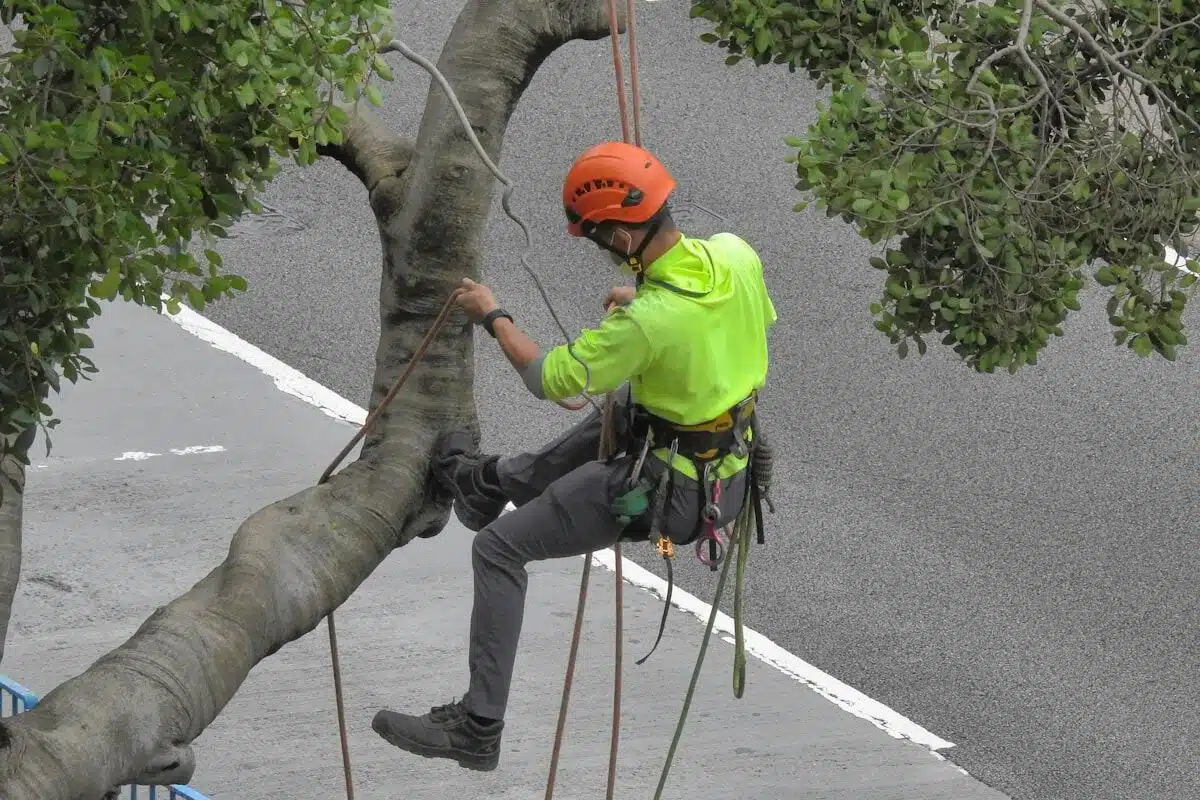
What surrounds the tree decides how it comes down, and that decides most of the price. OSHA’s tree care worker sheet tells tree-crew supervisors to cone off a drop zone at least two times the tree’s height before felling. When a yard can’t give a crew that much clear ground, the tree comes down in roped sections instead, and that is where the hours go.
Tree height 50 ft
A single-storey eave is about 10 feet, a two-storey ridge about 25.
Trunk diameter at chest height 24 in
Measure the circumference with string and divide by three.
How many trees like this one 1
What is in the fall radius
How far can the truck get from the tree
Some of this is yours. Moving cars off the drive, taking off a fence panel, or keeping the logs instead of having them hauled all shorten the carry.
Species
Canopy
Condition
Timing
Stump grinding
Haul-away
Your state
Biggest variable
Drop zone, not size
Most single trees
$300–$2,000 per HomeGuide
Usually extra
Stump and haul-away
Adds cost
Dead or decayed wood
The three quotes you’ll get
Same tree, wildly different numbers, usually because they’re quoting different work.
Compare this
Itemized
Felling, stump grinding and debris removal as three lines. The only kind of quote you can hold against another one.
Ask again
One number
Might be complete, might be felling only with the stump to follow. Ask what it excludes before comparing it to anything.
Be careful
Unusually low, offered on the doorstep
Typically after a storm, cash preferred, price good today only. The FTC warns that scammers appear right after weather emergencies and says never to pay for debris removal in cash. And NC State Extension notes that in some circumstances a homeowner can be held financially responsible if an uninsured worker is hurt or damages a neighbor’s property.
The seven variables, in rough order of impact
1. Drop zone. Open ground means one cut sequence and a tree on the ground in minutes. Structures inside the fall area mean a climber and hours of roped sections. HomeGuide lists climbing and cutting at $50–$125 an hour for exactly that case, when there’s no safe place for the tree to fall. This is why a small tree in a tight yard can cost more than a large one in a field.
2. Machinery access. Whether a chipper, truck or crane can get near the tree, or whether everything has to be carried out by hand. Angi says tight, hard-to-reach or unsafe spots add 25%–50%, and HomeGuide notes that slopes, rocks or muddy ground can rule out a crane. When a crane is the answer, HomeGuide puts it at $500–$2,500 a day extra; Angi lists crane service lower, at $250–$600 a day, which shows how much local pricing varies.
3. Height and diameter. Real, but less decisive than either of the above. HomeGuide’s bands run from $150–$500 for trees under 30 feet to $1,200–$2,700 for trees over 80 feet; Angi’s run from $150–$450 to $1,000–$2,000.
4. Condition. Dead, hollow or storm-damaged trees behave unpredictably. UMass Extension points out that trees with severe structural defects may not support a climber, so a bucket truck or crane may be needed. HomeGuide puts dead tree removal at $800–$1,600.
5. Debris. Hauled away, chipped and left, or logs stacked for you. HomeGuide lists hauling at $75–$250 per dump trip plus $30–$100 a ton in dump fees (some crews fold these into labor), and chipping at $100–$150 an hour.
6. Stump. Separate machine and usually a separate line. HomeGuide puts grinding at $120–$400 for the first stump and $30–$60 for each additional one; Angi at $100–$150 for the first and about $50 for each after. Grinding disturbs soil, and in Wisconsin the Public Service Commission says to call 811 at least three business days before digging or disturbing soil; notice rules vary by state. More on depth and cleanup on the stump grinding page.
7. Species. Minor next to access, though the guides do list species ranges: HomeGuide shows oak at $250–$2,500 and palm at $150–$900, with dense hardwoods slower and heavier to handle.
What each line costs, by guide
Two national cost guides, side by side. Where they disagree, that gap is local pricing, not an error; your quotes will sit wherever your market does.
Worked example (our arithmetic, not a guide’s figure): using HomeGuide’s ranges, a 30–60 ft tree ($300–$1,000) plus grinding its stump ($120–$400) plus one dump trip ($75–$250) adds up to $495–$1,650, before any crane, dump fees or permit. Three quotes that each describe those three lines can be compared against that; a single number can’t.
Getting comparable numbers
Three quotes that describe the same work, rather than three numbers.
Describe what surrounds the tree
On the phone, before anyone visits. Distance to the house, the fence, the neighbor’s yard, any wires. That’s what sets the method.
Ask for three separate lines
Felling, stump, haul-away. Every company, same format. NC State Extension also suggests the contract say who keeps the firewood and chips.
Ask what’s excluded
Explicitly. NC State Extension suggests the contract state whether stump and surface-root grinding, topsoil fill and planting grass are included.
Ask about the lawn
Machinery ruts and impact marks are normal. Knowing in advance is different from finding out.
Have the certificate sent to you
NC State Extension suggests asking the company’s insurance agent to send the certificate of insurance directly to you, then calling the insurer to confirm the policy is current.
What moves the number
Where this stops being a DIY job
Hire it out if any one of these is true: the tree is closer to a house, fence, road or line than two times its height (the drop zone OSHA sets for tree crews); it’s dead, cracked through the trunk or has a lifted root plate; or it can only come down in sections from a climber. Those are rigging jobs, and they are exactly the ones priced by the hour.
Never choose on price alone for work over a structure. A cheap uninsured crew putting a limb through your roof — or your neighbor’s — can turn a saving into a claim against you. Ask for the certificate and confirm it with the insurer.
Anything near a power line goes to the utility first. OSHA’s rule for tree workers is to stay at least 10 feet from power lines unless the utility de-energizes and grounds them. Some utilities, such as Wisconsin’s We Energies, trim branches that keep service wires from hanging freely, and will temporarily turn off power at no charge so a contractor can work near service lines; policies vary by utility.
Doorstep quotes after a storm. NC State Extension warns about door-to-door solicitors with no identification on their vehicle, uniform or ID card, especially after storms, and advises never paying in advance.
What a real quote contains
Method
Says how it comes down
Straight fell or sectional. That single line explains most of the price.
Scope
Three separate figures
Felling, stump, debris. Anything less can’t be compared.
Cover
Offers the certificate
Without being chased for it, and from the agent if you ask.
Price
A total, or a cap
NC State Extension advises an absolute total, or “not to exceed” wording if the job is billed hourly.
Common questions
How much does tree removal cost?
HomeGuide puts most single trees at $300–$2,000 with a national average of $1,150; Angi gives $200–$2,000 with an average of about $750. Within that range, access matters more than size: the same tree can cost much more if it has to be dismantled in sections.
Why are tree removal quotes so different?
Usually because they cover different work. One may include the stump and haul-away, another may be felling only. Ask every company for three separate lines.
Is stump grinding included in the price?
Often not, so ask. HomeGuide lists grinding separately at $120–$400 for the first stump, and NC State Extension suggests the contract state whether stump grinding is included.
Will homeowners insurance pay to remove a tree?
Typically only a limited amount, and check your policy. The Maryland Insurance Administration says in its general guidance that many policies pay a limited amount for removal, usually $500–$1,000, typically per event rather than per tree.
Does tree size determine the price?
Less than people expect. Drop zone and machinery access matter more — a small tree in a tight yard can cost more than a large one with open ground around it.
Comparing quotes that don’t match?
Describing what surrounds the tree and asking for three separate lines costs nothing and makes quotes comparable for the first time. Work over a structure is where the insurance question matters more than the price difference.
Call (804) 488 3350
Related
Sources: HomeGuide tree removal cost · Angi tree removal cost · OSHA 3752, Tree Care Work · UMass Extension, Inspection of storm-damaged trees · NC State Extension, How to hire a tree care professional · FTC, Four ways to avoid scams after a weather-related disaster · Maryland Insurance Administration, If a tree falls on your property · We Energies, Trees and power lines · Public Service Commission of Wisconsin, Natural gas safety