
Advertising disclosure: calls are routed to an independent local provider. We’re paid a referral fee for the call. You pay the provider, never us.
The short answer
A half-round has no internal corner, so debris tends to move along the curve toward the outlet rather than lodging where a flat bottom meets a front face. That means noticeably less frequent cleaning under trees. The trade is cross-sectional area: for the same nominal width it holds less than K-style, so on a large or steep roof you may need to go up a size or add a downspout.
Advantage
Self-clears debris
Trade
Less capacity per width
Suits
Period properties, heavy leaf load
Often paired with
Copper
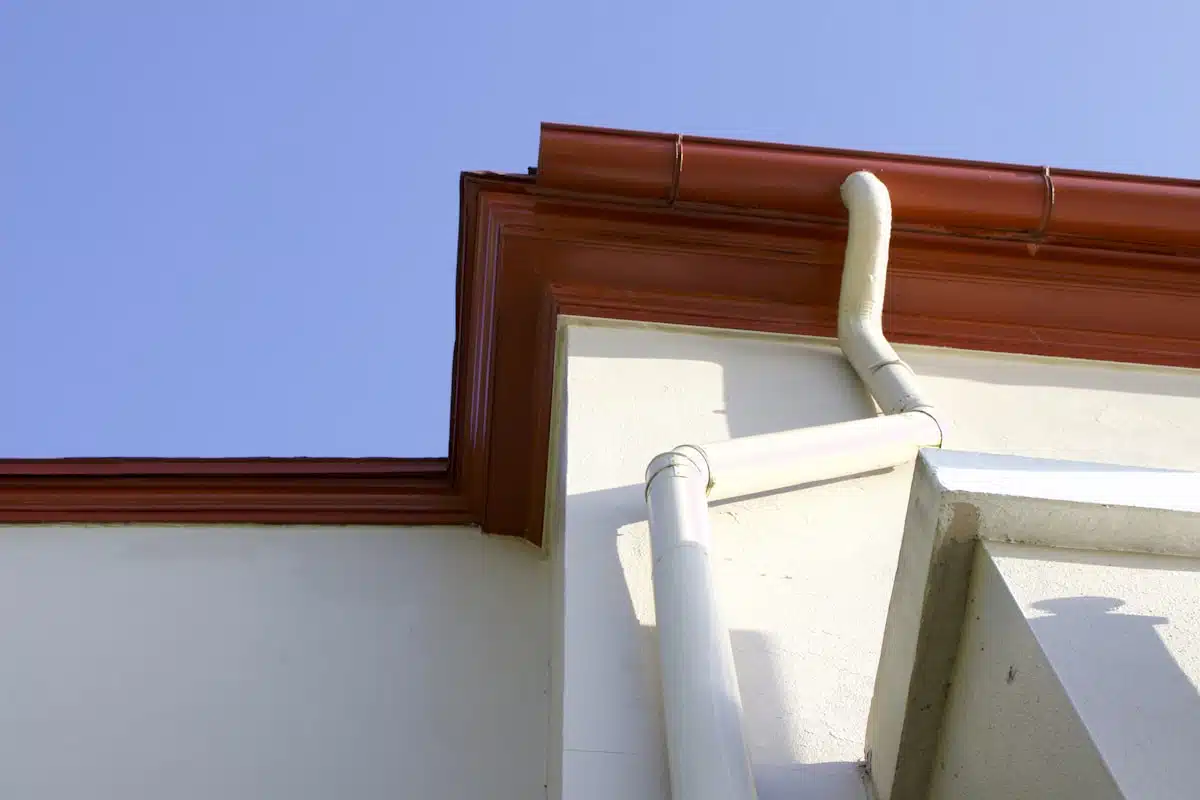
When half-round is the right call
Three good reasons and one poor one.
Strong case
Heavy leaf or needle load
Conifers or dense deciduous cover overhead. The curved section moves debris toward the outlet instead of trapping it, which genuinely reduces cleaning frequency.
Strong case
Period architecture
On older buildings K-style’s moulded front face reads as wrong. Half-round is what those buildings originally had.
Reasonable
Copper installation
Half-round is the traditional copper profile and the two are usually specified together.
Poor reason
Assuming it drains better
It clears debris better. It carries less water. Those are different things and the second one matters on a large roof.
The capacity trade, in practical terms
A semicircular section encloses less area than a K-style of the same top width. On a modest roof that difference is irrelevant. On a large roof, a steep pitch, or under high-intensity rainfall, it’s the difference between coping and overflowing.
The straightforward answer is to size up — a six-inch half-round rather than a five — or to add a downspout so each outlet serves a shorter run. Either is cheaper than discovering the problem in the first heavy storm.
Brackets are different
Half-round takes its own bracket profile, usually a shaped strap cradling the underside rather than a bracket clipping inside a flat channel. They aren’t interchangeable with K-style fittings, which is worth knowing if you’re changing profile: hangers, outlets and downspout connections all change with it.
Specifying it
Four things, and the first prevents the common disappointment.
Size up for the capacity difference
Half-round holds less per width. On a large or steep roof, go a size larger or add an outlet rather than matching the K-style dimension.
Confirm bracket type
Half-round takes its own cradle-style brackets. Nothing from a K-style system transfers.
Decide the material with it
Copper is traditional and expensive. Aluminium half-round exists and costs far less.
Check the downspout connection
Round downspout on a round gutter is the usual pairing, and it’s a different outlet fitting from rectangular.
Half-round against K-style
Where this stops being a DIY job
The installation, above single storey. Standard limit.
Changing profile on an existing system. New brackets, outlets and downspout connections — it’s a replacement rather than a swap.
Sizing it like-for-like from a K-style system. Matching the number rather than the capacity is how a new system overflows in its first storm.
Advertising disclosure: calls are routed to an independent local provider. We’re paid a referral fee for the call. You pay the provider, never us.
What a good installer accounts for
Sizes
For the profile difference
Not matching the old dimension. Half-round holds less.
Fittings
Uses the right brackets
Cradle type. Nothing transfers from K-style.
Asks
What’s overhead
Because self-clearing is the main reason to choose it.
Common questions
Is half-round gutter better than K-style?
At clearing debris, yes — no internal corner for leaves to lodge in. At capacity, no — it holds less for the same width. What’s overhead usually decides it.
Does half-round gutter clog less?
Yes. The curved section moves debris along toward the outlet rather than trapping it where a flat bottom meets a front face.
Do I need a bigger half-round gutter?
Often, yes. Because it holds less per width than K-style, matching the old dimension on a large or steep roof risks overflowing.
Can I use my existing brackets?
No. Half-round takes cradle-style brackets and its own outlets, so changing profile means changing all the fittings.
Heavy leaf load, or a period property?
Deciding whether half-round suits the building and the tree cover is something you can settle from the ground. Sizing it correctly for the capacity difference, and the install itself, are the parts worth handing over.
Call (877) 360-4657