
Advertising disclosure: calls are routed to an independent local provider. We’re paid a referral fee for the call. You pay the provider, never us.
The short answer
Single-storey gutters, on level ground, with a stable ladder and someone home — that’s a Saturday morning and a pair of gloves. Second storey, a sloped or soft footing, or anything over a conservatory roof is where the risk stops being worth the saving. Falls from height are the injury that ends this job, and they happen on the way down rather than while you’re working.
What decides it
Ladder height, not skill
Frequency
Twice a year minimum
With pines nearby
Three or four times
Never do this
Work from the roof
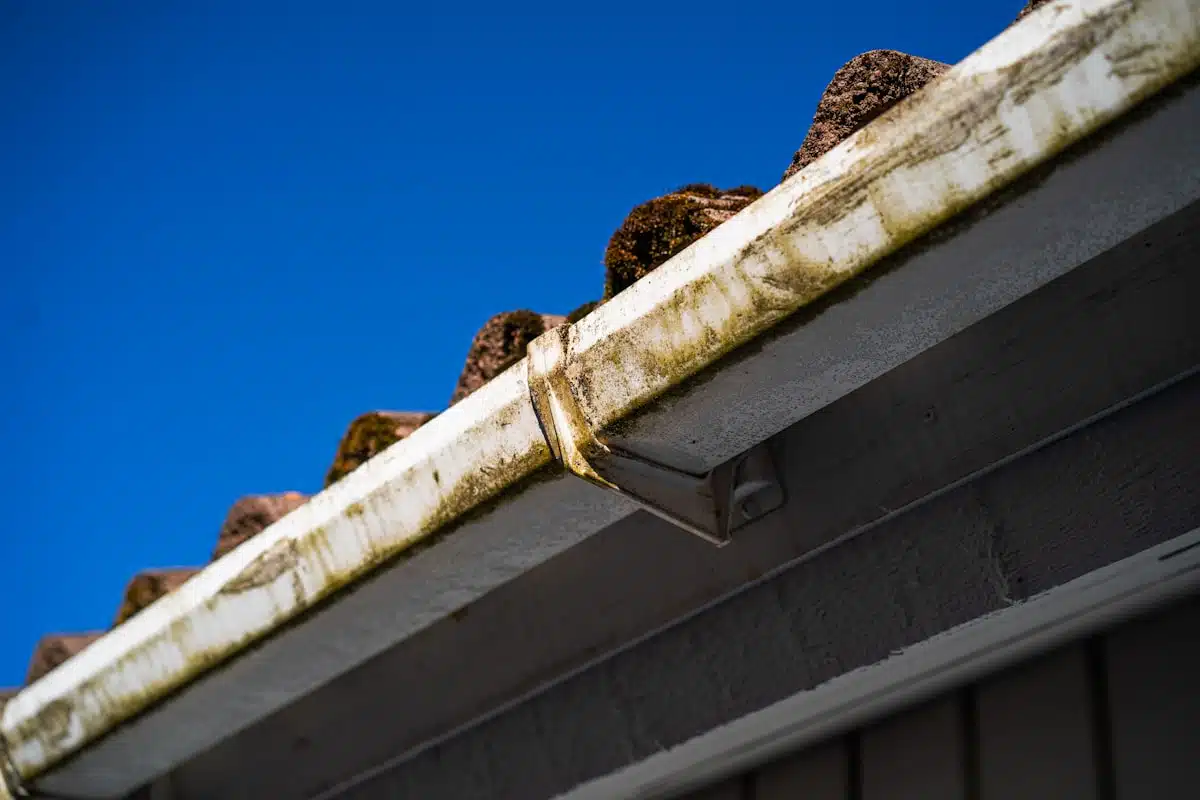
Is this actually a debris problem?
A surprising share of “blocked gutters” are clean and still failing. Check which you have before booking a clean that won’t fix it.
Yes, clean them
Overflow along a whole run
Water spilling over the front edge in several places, visible debris, plants growing in the channel. This is what cleaning is for and it works.
Not debris
Overflow at one spot only
Consistently the same corner or the same three feet. That’s pitch or a sag — the channel is holding water there. Cleaning it changes nothing and it’ll do the same next month.
Not debris
Clean gutters, water at the foundation
The gutter is doing its job and the downspout isn’t. Usually a blocked underground drain or a discharge point too close to the house.
Different job
Overflow only in heavy rain
Undersized gutters or too few downspouts. Capacity is calculated from roof area and rainfall, and an undersized system overflows however clean it is.
How often, and why the answer isn’t always twice
Twice a year is the standard advice: once after leaf fall, once in late spring. It holds for most properties.
What changes it is the tree species overhead. Pine and spruce needles shed continuously rather than in one autumn drop, they pack tighter than leaves, and they knit into a mat that water runs straight over. A house under conifers realistically needs three or four visits. A house with nothing overhanging can often stretch to once.
The other variable is what the gutter empties into. An underground drain silts up slowly and invisibly, and it is the failure people discover during the first heavy storm after a clean.
Doing it yourself, single storey
Assuming level ground, a stable footing and a ladder you trust. If any of those is missing, skip to the stop point.
Set the ladder properly
One foot out for every four feet up, on firm level ground, and tied or footed by someone. Most falls are the ladder moving, not the person slipping.
Move the ladder, don’t lean
Reaching sideways past your belt buckle is what tips a ladder. Climb down and shift it. Every time.
Scoop, don’t flush first
Get the bulk out by hand into a bucket hooked on the ladder. Flushing packed debris just drives it into the downspout.
Check the downspout separately
Run water down it once the channel is clear. If it backs up, the blockage is in the spout or the drain below it, not the gutter.
Flush and watch the flow
Hose from the far end. Watch where water pools rather than runs — a standing puddle marks a pitch problem you now know about.
Look at the fascia
While you’re up there. Soft or stained timber behind the gutter is a bigger job than the one you came to do.
Yourself or hired
Where this stops being a DIY job
Anything above single storey. Not a skill judgement. Falls from ladder height are the serious injury category in home maintenance, they happen in a fraction of a second, and the saving on a gutter clean is not a sensible trade against them.
Never work from the roof. Standing on tiles or slates to reach a gutter is how people go through a roof or off the edge. If it can’t be reached from a ladder, it needs someone with the right equipment.
No one else at home. An unfooted ladder and nobody to find you is the combination that turns a fall into something worse.
Advertising disclosure: calls are routed to an independent local provider. We’re paid a referral fee for the call. You pay the provider, never us.
What you’re actually paying for
Access
Reach without a ladder
Standoffs, roof ladders, or a vacuum system from the ground. That’s the cost, and it’s a fair one.
Diagnosis
They see the fascia
A good one tells you about soft timber, loose hangers or a bad pitch while they’re up there. Ask for photos.
Downspouts
They clear the spout too
Ask specifically. Clearing the channel and leaving a blocked spout is half a job.
What to ask before you book
- Do you clear the downspouts as well as the channel?
- Will you send photos of what you found?
- Do you check the pitch and flag sagging sections?
- What happens if the downspout turns out to be blocked underground?
- Do you bag the debris or leave it?
The photo question is the useful one. It’s the only way to know the work happened, and the companies that offer it unprompted tend to be the ones doing it properly.
Common questions
How often should gutters be cleaned?
Twice a year for most houses — after leaf fall and in late spring. Three or four times if there are pines or spruces overhead, because needles shed year-round and mat tighter than leaves.
Can I clean gutters from the roof?
No. Working from tiles or slates to reach a gutter is how people fall or go through the roof. If a ladder can’t reach it safely, it needs someone equipped for height.
Why do my gutters overflow even when clean?
Usually pitch, a sag, or undersizing. If it overflows in the same spot every time the channel is holding water there; if it only happens in heavy rain the system is too small for the roof.
Is it worth paying for gutter cleaning?
On a single storey with level ground, rarely. On a second storey, yes — you’re buying safe access, which is the whole cost and the whole risk.
Above single storey, or still overflowing after a clean?
Single-storey gutters on solid ground are genuinely a morning’s work with a ladder and a bucket. Height is where that stops being true, and repeated overflow in one spot means the problem was never debris.
Call (877) 360-4657