
The short answer
Wet and dry vacuums with curved extension poles, telescopic gutter tongs, hose attachments with an angled nozzle, and leaf blower kits all work from ground level. The vacuum is by far the most effective; the blower is the least, and it distributes wet debris over everything. All of them are compromised on a second storey because reach and control fall off sharply with pole length.
Most effective
Wet/dry vacuum with poles
Least effective
Leaf blower kit
Common limit
Pole flex beyond about 20ft
Still true
Never work from the roof
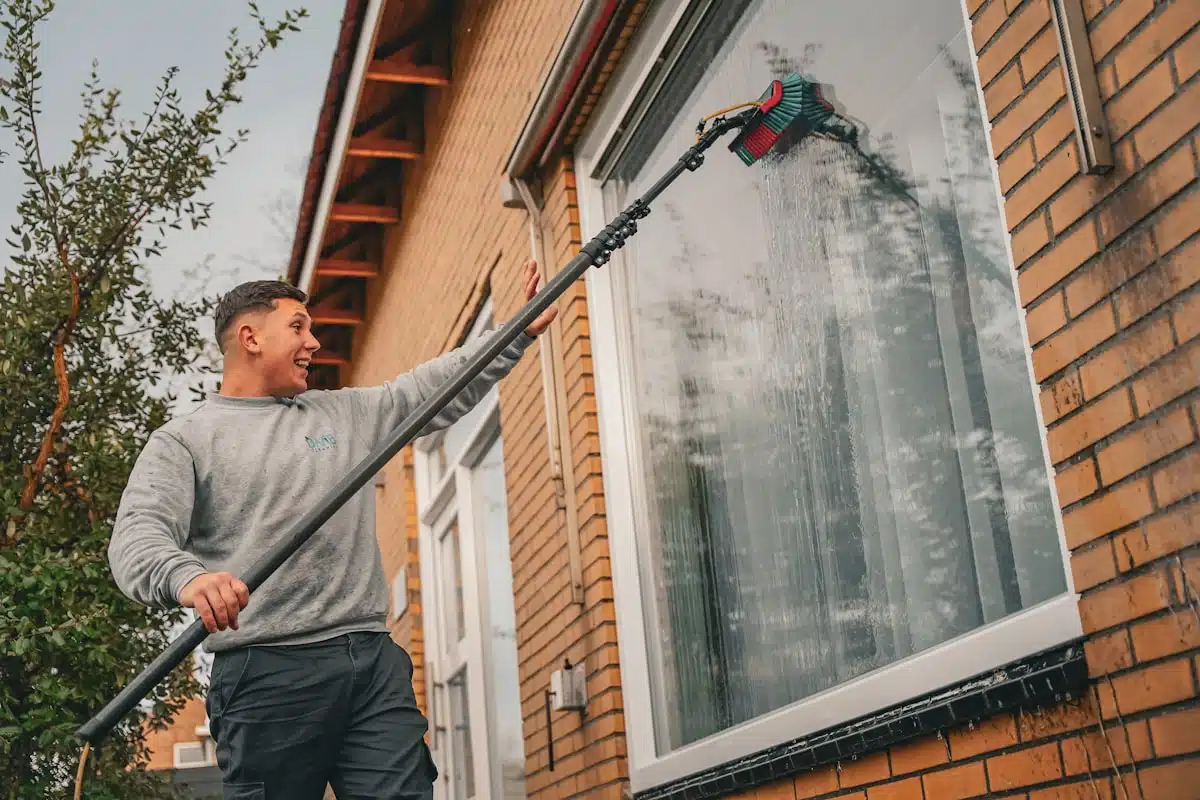
Four ground-level methods
In descending order of how well they actually work.
Best
Wet and dry vacuum with curved poles
Clear extension tubes let you see what you’re collecting, and it handles wet compacted debris that other methods just push around. The most effective option and the most expensive.
Good
Telescopic gutter tongs
A grabbing claw on a pole, operated from below. Slow, and genuinely effective on leaves and larger debris. Less good on the wet silt at the bottom of the channel.
Moderate
Hose attachment with an angled nozzle
Flushes rather than removes. Fine for a light seasonal clear on a channel that isn’t badly blocked. On a packed gutter it drives material into the downspout, which is worse.
Poor
Leaf blower attachment
Works only on dry loose debris, and distributes it across the roof, the walls and you. Ineffective on anything compacted, which is most of what actually blocks a gutter.
Where all of these stop working
Pole flex. Beyond about twenty feet, extension poles bend enough that you lose the control needed to position an attachment accurately, and you’re working blind at the far end of something wobbling.
That puts a second storey out of practical reach for most of these methods regardless of what the packaging claims — which matters, because a second storey is exactly the situation people are trying to solve.
The honest comparison
Ground-level methods do a partial job. They clear the bulk and they miss what’s stuck. They also mean nobody looks at the fascia, the hangers or the seams — and the annual look at those is a meaningful part of what a gutter clean is for.
For a single storey where you simply don’t want to go up a ladder, a vacuum system is a genuinely reasonable answer. For a second storey it’s a partial solution to a problem that needs a proper one.
Doing it from the ground
Vacuum or tongs. The other two are compromises.
Pick the method for the debris
Wet compacted silt needs a vacuum. Dry leaves can be managed with tongs. A hose only helps on a channel that isn’t badly blocked.
Wear eye protection
Everything you dislodge comes down. This is the most-skipped item and the one that matters.
Start at the far end
Work toward the downspout, so you’re moving material toward the outlet rather than away from it.
Check the downspout separately
None of these methods clears a blocked spout. Run water down it once the channel is clear.
Look at what comes out
Grit from shingles means the roof is shedding. Worth noticing while you’re down there.
Accept it’s partial
Ground methods clear the bulk and miss what’s stuck. Plan a proper clean periodically.
How the methods compare
Where this stops being a DIY job
Second storey, whatever the pole claims. Beyond about twenty feet you lose the control to do anything useful, and the temptation at that point is to get a ladder out — which is the thing this page exists to avoid.
Never work from the roof. Standing on tiles to reach a gutter is how people go through it or off the edge.
A downspout blocked below the outlet. Nothing on a pole reaches an underground drain.
What you gain by having someone up there
Thorough
Actually clears it
Including the compacted material at the bottom of the channel that poles can’t shift.
Diagnostic
Someone sees the fascia
The annual look at hangers, seams and timber. Ask for photographs.
Complete
The downspout too
Ask specifically. Channel cleared and spout left blocked is half a job.
Common questions
Can you clean gutters without a ladder?
Yes, from the ground — a wet and dry vacuum with curved extension poles is the most effective, followed by telescopic tongs. Hose and blower attachments are more limited.
Do gutter cleaning vacuums work?
The better ones do, and they handle wet compacted debris that other ground methods just push around. Clear extension tubes let you see what you’re collecting.
Can I clean second-storey gutters from the ground?
Not well. Beyond about twenty feet, pole flex removes the control needed to position anything accurately, whatever the packaging claims.
Is a leaf blower gutter attachment any good?
Only on dry loose debris, and it distributes it across the roof, the walls and you. Ineffective on compacted material, which is most of what blocks a gutter.
Second storey, or debris a pole can’t shift?
On a single storey, a vacuum system is a genuinely reasonable way to avoid the ladder entirely. Second storey is where these methods stop working — and the temptation to get a ladder out is the exact risk worth avoiding.
Call (877) 360-4657
Calling connects you with a gutter service serving your area. We’re paid for that referral, which is how these guides stay free.