
Home › Services › Tree Service
Emergency Tree Removal
After a storm everything looks urgent. A short list genuinely is, one item on it isn’t a tree service call at all, and the leaning tree people worry about most usually isn’t on the list.
Advertising disclosure: calls are routed to an independent local provider. We’re paid a referral fee for the call. You pay the provider, never us.
The short answer
Genuinely urgent: a tree or limb resting on a building, a limb hanging over a door or path, a tree blocking your only way out, and any tree that has shifted since the storm. Not urgent: a long-standing lean, a split branch high in the canopy away from anything, or debris on the lawn. Anything touching a power line isn’t a tree service call at all.
Genuinely urgent
Four situations
Not a tree service
Anything on a line
Usually not urgent
A long-standing lean
After storms
Doorstep crews appear
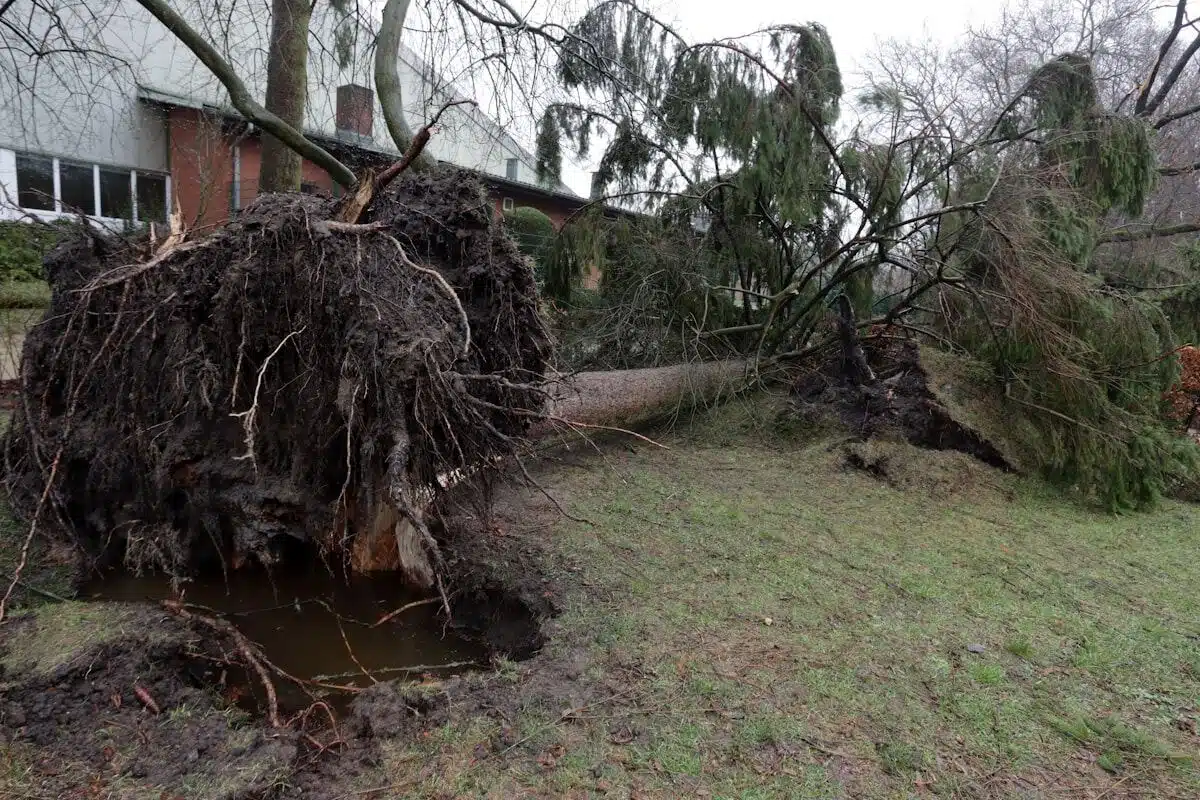
Is this actually an emergency?
Four categories, and they need four different calls.
Call the utility
Touching a power line
Not a tree service. Contact your electricity provider immediately and keep everyone well clear — current can arc without contact, and the ground around a downed line can be live.
Tonight
On a building, or hanging over a used space
A tree resting on a roof is still moving and still loading the structure. A hung limb over a door, path or play area falls on its own schedule.
Tonight
Blocking your only exit
Access matters independently of damage. If you can’t get out, or emergency services can’t get in, that’s urgent regardless of the tree.
This week
Leaning, but stable and away from anything
A lean that predates the storm, with no fresh soil heave at the base and nothing beneath it, is usually a scheduled job rather than a midnight one.
The lean that matters and the one that doesn’t
Trees lean. Most have leaned for years, growing to compensate, and they’re no more likely to fail tonight than last month.
What changes the picture is new movement. Look at the base: soil lifting or cracking on the side opposite the lean, roots visible that weren’t before, a gap opening between trunk and ground. That means the root plate is moving, which is a different situation entirely.
The other thing worth checking after wind is whether a limb is hung up — broken but caught in the canopy rather than fallen. Those come down without warning and they’re impossible to time.
What to do before anyone arrives
In order. The first two matter more than the tree.
Keep people away
Rope off or block the area beneath. Hung limbs and loaded trunks fail without notice, and most injuries are to people standing underneath looking up.
Check for lines first
Before anything else. If a line is involved, it’s the utility’s job and nobody should approach.
Photograph everything
From several angles, before anything is moved. Insurers want it and memory isn’t evidence.
Call your insurer early
Some policies require notification before work starts, or use approved contractors. Finding out afterwards is expensive.
Don’t cut anything under load
A trunk resting on a roof, or a bent limb, is holding energy. Cutting it releases that energy in a direction nobody can predict.
Tonight, this week, or whenever
Where this stops being a DIY job
Any tree or limb in contact with a power line, or a line brought down with it. Contact your electricity utility immediately and keep everyone well back — including from the ground nearby, which can be energised. Do not attempt to move anything, and do not let a tree service touch it either. This is not a situation any phone number on this page addresses.
Anything resting on a structure. The load is being carried by something not designed to carry it, and cutting into that load releases it unpredictably. Get people out from underneath and leave it to someone with rigging.
Anything hung up in a canopy. A broken limb caught overhead comes down on its own schedule. Nobody should be beneath it, including whoever is looking at it.
What an emergency crew should do first
Assesses
Checks for lines before touching
Any crew that starts cutting without walking the site is one to stop.
Rigs
Doesn’t cut loaded wood freehand
Loads get taken off deliberately, not released by guesswork.
Documents
Photographs for your insurer
Before clearing. Good crews do it without being asked.
Common questions
What counts as an emergency tree removal?
A tree or limb on a building, a limb hanging over a door, path or play area, a tree blocking your only exit, or fresh soil movement at the base. A long-standing lean away from everything usually isn’t.
Who do I call if a tree hits a power line?
Your electricity utility, immediately — not a tree service. Keep everyone well clear, including from the ground nearby, which can be energised by a downed conductor.
Will insurance cover emergency tree removal?
Often, when the tree has damaged a structure, and less often when it simply fell in the garden. Call your insurer before work starts — some policies require it, or specify approved contractors.
Is a leaning tree dangerous?
Not necessarily. Many have leaned for years. What matters is new movement — soil lifting or cracking on the opposite side of the base, or roots newly visible.
On a structure, or hung above somewhere people walk?
Keeping people out from underneath, photographing it and calling your insurer are the first three things and they’re all yours. Anything loaded, hung up, or on a building needs rigging — and anything involving a line belongs to the utility, not to anyone you’d pay.
Call (804) 488 3350