
Lawn Care · Grass Types
Tall fescue seed is built for dry, busy yards, not for filling gaps.
Turf-type tall fescue grass seed grows the deepest roots of the cool-season lawn grasses, so it rides out drought and heavy wear better than bluegrass or ryegrass. It grows in clumps and barely spreads, so thin spots need reseeding, and it’s prone to brown patch. Sow 8–10 lb per 1,000 sq ft on bare soil, or 3–8 lb to overseed, from late August to mid-September.

GERMINATION
About 10–14 days (our seedings)
SEED RATE, NEW LAWN
8–10 lb per 1,000 sq ft
OVERSEEDING
3–8 lb per 1,000 sq ft
BEST SEEDING WINDOW (MA)
3rd week Aug to 3rd week Sept
What turf-type tall fescue is
Tall fescue (Festuca arundinacea) started out in lawns as Kentucky 31, a coarse, wide-bladed pasture grass. Turf-type tall fescue (TTTF) is the bred-up lawn version. Rutgers lists what breeding changed: much higher shoot density, darker green color, tolerance of closer mowing and better disease resistance than Kentucky 31. When a bag says “tall fescue” for a lawn, turf-type is what you want.
Here’s how it rates in UMass Extension’s turfgrass selection tables:
STRENGTH
Drought: excellent
Its deep roots are why. Penn State calls it the most heat- and drought-tolerant cool-season lawn grass. More in drought stress in lawns.
STRENGTH
Wear: excellent
Holds up to kids, dogs and foot paths as well as perennial ryegrass, which is why heavy-traffic blends are built on it.
STRENGTH
Shade, heat and salt: fair to good
UMass says it’s more shade tolerant than Kentucky bluegrass, and it rates salt tolerance good, handy along a salted driveway or road.
WEAKNESS
Recovery: poor
It’s a bunch grass. Worn or dead spots stay bare until you reseed them.
WEAKNESS
Cold hardiness: fair
UMass rates Kentucky bluegrass excellent here. In colder, icier spots, a bluegrass-led mix is the safer choice.
WEAKNESS
Disease: brown patch
UMass calls it highly susceptible to brown patch, red thread and Pythium blight. More on that below.
The catch: tall fescue is a bunch grass
Kentucky bluegrass spreads by rhizomes. Tall fescue mostly doesn’t: Penn State describes it as mainly bunch-type, with only occasional short rhizomes, and UMass gives it only fair recovery potential. Each plant thickens by sending up new shoots from its base, but it won’t creep into a bare patch next to it. Two ways to live with that:
- Overseed every fall or two. A tall fescue lawn stays thick by adding seed, not by spreading. Our overseeding guide and aeration and overseeding guide cover the steps.
- Add a little Kentucky bluegrass. UMass says a tall fescue mix should be at least 80% tall fescue; Rutgers suggests 85–95% tall fescue with 5–15% bluegrass, specifically because tall fescue lacks the rhizomes to spread. Bluegrass seed is tiny, so even 10% by weight is a big share of the seeds in the bag.
What about RTF? Some cultivars produce short rhizomes and are sold as rhizomatous tall fescue. Purdue notes they’re still ordinary tall fescue, not a different species. Treat the rhizomes as a small bonus, not a substitute for overseeding or a bluegrass share.
What we found seeding GCI turf-type tall fescue
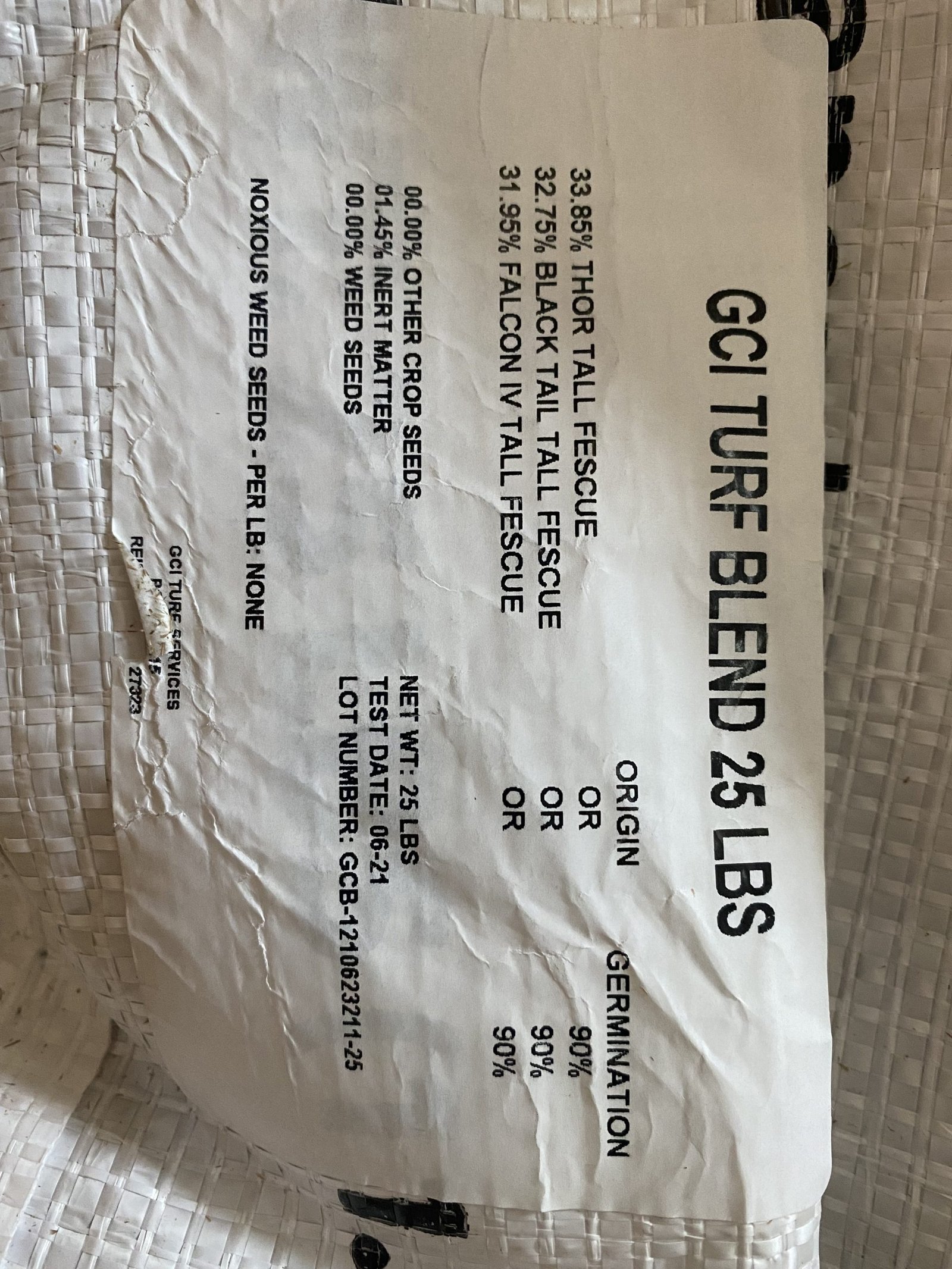
LawnPhix has seeded tall fescue on its own Massachusetts lawn for years: Jonathan Green Black Beauty Original from 2015 to 2017, then GCI Turf-Type Tall Fescue in fall 2018. Both are blends of three tall fescue cultivars. Here’s what the Black Beauty vs GCI review recorded.
| GCI TTTF (fall 2018) | Black Beauty Original (2015–17) | |
|---|---|---|
| Cultivars | Thor, Falcon, Blacktail (as of 2020) | Dakota (about half), Taos, Tombstone |
| Rate we used | About 6 lb per 1,000 sq ft (100 lb over ~16,000 sq ft) | — |
| Germination started | About 14 days | About 10 days |
| Early color | Lighter at first; darkened the next spring | Slightly darker |
| Disease that season | More fungus; two DiseaseEx and one propiconazole applications | — |
| Cost (2018 prices) | About $2.30 per lb; under $250 for 16,000 sq ft | About $3.20 per lb |
The seeding went down on September 8, 2018 after dethatching, a double pass with a core aerator and a slightly lower mow, with starter fertilizer, Milorganite and lime applied the same day. A heavy rainstorm three days later washed some seed off the sloped front yard, while the flat back and side yards filled in thicker. The verdict: Black Beauty got a slight nod on color and disease, GCI on price, and either is a good tall fescue seed.
The coverage lesson. Jonathan Green rates a 50 lb bag of Black Beauty at up to 15,000 sq ft, just over 3 lb per 1,000. GCI recommends 4–7 lb per 1,000 to overseed a lawn with 50–75% existing cover, and 5–7 lb where only 20–50% is left. Treat the “covers up to” number on the front of any bag as a ceiling, and work out pounds from the rate you actually need.
How much tall fescue seed to use
Tall fescue seed is big: UMass counts about 227,000 seeds per pound, against more than 2 million for Kentucky bluegrass (UMass). So you need several times the weight. These are LawnPhix’s standard rates from how much grass seed do I need.
| Job | Turf-type tall fescue (lb per 1,000 sq ft) |
|---|---|
| New lawn on bare soil | 8–10 |
| Overseeding a thin lawn | 6–8 |
| Overseeding a healthy lawn | 3–6 |
Worked example: a 3,000 sq ft bare-soil area at 8–10 lb per 1,000 needs 24–30 lb, so one 50 lb bag with seed to spare for touch-ups. The grass seed calculator handles any size. For comparison, Penn State recommends 6–8 lb for a straight tall fescue lawn. Don’t go far past the top of the range: UMass warns that very heavy seeding leaves a crowd of weak young plants, and crowded, humid turf is exactly where brown patch starts.
When to plant tall fescue seed in New England
UMass Extension puts the best seeding window at about the third week of August to the third week of September. Soil is still warm enough for fast germination, days are cooling and weeds are winding down. In our GCI seeding, early-September Massachusetts weather ran mostly under 80°F by day and above 40°F at night, and the seed was up in about two weeks. Our best time to aerate and overseed guide covers the timing in more detail.
- Keep it moist. Light, frequent watering until the seed is up, then deeper and less often. See how often to water grass seed; on slopes, a straw cover helps hold seed in a downpour.
- Feed at seeding. A starter fertilizer goes down with the seed.
- Spring is second best. UMass notes spring seedings get only one good growing period before summer stress. Standard crabgrass preventers also stop grass seed; LawnPhix uses Tenacity (mesotrione), which is seed-safe (Tenacity review, spring seeding guide).
Brown patch: the tall fescue disease to plan for
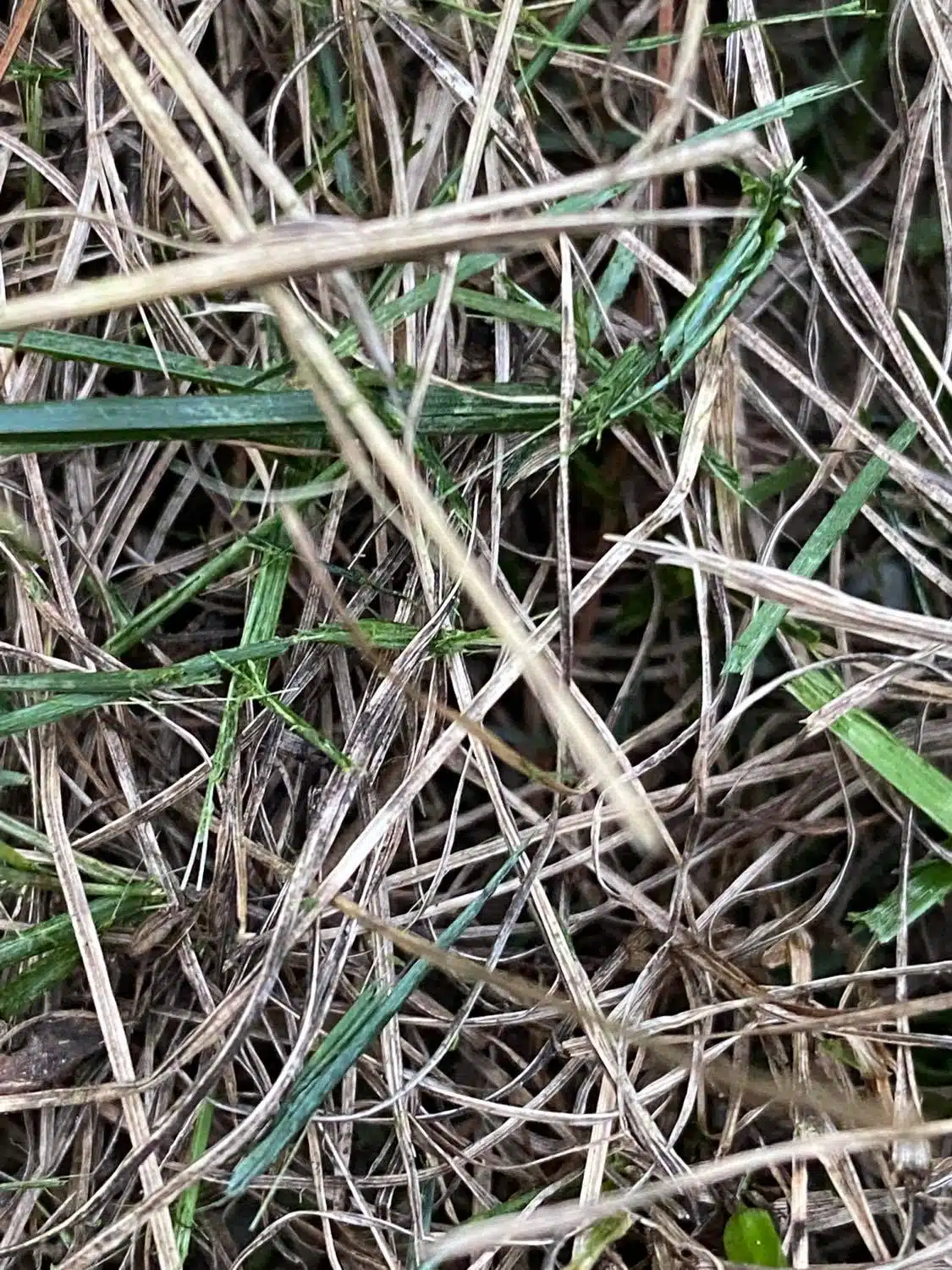
Brown patch is the price of tall fescue’s other strengths. Penn State calls it the most serious tall fescue disease, and UMass flags tall fescue as particularly susceptible to brown patch and Pythium blight. It shows up as tan, roughly circular patches in hot, humid summer weather. Our own lawn saw more fungus the season after the GCI overseed than in the Black Beauty years.
- Pick cultivars with good brown patch ratings. UMass points to NTEP trial data for disease tolerance of specific cultivars. Look up the names on your seed tag.
- Don’t overseed too heavily. Stick to the rates above so the stand isn’t crowded and airless.
- Go easy on summer nitrogen and water early in the day so the grass blades dry quickly. Our brown patch prevention guide covers fungicide timing and the rest.
- Watch for red thread too, which UMass also lists as a tall fescue problem.
Two tall fescue mistakes to avoid.
First, don’t buy Kentucky 31 or plain “tall fescue” for a lawn when it isn’t sold as turf-type. It’s the coarse pasture grass that turf-types were bred to replace. Second, don’t overseed tall fescue into a fine fescue or bluegrass lawn to “toughen it up.” Penn State notes tall fescue often doesn’t blend with finer-textured grasses and can form coarse clumps. If your lawn is fine-bladed now, either stay with what’s there or renovate fully to a tall fescue blend.
Is tall fescue seed right for your yard?
| Your yard | Tall fescue? | Why |
|---|---|---|
| Sunny, no irrigation, hot dry summers | Yes, as the main grass | Best drought tolerance of the cool-season grasses |
| Kids, dogs, worn paths | Yes, ideally with 5–15% Kentucky bluegrass | Excellent wear; bluegrass patches the holes |
| Partial shade | Yes, it’s the best of the sun grasses here | Fair shade tolerance; for deeper shade see grass for shade |
| Low, icy spots or the coldest parts of New England | Lean toward a bluegrass mix | UMass rates its cold hardiness fair |
| Existing fine fescue or bluegrass lawn | Only with a full renovation | Coarse blades clump in a fine-textured lawn |
| Irrigated lawn where you want it to self-repair | Use bluegrass as the main grass | Tall fescue’s recovery rates poor |
Tall fescue seed FAQs
How long does tall fescue seed take to germinate?
In our Massachusetts seedings, GCI tall fescue started coming up at about 14 days and Black Beauty at about 10. Rutgers says emergence can be as quick as 5–7 days in warm, moist soil. Plan on one to two weeks.
Does tall fescue spread?
Very little. It’s a bunch grass with only occasional short rhizomes, even in “RTF” cultivars, so bare spots need reseeding or a bluegrass share in the mix.
What is the difference between tall fescue and turf-type tall fescue?
Turf-type tall fescue is bred for lawns: denser, darker, finer and more disease resistant than the old Kentucky 31 pasture type. Buy turf-type for a lawn.
How much tall fescue seed per 1,000 square feet?
8–10 lb for a new lawn, 6–8 lb to overseed a thin lawn and 3–6 lb to overseed a healthy one, per LawnPhix’s seeding-rate table.
Can you mix tall fescue and Kentucky bluegrass?
Yes. Keep tall fescue at 80% or more of the mix by weight; Rutgers suggests 5–15% bluegrass so the lawn can fill its own gaps.
Is tall fescue good for Massachusetts lawns?
Yes for sunny, dry or high-traffic yards; it’s what LawnPhix has overseeded with since 2015. Plan for brown patch in humid summers and overseed thin spots in late summer.
Related guides
REVIEW
Black Beauty vs GCI tall fescue
Two tall fescue blends seeded on the same Massachusetts lawn.
REVIEW
Black Beauty Heavy Traffic review
A tall fescue and ryegrass blend seeded and tracked for a year.
Sources: UMass Extension: Turfgrass Selection · UMass: Establishment, Renovation & Repair · UMass: Selection of Grasses · UMass: Seeding Rate Considerations · Penn State: Turfgrass Species for Pennsylvania · Penn State: Turfgrass Seed and Seed Mixtures · Rutgers: Tall Fescue Varieties for New Jersey (FS990) · Purdue: Fine Fescues, Understanding the Differences · NTEP
