

LAWN PHIX PRO TIPS
After treating hundreds of residential and commercial properties, I can confidently say that these purple-flowered broadleaf weeds are the No. 1 nemesis. They’re a battle, but follow these tips to keep these weeds at bay in your lawn.
- For best results, spray these weeds in the early spring, two weeks apart, and again in the fall.
- Choose products with the active ingredient Triclopyr.
- Mix Triclopyr with other two-way herbicides containing 2,4-D acid, Dicamba, and a non-ionic surfactant.
- If possible, spray these weeds before they flower, as they tend to form a waxy coating, making them more challenging to eradicate.
- To limit the effect on pollinators, mow and bag the flowers 1-2 days before spraying.
My general approach:
- Spray in early spring, two rounds about two weeks apart, then hit it again in fall.
- Triclopyr is the active ingredient I reach for first
- I’ll usually tank mix Triclopyr with a tw.
- -way product (2,4-D and Dicamba) plus a non-ionic surfactant. One product alone just doesn’t cut it as well.
- Try to get to these before they flower. Once they bloom the leaves get a waxy coating and herbicide just beads up and rolls off instead of soaking in.
- If you’re worried about pollinators, mow and bag the flowers a day or two before you spray so bees aren’t hanging around a lawn that’s about to get treated
Purple flowered weeds show up in pretty much every lawn I’ve worked on at some point, usually in the thin, shady, or damp spots where the turf just isn’t thick enough to hold its own. The four I run into most are wild violet, creeping charlie, henbit, and purple deadnettle. They all bloom purple but that’s about where the similarities end, and treating them all the same way is where I see a lot of people go wrong.
Identifying What You’re Looking At
Wild violet has heart-shaped, waxy leaves and small purple flowers in spring. It spreads through underground rhizomes sideways under your turf, so spot treating it almost never works, you just end up chasing it around the yard for a couple years. I tell people this one needs a real program, not a one-time spray.
Creeping charlie (some people call it ground ivy) has square stems and rounded, scalloped leaves. Crush one and it smells faintly minty, it’s actually in the mint family. It spreads by stems, seeds, and rhizomes all at the same time. I’ve had it creep back into a yard from an untreated neighbor’s property after the client thought they were done with it. Blanket spraying the whole area instead of just the visible patches is really the only thing that works long term.
Wild Violet

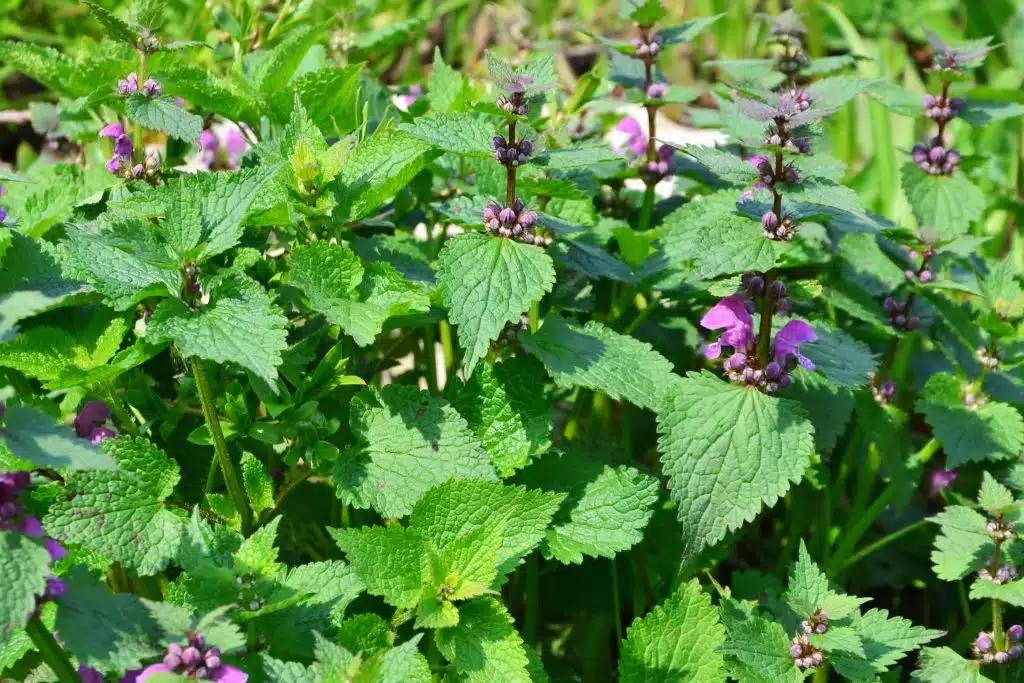
Henbit is easier to live with. It’s a winter annual, germinates in fall and flowers in early spring, dark green scalloped leaves on square purplish stems with small pink purple flowers. Usually shows up in thin, damp turf. A fall or early spring herbicide application takes care of it without much fuss.
Purple deadnettle is henbit’s cousin more or less, same winter annual life cycle but it grows more upright with triangular leaves and flowers bunched at the top of the plant. It seeds heavily too, so if you had it last year plan on seeing it again unless you get a fall pre-emergent down.
Creeping Charlie (Ground Ivy)

Getting Rid of Them
For wild violet I lean on Triclopyr products, T-Zone and Trycera are two I’ve had good luck with, applied early spring and again about two weeks later.
Creeping charlie responds to Dicamba or Triclopyr, spring or fall application. Blanket spray, not spot treatment, I can’t say that enough with this one.
Henbit and purple deadnettle are the easy ones by comparison. A general broadleaf herbicide with 2,4-D or Dicamba clears them out pretty fast.

A few things that apply no matter which of these you’re treating. Don’t mow for 2-3 days before or after you spray. And blanket spray the problem area rather than trying to spot treat, especially with these four, spot treating just means you’ll be back out there in three weeks doing it again.
If you’d rather skip herbicide altogether, maybe it’s a small patch or you’re close to a flower bed, you can pull these by hand. Loosen the soil with a garden fork first so the rhizomes come out with the roots and not just the top growth. If you don’t get the roots you’ll see regrowth in a couple weeks. Bag what you pull too, some of these will still produce viable seed even after you’ve yanked them.
Keeping Them From Coming Back
A thick, healthy lawn is still your best defense here. Overseed the thin spots, deal with any soil compaction, keep your fertility program going. Weeds move into gaps and a dense lawn just doesn’t leave many gaps open.
Mow at the right height for your grass, mulch flower beds so seedlings don’t get a foothold, and if henbit or deadnettle have been a recurring issue put down a fall pre-emergent. That one step alone will knock out most of next spring’s crop before it even germinates.
FAQs
What are these purple flowered weeds called?
Wild violet, creeping charlie (ground ivy), henbit, and purple deadnettle, those are the four I see most.
Are they actually harmful to my lawn?
They compete with your turf for water, nutrients, and light. Wild violet and creeping charlie in particular can take over a thin area pretty fast.
What’s the best way to deal with creeping charlie?
Triclopyr or Dicamba, applied as a blanket spray, not spot treatment. Takes some persistence; don’t expect it to be gone after one round.
When should I treat wild violets?
Early spring, a follow-up about two weeks later, then again in fall. A single spray just won’t get it.
Can I stop these weeds from showing up at all?
Not completely, but a dense, well-maintained lawn plus a fall pre-emergent keeps the numbers way down.
Video source: https://www.solutionsstores.com/lawn-care

Even though these plants are considered weeds, I really like their purple coloring.