
Lawn care · Fertilizer
Milorganite feeds best in warm soil, so time it by soil temperature, not the calendar
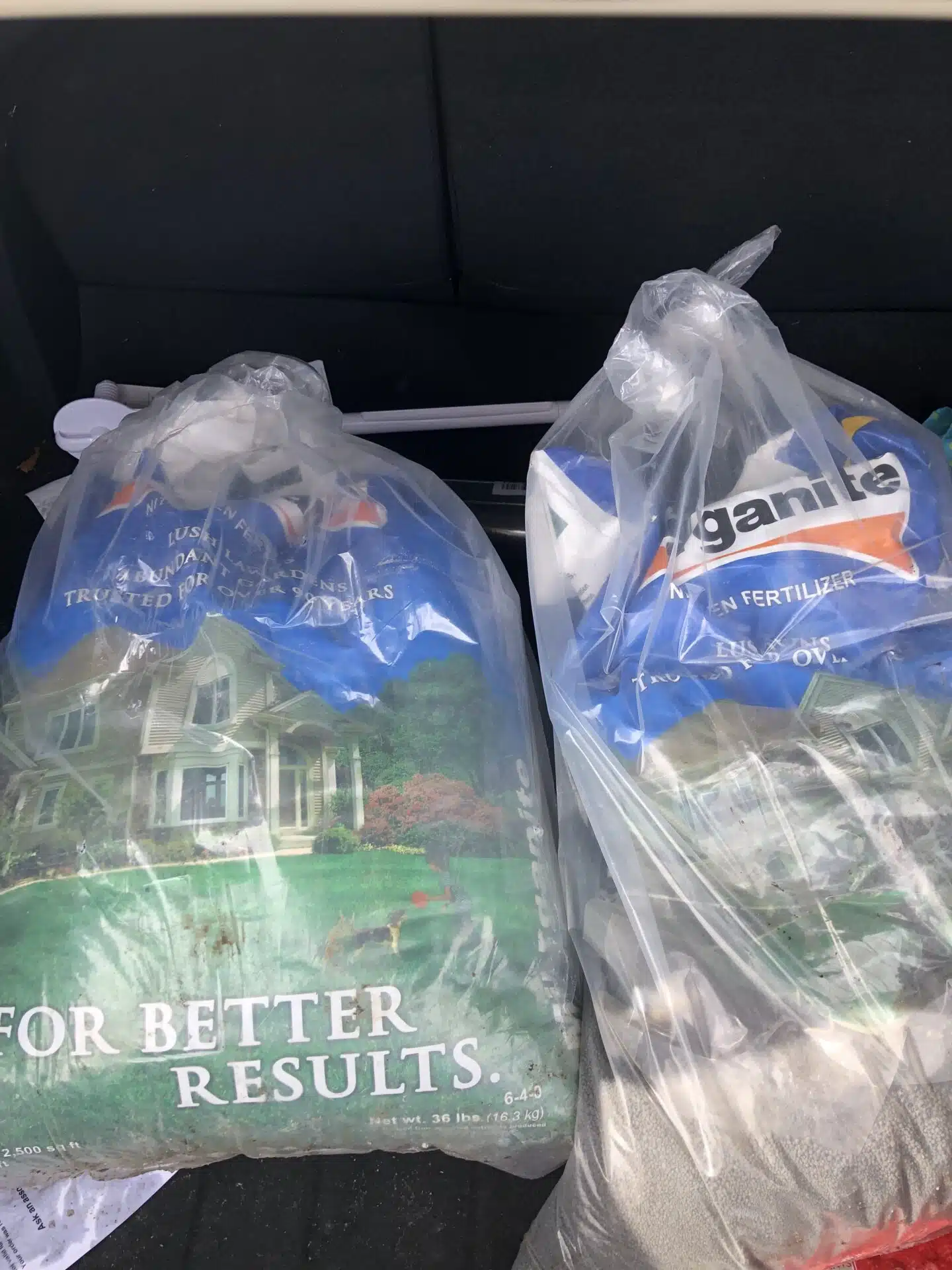
To use Milorganite, spread one 32 lb bag per 2,500 sq ft. That is 12.8 lb per 1,000 sq ft, or about 0.77 lb of nitrogen. Use a broadcast or drop spreader and split the bag into two passes at right angles. You don’t have to water it in, but watering speeds it up. In New England, it works best from late May through early September, when soil microbes are active.
ANALYSIS
6-4-0 + 2.5% iron
FULL RATE
12.8 lb / 1,000 sq ft = 0.77 lb N
FEEDS FOR
Up to 8–10 weeks
NEEDS
Warm, moist soil
Milorganite is a heat-dried biosolids fertilizer made by the Milwaukee Metropolitan Sewerage District. Of its 6% nitrogen, 3.5% is water-insoluble, so about 58% of the nitrogen is slow-release (Milorganite spec sheet). That slow part is why Milorganite won’t burn your lawn. It is also why Milorganite does very little in cold soil. This guide covers how much to put down, when it actually works in New England, spreader settings, seeding, and the phosphorus rules that apply in Massachusetts. For the full-year plan, see when to fertilize your lawn.
How much Milorganite per 1,000 sq ft
Milorganite’s bag rate is 32 lb per 2,500 sq ft on an established lawn. Here is the math: 32 lb × 6% = 1.92 lb of nitrogen, spread over 2.5 thousand sq ft, gives 0.77 lb N per 1,000 sq ft. The phosphate works the same way at 4%. The lawn fertilizer calculator does this for any bag.
| Rate | Lb per 1,000 sq ft | Nitrogen (N) | Phosphate (P2O5) | Use it for |
|---|---|---|---|---|
| Full bag rate (32 lb / 2,500 sq ft) | 12.8 lb | 0.77 lb | 0.51 lb | Late spring and Labor Day feedings |
| Half rate (32 lb / 5,000 sq ft) | 6.4 lb | 0.38 lb | 0.26 lb | July, on irrigated lawns only. This is the rate we give customers who want to feed in summer (best lawn fertilizers). |
| Regulated-state rate (32 lb / 5,200 sq ft) | 6.2 lb | 0.37 lb | 0.25 lb | Milorganite’s label rate in PA, MD and MI |
| At seeding | 12.5 lb | 0.75 lb | 0.50 lb | Milorganite’s seeding guidance; see below |
Fit it into your yearly nitrogen budget. UMass targets 2–4 lb of nitrogen per 1,000 sq ft per year for Kentucky bluegrass, perennial ryegrass and tall fescue, and 0–2 lb for fine fescue (UMass turf BMPs). Four full-rate Milorganite feedings add up to about 3.1 lb, and five add up to about 3.85 lb. That is near the top of the range, so if your lawn is mostly fine fescue, cut back to one or two feedings. You also need more product than you might expect. To get the same 0.75 lb of nitrogen, you spread 12.8 lb of Milorganite per 1,000 sq ft, compared with 3.1 lb of a synthetic like The Andersons 24-0-8. Plan on four bags for a 10,000 sq ft lawn.
When to apply Milorganite in New England
Milorganite’s own “holiday schedule” for northern lawns is Memorial Day, July 4th, Labor Day and Thanksgiving. It says to start in spring once daytime highs stay in the 60s and soil is in the mid-50s. Microbes do the releasing, though, and Cornell says organic fertilizers need warm soil, above 65°F, to give up their nutrients. Here is how the schedule plays out in New England.
| Milorganite date | New England reality | Our call |
|---|---|---|
| Memorial Day | Soil is warming and turf is growing. | Full rate. This is a good first feeding. |
| July 4th | Heat and drought stress. UMass wants at least 50% slow-release N in summer, and Milorganite’s 58% meets that. | Half rate, only on irrigated, green turf. Skip it on a brown, dormant lawn. |
| Labor Day | UMass calls early fall the most important cool-season feeding, and soil is still warm. | Full rate. See fall fertilizer timing. |
| Thanksgiving | Soil is cold, so a microbe-driven product releases little until spring. Massachusetts bans fertilizing frozen or snow-covered soil (330 CMR 31.05), and New York bans lawn fertilizer from December 1. | Skip Milorganite. If you do a late-fall feeding, use a quick-release product. |
On our own Massachusetts (Zone 6) program, we put Milorganite down up to five times between May and September, with half rates in midsummer. If you want earlier color in April, Milorganite is the wrong product. A coated or partly quick-release fertilizer will respond in cold soil (see our spring fertilizer guide).
Milorganite spreader settings
These are Milorganite’s published settings for the established-lawn rate of 32 lb per 2,500 sq ft. Treat them as a starting point, because wheel wear, walking speed and humidity all change the output.
| Spreader | Type | Setting |
|---|---|---|
| Scotts EdgeGuard (Pro, Mini), Basic, Standard, Lawn Pro | Rotary | 11.5 |
| Scotts Deluxe Edge Control, Speedy Green | Rotary | 11.5 |
| Scotts Edgemaster | Rotary | 10.5 |
| Scotts Easy Green | Rotary | 29 |
| Earthway EV-N-Spred (most models), Earthway 2050P | Rotary | 19 |
| Republic EZ | Rotary | 14 |
| Scotts AccuGreen (1000/2000/3000), Turf Builder Classic | Drop | 10 |
| Ames / Earthway | Drop | 12 |
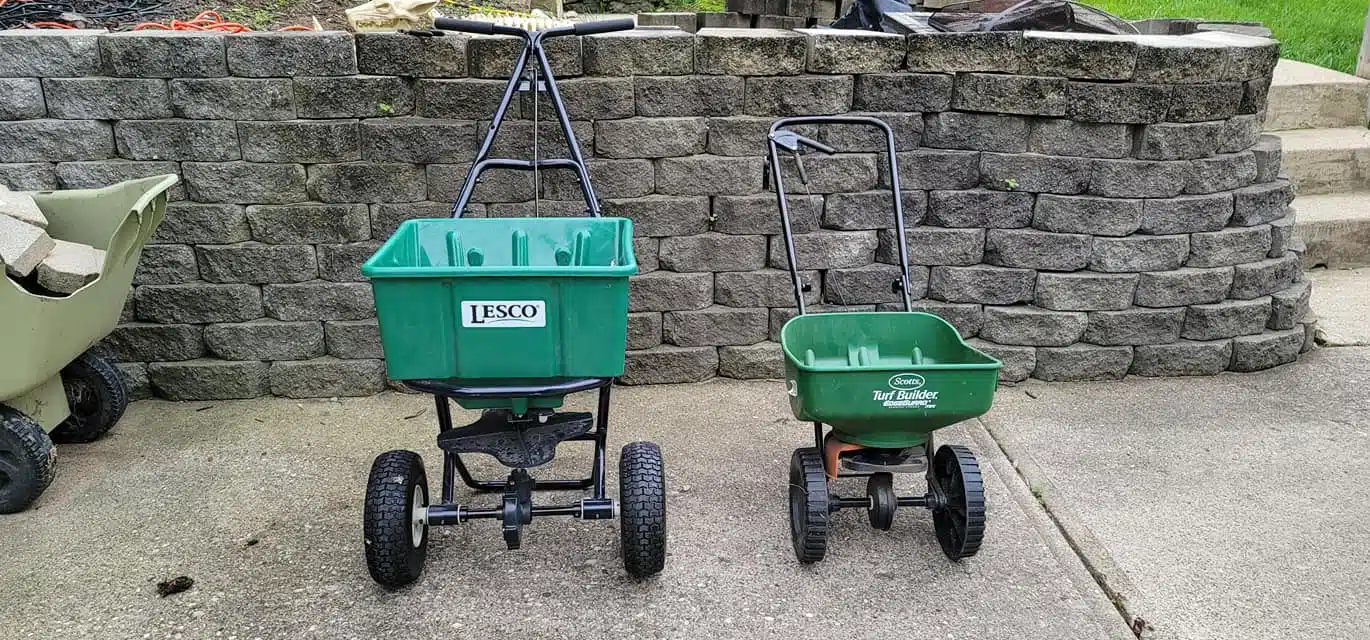
No setting for your spreader? Calibrate it. When we ran a bag of Milorganite through each spreader for our Spyker vs Lesco review, we couldn’t find a published Lesco setting. Spyker’s formula (bag weight × 1,000 ÷ coverage) gives 12.8, which is off the end of the P20-5010’s 1–10 dial. The fix is to calibrate by weight. Milorganite says 3 cups weighs about 1 lb, so a 250 sq ft test strip needs 3.2 lb, or about 9.6 cups. Load that amount, spread the strip, and open or close the gate until the hopper runs out right at the end. Milorganite recommends putting half the product down in one direction and half crosswise to avoid stripes. If you do that, calibrate each pass to half the rate. Our fertilizer spreader reviews cover the models we use.
Do you need to water Milorganite in?
No. Milorganite is salt-free and won’t burn the lawn if it sits on dry grass. It does work faster with water. The Milorganite FAQ says watering in gets the granules into contact with the soil, speeds up release, and helps the smell fade. A light rain in the forecast is ideal. Don’t spread before a downpour or onto saturated soil, which Massachusetts prohibits. See fertilizing before or after rain. Sweep any granules on driveways and walks back onto the lawn.
Using Milorganite when seeding or overseeding
Milorganite says you can use it as a starter: apply about 12.5 lb per 1,000 sq ft right after you seed, then again about 30 days later. Its FAQ also suggests mixing 4 parts Milorganite with 1 part seed by weight so small seed spreads more evenly. When we overseed in the fall, we pair Milorganite with a starter fertilizer, lime and Kelp4Less (Milorganite alternatives). A quick-release starter fertilizer feeds seedlings right away, and Milorganite carries them through the following weeks. In a cool September, Milorganite on its own is slow to help a new seedling. Massachusetts allows phosphorus when you are establishing a new lawn, but only during the first growing season. For the full process, see how to overseed a lawn and our watering guide for new seed.
Iron, odor and pets
- Iron: Milorganite contains at least 2.5% iron, and the company says it won’t leave rust stains on walks. Don’t pile a high-iron supplement on top of it. Ironite is 20% iron, and stacking the two can blacken grass (Ironite vs Milorganite). If you want more color, see iron for lawns.
- Odor: It has an earthy smell when first spread. Milorganite says it fades within a few days, faster after rain or irrigation. We list the smell as a con in our fertilizer roundup. Skip it right before a backyard party.
- Dogs: Some dogs like to eat it. Milorganite says that isn’t an emergency but can upset their stomach. If your dog shows interest, keep it off the lawn for about 24 hours and water the product in.
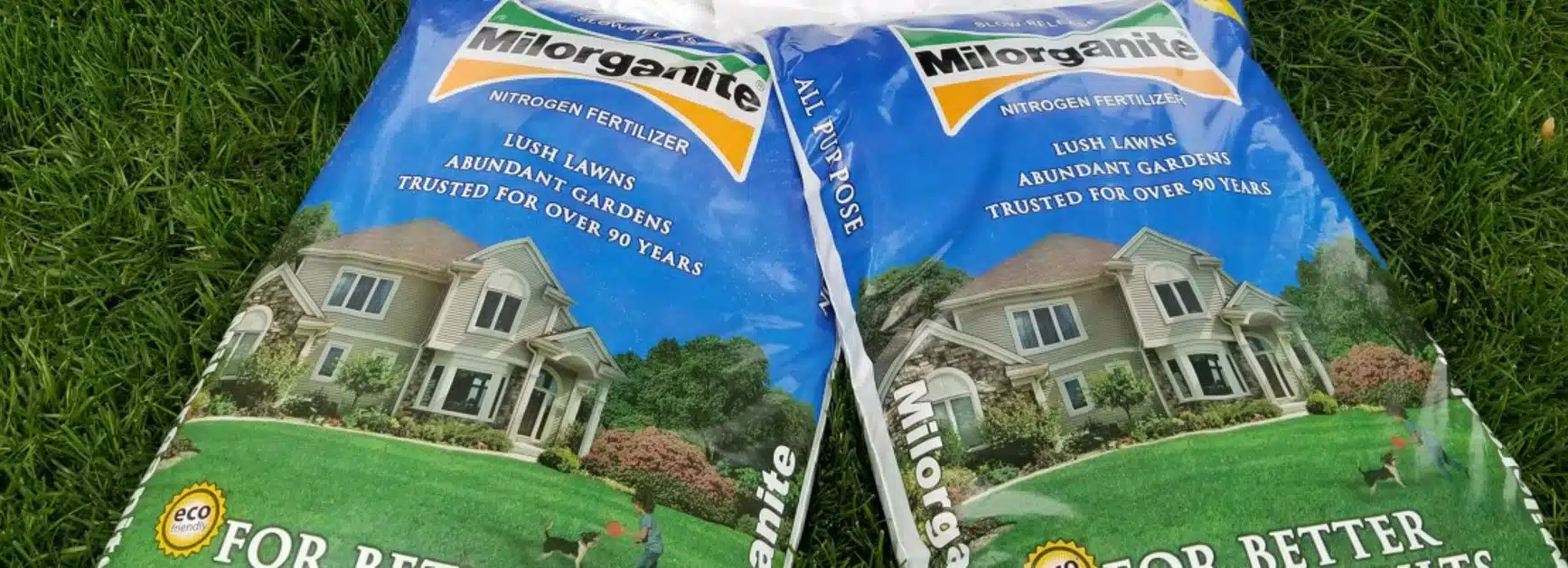
In Massachusetts, get a soil test before you make Milorganite a regular feeding.
Milorganite is 6-4-0, and the 4 is phosphate from biosolids. Under 330 CMR 31.05, phosphorus on an established lawn is allowed only when a soil test from the past three years shows a need, or when you are establishing new turf. Organic sources such as biosolids have their own rules. Their nitrogen and phosphorus must be accounted for, a soil test is required before the first application, and the phosphorus can’t exceed UMass maintenance rates. Two exemptions apply: a single application per 12 months of no more than 0.25 lb P2O5 per 1,000 sq ft, or products with 0.67% available P2O5 or less.
By our math, a full bag rate puts down about 0.51 lb P2O5 per 1,000 sq ft. That is double the exemption, and even a half rate (0.26 lb) is just over it. So a routine Milorganite program in Massachusetts appears to require a current soil test. This is our reading of the regulation, not legal advice. The Massachusetts Department of Agricultural Resources enforces it, so check with them if you’re unsure. Connecticut and New York also tie lawn phosphorus to soil tests.
Keep broadcast spreaders at least 20 feet from surface water, or 10 feet with a drop spreader or deflector, and don’t spread on frozen, saturated or dormant turf. If your soil test shows high phosphorus, switch to a 0-phosphorus product from our Milorganite alternatives list.
Milorganite vs synthetic fertilizer
PROS
Where Milorganite wins
It won’t burn in summer heat. About 58% of its nitrogen is slow-release, and it feeds for up to 8–10 weeks. The iron doesn’t stain, and the organic matter feeds soil microbes. That is why it is our “best non-burning” pick in the fertilizer roundup.
CONS
Where synthetic wins
Synthetics respond in cold spring and late-fall soil, and you carry about 4× less product for the same nitrogen. They also avoid the phosphorus rules. Cornell notes that organics usually cost more per unit of nutrient. Milorganite has also been in short supply in some years.
PFAS
The biosolids question
We list PFAS as a con. Milorganite reports an average of 5.4 ppb PFOA/PFOS, below the 20 ppb state standard it cites (Milorganite FAQ). If you’d rather avoid biosolids altogether, plant-based options are in our organic fertilizer guide.
How to use Milorganite: FAQs
How often can I apply Milorganite?
Milorganite suggests four times a year. On a New England cool-season lawn, three to five feedings between late May and early September keeps you within UMass’s 2–4 lb yearly nitrogen range.
Can you put down too much Milorganite?
It won’t burn, but extra nitrogen and phosphate don’t help either. Grass can only take up so much, and whatever it can’t use can run off. Stay at the bag rate and track your yearly total.
How long does Milorganite take to work?
It depends on soil temperature. In warm, moist soil, microbes start releasing nitrogen soon after you spread it, and watering speeds that up. In cold soil it can sit for weeks, which is why we don’t use it in early April or late November.
Can I mix Milorganite with other fertilizers?
Yes. Add up the nitrogen from both products with the nitrogen calculator, and keep the water-soluble portion at 1 lb per 1,000 sq ft or less per application, per UConn.
Does Milorganite go bad?
No. Milorganite says it stores indefinitely if kept dry. Keep opened bags sealed and away from pets.
Related guides
Sources: Milorganite: Rates & Schedule · Milorganite: Spreader Settings · Milorganite: How to Use Milorganite · Milorganite: Starter Fertilizer · Milorganite FAQ · Milorganite Specifications · UMass Turf BMPs: Soil & Nutrient Management · Cornell Turf: Feeding · 330 CMR 31.05
