
Lawn Care · Soil
The right soil pH depends on your grass, and most lawns want 6 to 7.
Most lawn grasses grow best in slightly acidic soil, roughly pH 6.0 to 7.0, though centipedegrass prefers 5.0 to 6.0 and tall fescue and bermuda are comfortable down to 5.5. Test before you change anything: lime raises pH slowly over months, and lowering pH under an established lawn is slower still and limited to small doses of sulfur.
UMASS LAWN TARGET
pH 6.5
CENTIPEDEGRASS
pH 5.0–6.0, no lime unless tested
LIME PER APPLICATION
50 lb per 1,000 sq ft max (UMass, UGA)
SULFUR PER APPLICATION
5 lb per 1,000 sq ft max
What soil pH changes in a lawn
Soil pH is a measure of acidity on a scale where 7 is neutral, lower is acidic and higher is alkaline. It matters to a lawn mostly through what it does to nutrients and soil life. Away from the middle of the range, some nutrients become harder for roots to take up even when the soil test shows plenty of them.
Penn State Extension adds a less obvious benefit: a pH of about 6.0 to 7.0 supports the microbes that break down thatch. Very acidic soil is also one of the conditions behind moss (see getting rid of moss), while soil that runs too alkaline can show up as yellowing between leaf veins from poor iron uptake, which we cover in iron for lawns.
Most lawns don’t need pH fixed at all. In the Northeast, where soils are naturally acidic, the target UMass recommends for lawns is 6.5, and lime is the common correction. In parts of the Midwest, Purdue notes, soils are heavily buffered by calcium and sit at or above neutral, which is a different problem with fewer good fixes.
Ideal soil pH by grass type
These ranges come from UGA Extension Circular 1058-1 and Penn State’s liming guide. Where the two differ, both are shown. Treat them as a target zone rather than a single magic number.
| Grass | Preferred pH | Notes |
|---|---|---|
| Kentucky bluegrass | 6.0–7.0 (UGA); 6.5–7.2 (Penn State) | The least tolerant of acidity among the common cool-season grasses. |
| Tall fescue | 5.5–6.5 (UGA) | Penn State groups turf-type tall fescue with grasses that tolerate slightly acid soil, 6.0–6.5. |
| Perennial ryegrass and fine fescues | 6.0–6.5 tolerated (Penn State) | Cool-season lawns generally do best at 6.0–7.2. |
| Bermudagrass | 5.5–6.5 (UGA) | |
| Zoysiagrass | 6.0–7.0 (UGA) | |
| St. Augustinegrass | 5.5–6.5 (UGA) | |
| Centipedegrass | 5.0–6.0 (UGA) | UGA says not to lime centipede unless a soil test calls for it. |
| White clover or microclover in the lawn | 6.0–7.0 | Nitrogen fixation falls off in acidic soil; see our clover lawn guide. |
How to test your lawn’s pH
A university lab test is the only reading you should base lime or sulfur on. Our lawn soil test guide walks through sampling depth, where to send the sample and how to read the report. Two points matter most for pH:
- pH alone doesn’t give a lime rate. The lab also measures buffer pH or exchangeable acidity, which tells it how hard the soil resists change. That second number is how the lab turns a pH reading into a pounds-per-1,000 sq ft lime rate (Oklahoma State Extension).
- Home kits are a rough check. When South Dakota State Extension compared cheap kits with lab results, kit pH readings landed within about one unit. That’s fine for spotting a big problem and not good enough to set a rate.
- Retest after a correction. UMass suggests waiting 4 to 6 months after the last lime application before testing again.
What to do with your result
Match the reading on your report to the row below. The point of the table is to stop you from treating a number that doesn’t need treating.
| Your soil test shows | What to do | Why |
|---|---|---|
| Below your grass’s range, and the report gives a lime rate | Apply lime at the report’s rate, no more than 50 lb per 1,000 sq ft at once; split larger amounts between fall and spring | Lime is the only practical way to raise pH. UMass and UGA both cap single applications at 50 lb (UMass, UGA). |
| Within your grass’s range | Nothing. Retest in two to three years | Lime on soil that doesn’t need it only pushes pH higher. |
| Centipedegrass lawn at 5.0–6.0 | Nothing | That is its preferred range; UGA warns against liming centipede without a test. |
| About 7.0 to 7.8 | Don’t lime. Use ammonium-based nitrogen (ammonium sulfate, urea) in your normal feeding program | UGA says these sources lower pH gradually and reserves sulfur for soils above about 7.8. |
| Above about 7.8 | Consider small, repeated sulfur applications and retest; in calcium-rich soils, manage the grass instead of the number | See the sulfur limits below. Purdue found safe rates rarely move heavily buffered soils. |
| Bare soil before seeding or sodding | Correct pH now, working lime into the top 4 to 6 inches | Penn State allows the whole lime requirement before seeding when it’s mixed in; Purdue notes sulfur can also be tilled in at higher rates before turf goes down. |
Raising pH with lime
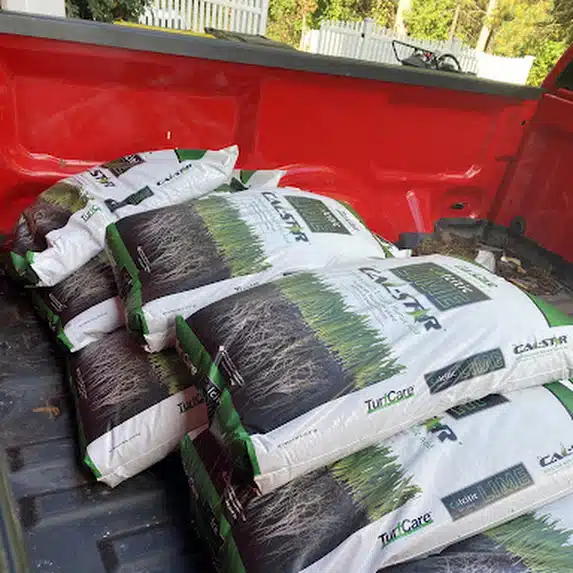
Ground limestone is the standard material. Penn State describes lime movement into the soil as slow even under ideal conditions, which is why fall is the preferred time: winter rain, snow and freeze-thaw cycles help work it in. UMass allows lime on established lawns in both spring and fall. Choose calcitic or dolomitic lime from the magnesium line on your report; our calcitic vs dolomite lime comparison explains the choice, and lime for lawns covers product forms. Pelletized lime is ordinary ground limestone pressed into granules so it spreads cleanly through a lawn spreader.
One note on caps: UMass and UGA both limit a single application to 50 lb per 1,000 sq ft, while Penn State’s older guide allows up to 100 lb on general turf. Follow the lab you tested with, since its recommendations are written around its own limits.
Worked example. Your report for a 5,000 sq ft lawn calls for 80 lb of limestone per 1,000 sq ft. That’s 400 lb in total, more than a single 50 lb dose allows.
Split it: 50 lb per 1,000 sq ft in fall (250 lb, or about seven 40-lb bags) and the remaining 30 lb per 1,000 sq ft in spring (150 lb, or four bags). Retest four to six months after the spring application.
Lowering pH in an established lawn
This is the harder direction. Elemental sulfur acidifies soil as soil bacteria convert it, but it burns grass at high doses. UGA says not to put more than 5 lb of elemental sulfur per 1,000 sq ft on mature turf at once, and suggests about 2 lb per 1,000 sq ft every eight to ten weeks instead, watered in with 0.3 to 0.5 inch right away to wash it off the leaves. Retest after the second application to decide on a third. Purdue’s turf program gives the same 5 lb single-application ceiling for turf mowed at 2 inches or higher, with no more than 10 lb in a year.
Purdue’s bigger point is a reality check. In soils heavily buffered with calcium, those safe rates are too small to change pH in any reasonable time, so it suggests adjusting fertility, and possibly adding iron, rather than chasing the number. Below about 7.8, UGA leans on ammonium-based fertilizers, which nudge pH down a little every time you feed.
Worked example. A 5,000 sq ft lawn tests at pH 8.0. At 2 lb of sulfur per 1,000 sq ft, one application is 10 lb of actual sulfur.
Check the sulfur percentage on the product label: if the bag is 90% sulfur, divide 10 by 0.90 for about 11 lb of product. Water it in the same day, repeat in eight to ten weeks and send a new sample after the second round.
Don’t treat a number you haven’t measured.
The common mistakes run both ways: a bag of lime every spring “because lawns like lime,” and a heavy dose of sulfur to fix alkaline soil in one go. The first slowly pushes a fine lawn too alkaline; the second burns the grass. Get a lab test, use its rate, keep sulfur at or under 5 lb per 1,000 sq ft per application, and if the report shows a calcium-buffered soil above 7.8, accept that pH there is a long-term project rather than a weekend fix.
Lawn soil pH FAQs
What pH should lawn soil be?
For most lawns, 6.0 to 7.0. UMass uses 6.5 as its lawn target. Centipedegrass prefers 5.0 to 6.0, and tall fescue, bermuda and St. Augustine are comfortable from about 5.5.
How do I test my lawn’s soil pH?
Send a composite sample to your state university lab. It reports pH plus buffer pH, which sets the lime rate. A home kit or meter is useful for a quick check between lab tests.
How long does lime take to change soil pH?
Months, not weeks. Lime moves into soil slowly, which is why UMass suggests waiting four to six months after the last application before retesting.
How do I lower the pH of lawn soil?
Use small doses of elemental sulfur, about 2 lb per 1,000 sq ft every eight to ten weeks and never more than 5 lb at once, or rely on ammonium-based fertilizers if the pH is below about 7.8.
Can I just lime every year to be safe?
No. On soil already in range, lime only raises pH further. Lime when a soil test says to, at the rate it gives.
Related guides
Sources: UGA Extension C1058-1: Turfgrass Fertility, Soil Texture, Organic Matter, Aeration and pH (rev. 2021) · Penn State Extension: Liming Turfgrass Areas · Purdue Turf: Sulfur Is Not Effective for Lowering pH of Turfed Soils · UMass: Fertilizer Guide for Lawns · UMass: Timing of Lime and Fertilizer Applications · Oklahoma State Extension: Understanding Your Lawn and Garden Soil Test · SDSU Extension: Are Cheap Home Soil Test Kits Accurate?
