
Lawn Care · Seeding
A new lawn is won in the soil, not the seed bag.
To plant grass seed on bare soil, test the soil, loosen and amend the top 4–6 inches, grade it, let it settle, then spread seed in two directions at the new-lawn rate, rake it in no deeper than about ¼ inch, roll, mulch and keep the surface damp until it’s up. Time it to your grass: late summer for cool-season lawns, late spring into early summer for warm-season ones.
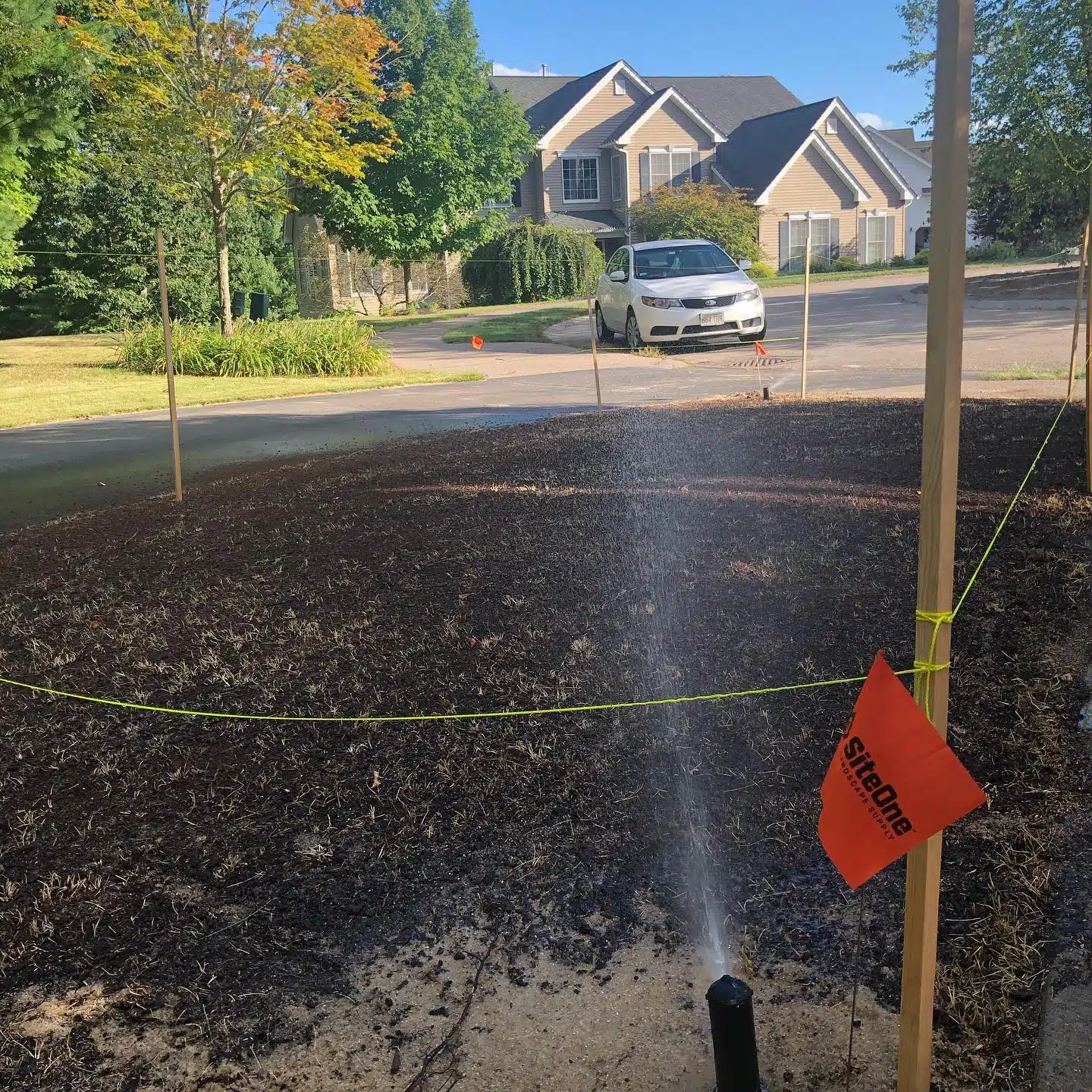
WORKED SOIL DEPTH
4–6 in, more if you can
SEED DEPTH
About ¼ in or less
TALL FESCUE, NEW LAWN
7–9 lb per 1,000 sq ft
WATERING UNTIL UP
Light, 2–3 times a day
This guide is for starting a lawn where there isn’t one: a new build, a regraded yard, a strip that was dug up for a septic or drainage job, or soil you’ve already cleared. If you’re thickening a lawn that’s still there, you want how to overseed a lawn. If there’s an old, weedy lawn to get rid of first, start with how to renovate your lawn and come back here once you’re down to soil.
Which seeding job is yours?
The steps below assume bare soil. Use this to check you’re on the right page before you buy anything.
| Your situation | What to do | Where to go |
|---|---|---|
| Bare soil after construction, grading or excavation | Build the seedbed, then seed at the full new-lawn rate | This guide |
| A thin lawn with grass still covering most of the ground | Overseed at about half the new-lawn rate | How to overseed a lawn |
| An old lawn that’s mostly weeds or the wrong grass | Kill it, clear it, then follow the soil steps here | How to renovate your lawn |
| Cool-season lawn and you’ve missed the late-summer window | Seed into cold soil in late fall or winter, or wait for spring | Dormant seeding or spring seeding |
| You want St. Augustine or a hybrid bermuda | Plant sod, plugs or sprigs; there’s no seed to buy | Types of St. Augustine grass |
1. Pick a grass that suits your climate and yard
Seed choice comes first because it sets your timing and your seeding rate. Cool-season grasses (Kentucky bluegrass, tall fescue, perennial ryegrass, fine fescues) are the lawns of the North; warm-season grasses (bermuda, zoysia, centipede, buffalograss) belong in the South. Our guide to choosing grass seed compares them, and the cool-season seed buying guide covers mixes for sun, shade and traffic.
In warm climates, check that your grass even comes as seed. Clemson Extension notes that many warm-season grasses are sterile and have to be planted as sod, sprigs or plugs; the seedable ones it lists are centipedegrass, carpetgrass, common and improved bermudagrass, and Japanese lawngrass (Zoysia japonica). Texas A&M AgriLife lists St. Augustinegrass as sod only.
2. Test the soil before you add anything
A soil test tells you how much lime and phosphorus to work in, and the time to fix both is now, while you can mix them into the root zone. Clemson suggests testing two to three months before planting, and Oklahoma State suggests about two months ahead, pulling 10 to 15 cores 3 to 4 inches deep. Our soil test guide covers sampling and reading the report.
3. Grade for drainage and clear the debris
Rough-grade so water runs away from the house. Michigan State University Extension uses a fall of about 1 foot per 50 feet, and Oklahoma State calls for at least a 1% slope away from buildings. Rake out construction debris, rocks and roots as you go. Buried scraps of lumber and concrete leave dry patches that show up every summer.
4. Build the root zone
Grass roots need loose, workable soil. Extension minimums vary: MSU asks for a root zone at least 4 inches deep, UMass a minimum of 6 inches, and Texas A&M prefers 10 to 12 inches. Deeper is better, especially on compacted building sites.
- If you’re bringing in topsoil, mix the first layer into the soil underneath instead of laying it on top, so water and roots don’t stop at the boundary. Oklahoma State suggests 4 to 6 inches of loamy topsoil worked into the top 2 to 4 inches of a clay subsoil, and 6 to 8 inches into the top 4 to 6 inches of a sandy one.
- If you’re not adding topsoil, MSU says to till the existing subsoil at least 6 inches deep, which usually takes a tractor-mounted tiller.
- Add organic matter. MSU suggests 2 inches or more of well-rotted organic matter tilled into the top 4 to 6 inches.
- Work in lime and fertilizer at the soil-test rates, into the top 4 to 6 inches.
- Don’t till wet soil. Texas A&M warns against it; you’ll smear clay into clods that set like brick.
5. Let it settle, then firm it
Freshly tilled soil is fluffy and will sink unevenly after the first heavy rain, leaving puddles and scalped high spots. Texas A&M suggests irrigating the area three to six times after tilling to settle it and show the low spots, then filling those in. Roll it, or water it and let it settle again, until it passes the footprint test: Oklahoma State says footprints deeper than about ½ inch mean the seedbed is still too loose, and MSU uses the same ½-inch heel mark. Finish with a light raking so the surface has small ridges for seed to fall into.
6. Starter fertilizer, and the phosphorus rules
Phosphorus helps new roots, which is why starter fertilizers carry more of it. Without a soil test, Texas A&M suggests about 1 lb of nitrogen, 1½ lb of phosphate and 1 lb of potash per 1,000 sq ft, mixed into the top 4 to 6 inches. With a soil test, use its numbers instead.
Several states limit phosphorus on lawns, but new lawns usually get an exception. Michigan allows it for new turf in its first growing season (MCL 324.8512b), and Massachusetts allows it when a lawn is being established, patched or renovated (MDAR fact sheet). Check your own state’s rule before you buy.
7. Spread the seed at the new-lawn rate
Bare soil needs the full rate; overseeding rates are about half. These are LawnPhix’s standard cool-season rates from how much grass seed do I need, based on UMass, with warm-season rates from Texas A&M and Oklahoma State. For a blend, follow the bag.
| Grass | New lawn (lb per 1,000 sq ft) | Notes |
|---|---|---|
| Kentucky bluegrass | 1–2 | Tiny seed; slow to come up |
| Perennial ryegrass | 7–9 | Fastest to germinate |
| Tall fescue | 7–9 | Bunch type; won’t fill gaps later |
| Fine fescue | 4–6 | Shade and low-input mixes |
| Bermudagrass (seeded types) | ½–1 (Texas A&M); 1–2 lb pure live seed (Oklahoma State) | Full sun only |
| Centipedegrass | ½–1 (Texas A&M) | Slow from seed; sod is faster |
| Zoysia (seeded types) | 1 (Texas A&M) | Needs warm, well-prepared soil |
| Buffalograss | 2–3 (Texas A&M) | Low-rainfall areas |
| St. Augustinegrass | No seed | Sod or plugs only |
Plug your square footage into the grass seed calculator to get pounds. Then split the seed in half and spread one half in one direction and the other half at right angles, as MSU and UMass both recommend. Two light passes fill the stripes and gaps one heavy pass leaves behind.
8. Rake it in, then roll
Seed needs firm contact with soil but very little cover. Clemson says to rake seed into the top quarter-inch, and Oklahoma State covers it about ⅛ inch with a light raking or by dragging a steel door mat. A useful check from MSU: after raking, about 10% of the seed should still be visible. Then roll with a light roller; MSU suggests one weighing about 50 to 75 lb, which means mostly empty if it’s a water-filled drum. Fine seed such as Kentucky bluegrass buried an inch deep may never make it to the surface.
9. Mulch so it doesn’t dry out or wash away
A thin layer of straw holds moisture at the surface and keeps seed in place in heavy rain. Use clean, weed-free straw and keep it thin enough to see soil through it. Clemson figures one 60 to 80 lb bale covers about 1,000 sq ft; MSU suggests about two 60-lb bales of wheat, oat or barley straw per 1,000 sq ft, and steers away from rye straw. Avoid hay, which brings its own weed seed. On slopes, an erosion blanket holds better. Our straw cover guide compares the options.
10. Water lightly and often, then deeper and less often
The top half-inch of soil has to stay damp from the day you seed until the grass is up. MSU says that can take two or three light waterings a day on hot, sunny days, and the University of Minnesota says up to three or four. Clemson keeps the soil moist 2 to 3 inches deep for about the first three weeks. Once seedlings are up, switch to fewer, deeper waterings to pull roots down. MSU starts tapering about a week after sowing, and Oklahoma State after 10 to 14 days of light daily watering. Schedules and timer settings are in how often to water grass seed.
11. First mowing and weed control
Mow for the first time when the grass is about a third taller than the height you plan to keep it at, with a sharp blade (UMass; Clemson). MSU also says to keep foot traffic off until you can no longer see soil between the plants.
Weeds will come up with the grass. Standard crabgrass preventers stop grass seed too; Rutgers names mesotrione (Tenacity) and siduron as the options that are safe at seeding, and LawnPhix’s experience with Tenacity is in our Tenacity review. Purdue advises waiting until new grass has been mowed at least three times before using a broadleaf herbicide. More on this in preventing weeds in new grass.
Stop before you seed if the ground still needs earthwork.
The steps above assume you can loosen and level the soil with a tiller and a rake. If the yard needs fill brought in, a slope changed near the foundation, a drainage problem fixed, or compacted subsoil broken up 6 inches deep (MSU notes that usually takes a tractor-mounted tiller), do that first, or hire it out. Seed spread over a bad grade or a compacted building pad germinates fine and then thins out as water pools in the low spots and roots stall in the hard layer. Also check the label of anything you sprayed on the area this year: many crabgrass preventers and some weed killers set a waiting period before seeding.
If you’d rather hand off the grading and seeding, our lawn seeding service page connects you with a lawn care company serving your area.
Planting grass seed FAQs
Can you just throw grass seed on bare dirt?
It will partly come up, but you’ll lose a lot of it. Seed sitting loose on hard soil dries out between waterings, washes into low spots and feeds birds. Loosening the surface, raking the seed in about ¼ inch and rolling it makes far more of it grow.
How deep should grass seed be planted?
Shallow. Clemson says the top quarter-inch, Oklahoma State about ⅛ inch. If roughly a tenth of the seed is still visible after raking, you’re about right.
Should I put topsoil over grass seed?
No. A layer of topsoil on top buries small seed too deep. Mix topsoil into the ground before seeding, then use a thin straw mulch or seed cover on top.
Do I need starter fertilizer for a new lawn?
New seedlings benefit from phosphorus, and most state phosphorus limits make an exception for new lawns. Use the rates on your soil test, or a starter fertilizer at the label rate.
How long before new grass comes up?
Perennial ryegrass can be up in 5 to 7 days (Penn State), while Purdue lists 14 to 21 days for tall fescue and 18 to 28 for Kentucky bluegrass. More in how long it takes grass to grow.
When can I walk on a newly seeded lawn?
As little as possible until you can’t see soil between the plants, which MSU uses as the signal. Plan on several weeks, and longer for bluegrass.
Related guides
Sources: MSU Extension E-2910: Establishing a New Lawn Using Seed · UMass Extension: Establishment, Renovation & Repair · University of Minnesota Extension: Seeding and Sodding Home Lawns · Purdue AY-20: Seeding a Turf Area · Oklahoma State HLA-6419: Establishing a Lawn in Oklahoma · Clemson HGIC 1203: Lawn Establishment · Texas A&M AgriLife SCS-2009-06: Turfgrass Establishment in Texas · Texas A&M AgriLife L-5519: Turfgrass Selection for Texas · Penn State Extension: Turfgrass Species for Pennsylvania · Rutgers: Weed Control in Spring Seedings · Michigan MCL 324.8512b · MDAR: Plant Nutrient Regulations for Turf and Lawns
