
Lawn Care
A $20 lab soil test tells you exactly how much lime and fertilizer your lawn needs
To soil test a lawn, pull 12 to 15 small cores from one area, mix them, air-dry about a cup and mail it to your state university lab. Test in late fall or early spring, every two to three years. The report gives your pH, phosphorus, potassium and other nutrients, plus lime and fertilizer rates per 1,000 sq ft.
BEST TIME
Late Oct–Nov, or early spring
HOW OFTEN
Every 2–3 years
CORES PER SAMPLE
12–15, zig-zag
NEW ENGLAND LAB COST
$17–$20 per sample
Why test your lawn soil
A soil test replaces guessing with numbers. Most New England lawns sit on naturally acidic soil, and the only way to know whether yours needs lime, potassium or nothing at all is to measure it. A routine lab report covers:
- pH and lime need. UMass recommends a target pH of 6.5 for lawns. pH tells you whether to lime. A second reading (buffer pH or exchangeable acidity) tells the lab how much lime, a point Oklahoma State’s soil test fact sheet makes clearly.
- Phosphorus (P) and potassium (K). These are the second and third numbers of the N-P-K ratio. Many established lawns already carry enough P. Potassium (potash) supports overall plant health and disease resistance.
- Calcium and magnesium. These two decide between calcitic and dolomitic lime (more on that below).
- Organic matter. This is included at UNH, UVM and UMaine. UMass charges it as a $6 add-on.
Nitrogen is the one big nutrient most labs leave out. The UMass lab explains that soil nitrogen swings too much with weather to be a useful routine number. Nitrogen rates come from your grass type and calendar instead (see when to fertilize your lawn).
When to test (and how often)
Any time the ground isn’t frozen works, but timing changes how useful the report is.
- Late fall is best. UMass suggests late October to November to beat the spring rush. Their backlog runs from mid-March through June. A fall result also leaves time for lime to work over winter.
- Early spring is second best. Results arrive in time for your first feeding, though possibly after a wait.
- Don’t sample right after feeding. Wait six to eight weeks after lime or fertilizer, and skip soggy soil.
- Repeat every 2–3 years. UMass turf guidance says to test established lawns at least every three years and check pH yearly. If you’re correcting a low pH, retest 4–6 months after the last lime application.
How to take a lawn soil sample, step by step
A careless sample gives a precise answer to the wrong question. The whole job takes about 20 minutes:
- Split the yard into areas. Front lawn, back lawn and any problem patch each get their own sample and bag. Don’t mix a thin, mossy corner into the average.
- Gather tools. Use a soil probe or a clean trowel, plus a clean plastic bucket. UMass turf specialists use a ½-inch stainless or chrome-plated sampling tube.
- Walk a zig-zag and pull 12–15 cores. UMass found that fewer cores often miss the true average. Stay away from driveway edges, foundations and spots where you spilled fertilizer.
- Go to the depth your lab asks for. Turf depth differs by lab. UConn wants 3–4 inches and UMass wants 4–6 inches. Follow the instructions for the lab you mail to, because their recommendations are calibrated to that depth.
- Clean and mix. Pick out stones, roots and debris, then mix all the cores thoroughly in the bucket.
- Air-dry it. Spread the soil on clean paper. A fan on low speeds drying, but never use heat, and don’t send wet soil.
- Bag and send about one cup. Use a labeled zip-top bag, the lab’s form and payment. Most New England university labs take a check or money order, not cards.
Lab test vs DIY kit
Store kits are fine for a quick pH check. They can’t tell you how much lime to buy. When South Dakota State Extension tested cheap kits against a lab, the kits got pH within about one unit. Their phosphorus and potassium readings were inconsistent, and one kit called for phosphorus on soils that already had plenty.
| What you need | University lab | DIY kit or meter |
|---|---|---|
| pH | Yes, precise | Roughly, within about 1 unit |
| Pounds of lime to apply | Yes, from buffer pH or exchangeable acidity | No |
| Phosphorus and potassium | Yes, with a pounds-per-1,000 sq ft recommendation | Inconsistent in testing |
| Calcium, magnesium, micronutrients | Yes | Usually not |
| Lead screen | Included at UMass, UConn and UNH | No |
| Turnaround | 6–10 business days at UMass; about 3 weeks at UNH | Minutes |
| Best use | Setting lime and fertilizer rates | A yearly pH check between lab tests |
Where to send a soil sample in New England
Each state university runs (or points you to) a lab whose recommendations fit Northeast soils. The UMass lab notes that its extraction method and recommendations were developed for New England soils and climate. Prices below were checked in October 2026 and can change each season.
| State | Lab | Home/lawn test |
|---|---|---|
| MA | UMass Soil and Plant Nutrient Testing Laboratory | $20 routine analysis (pH, nutrients, lead, CEC, lime and nutrient recommendations); organic matter +$6 |
| CT | UConn Soil Nutrient Analysis Laboratory (Plant and Soil Health Center) | $18 standard nutrient analysis with lead screen; $7 pH only |
| NH | UNH Extension Soil Testing Service | $20 home grounds test, including organic matter and lead screen |
| VT | UVM Agricultural and Environmental Testing Lab | $17, including organic matter, CEC and lime recommendations |
| ME | UMaine Analytical Lab and Maine Soil Testing Service | $20 standard test, including organic matter; sample kits by request |
| RI | URI GIST program | Free pH and texture check; for a full nutrient test URI points you to UConn or UMass |
How to read your soil test results
Reports differ in layout, but every New England lab report shows the same handful of lines. Here’s what to do with each one:
| Report line | What it tells you | What to do |
|---|---|---|
| Soil pH | Acidity. Turf does best at a slightly acidic to neutral 6–7. | Below target: follow the lime line. At or above 7: no lime. |
| Buffer pH / exchangeable acidity | How hard the soil resists a pH change | Nothing to calculate yourself. It sets the lime rate on the report. |
| Phosphorus (P) | Low, optimum or above optimum | Optimum or higher: use a fertilizer with 0 in the middle number |
| Potassium (K) | Low, optimum or above optimum | Low: add the recommended K2O as potash or a high-K blend |
| Calcium / magnesium | Base cations held by the soil | Low Mg plus a lime need: dolomitic lime. Mg fine: calcitic lime. |
| CEC and base saturation | How much nutrient the soil can hold. Sandy soils run low. | Low CEC: feed in smaller, more frequent doses |
| Lead | A screen for lead, most relevant near older painted houses | If flagged, follow your lab’s guidance before digging or planting edibles |
The pH 6–7 range comes from UMass turf best practices. For the calcitic vs dolomitic choice, see our calcitic lime vs dolomite lime comparison, and calcium for lawns if calcium itself comes back low.
Turn the results into lime and fertilizer rates
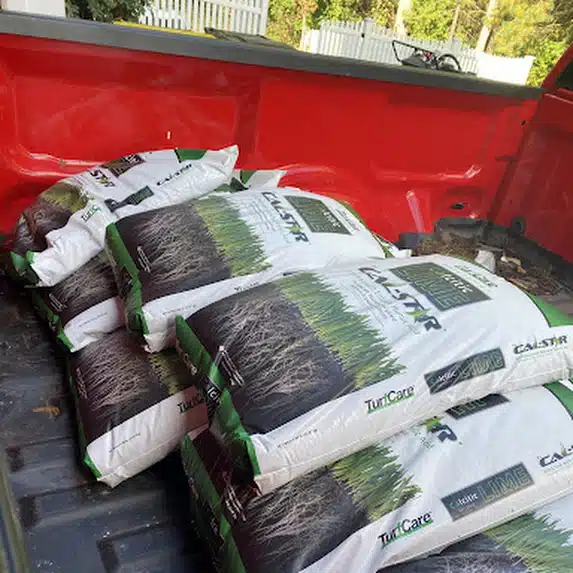
Lab recommendations come as pounds per 1,000 sq ft of lime, nitrogen (N), phosphate (P2O5) and potash (K2O). Those are the same units printed on a fertilizer bag, so you don’t need to convert anything.
Lime
- Use the lime number from the report. UMass caps established lawns at 50 lb of limestone per 1,000 sq ft at one time.
- If the report calls for 100 lb, split it into 50 lb in fall and 50 lb in spring. UMass allows limestone on established plantings in both spring and fall.
- Fall lime gets winter’s freeze-thaw cycles to help it work in, as we cover in lime for lawns.
Fertilizer
Divide the pounds of nutrient recommended by that nutrient’s percentage on the bag, then multiply by 100. That gives you pounds of product per 1,000 sq ft. UMass shows this same formula.
Worked example. The report asks for 1 lb K2O per 1,000 sq ft and you’re using 0-0-60 potash: 1 ÷ 60 × 100 = 1.7 lb of product per 1,000 sq ft.
For nitrogen with a 24-0-10 blend at 0.75 lb N: 0.75 ÷ 24 × 100 = 3.1 lb per 1,000 sq ft. Our lawn fertilizer calculator does this math for your exact lawn size and product.
Phosphorus: in some states the soil test is the law
In Massachusetts, phosphorus fertilizer can go on an established lawn only if a soil test taken within the past three years shows a need, or when you’re establishing new turf. Vermont’s rule is tighter: the test must be no more than 18 months old, with an exception for starter fertilizer during the first growing season of a new lawn. A dated lab report is your paperwork if you need P.
Stop before you lime on a hunch.
Lime only raises pH. On soil already at 7 or above, it just pushes the lawn further toward alkaline, which can bring on the yellowing we describe in lime for lawns. Also skip the “bag of lime every spring” habit and any single dose over 50 lb per 1,000 sq ft. If the report flags elevated lead, call your lab before you dig, regrade or start a vegetable bed.
Lawn soil test FAQs
How deep should I take a soil sample for a lawn?
Use your lab’s depth: 3–4 inches for UConn, 4–6 inches for UMass. Their recommendations are built on samples taken at that depth.
How many samples do I need?
Send one composite sample of 12–15 cores per area that you manage differently. A typical house might send two: front and back.
Are home soil test kits accurate?
For pH, roughly. For phosphorus and potassium, not reliably, and no kit gives you a lime rate. Use a kit between lab tests, not instead of one.
Why doesn’t my report show nitrogen?
Soil nitrogen changes too fast to be useful in a routine test. Base nitrogen on grass type and season. Most lab reports still suggest a nitrogen rate per feeding.
Can I lime and fertilize at the same time?
UMass schedules them separately. Lime goes down in spring or fall, and lawn nitrogen is concentrated in September and November. Plan both from the same report.
Related guides
TOOL
Lawn fertilizer calculator
Turn a pounds-per-1,000 sq ft recommendation into a spreader-ready amount.
Sources: UMass sampling instructions · UMass Turf: Soil sampling for meaningful results · UMass Fertilizer Guide for Lawns · UMass lime and fertilizer timing · UMass Turf BMPs: Soil and nutrient management · UConn sampling instructions · OSU HLA-6468 · SDSU Extension: home kit accuracy · 330 CMR 31.05 · 10 V.S.A. § 1266b
