
Lawn care · Fertilizer
Liquid fertilizer is a fast tool, not a whole feeding program
Liquid lawn fertilizer is dissolved nutrients you spray on, so grass colors up within days — and fades within weeks. It earns its place for spoon-feeding small nitrogen doses (0.1–0.5 lb per 1,000 sq ft), quick green-up, iron and micronutrients, and kelp or humic biostimulants. For season-long feeding of a cool-season lawn, slow-release granular still does the heavy lifting.
SPOON-FEED DOSE
0.1–0.5 lb N per 1,000 sq ft
INTERVAL
Every 1–2 weeks in season
SOLUBLE N CAP (UCONN)
1 lb per 1,000 sq ft, max
BEST TOOL
A calibrated backpack sprayer
Most of the confusion around liquid lawn fertilizer comes from treating it as a straight swap for a bag of granular. It isn’t. The nitrogen in a jug is almost always water-soluble, so it behaves like the quick-release part of a granular blend: fast color, short life, and more burn risk per pound. Used for the right jobs, it is the most precise way to feed a lawn. This guide covers where liquid fits in a cool-season program, how much to spray, and which sprayer to use. For the big-picture calendar, start with when to fertilize your lawn.
Liquid vs granular lawn fertilizer
| Factor | Liquid | Granular |
|---|---|---|
| Speed of response | Days. Nutrients are already dissolved and part is taken in through the leaf. | Quick-release granules respond once watered in; slow-release granules feed more gradually. |
| How long it lasts | Soluble nitrogen gives roughly 4–6 weeks of response at normal rates, per UMass, and much less at spoon-feed doses. | Slow-release nitrogen keeps feeding for weeks to months (see slow-release lawn fertilizer). |
| Dose control | Very fine. Easy to apply 0.1 lb N or less per 1,000 sq ft. | Set by bag rate and spreader setting; built for full feedings. |
| Equipment | Hose-end, pump or backpack sprayer. | Broadcast or drop spreader. |
| Burn risk | Higher per pound of N if you over-concentrate or spray in heat. | Lower with slow-release; quick-release prills can still burn where they pile up. |
| Cost per season | Higher. Spoon-feeding means more products and more trips. | Lower for the nitrogen you actually need. |
| Mixes well with | Iron, kelp, humic acid, many fungicides (check the label). | Pre-emergents come pre-blended, such as The Andersons 21-0-10 with Dimension. |
| Best for | Spoon-feeding, quick color, micronutrients, biostimulants. | Main spring and fall feedings. |
When liquid fertilizer makes sense
SPOON FEEDING
Small doses, all season
Our spoon-feeding guide runs 0.1–0.5 lb N per 1,000 sq ft every one to two weeks. It smooths out growth surges and keeps feeding going through summer at low risk. Liquid is the easiest way to hit doses that small.
QUICK GREEN-UP
Color before an event
Kelp4Less Greens Heavy Hitter 34-0-6 pairs fast urea with iron sulfate. The label allows up to 4 oz by weight per 1,000 sq ft about a week before a party. That is still less than 0.1 lb of nitrogen.
IRON & MICROS
Darker green without a growth flush
UConn notes that foliar sprays are best for micronutrients like iron, not for supplying bulk nitrogen. Our chelated vs non-chelated iron guide explains why a leaf spray doesn’t need the pricier chelate.
BIOSTIMULANTS
Kelp and humic acid
Products like Kelp4Less Extreme Blend (12-0-6) are about plant and soil health, not feeding. At 1 tablespoon per gallon per 1,000 sq ft, they add only a trace of nitrogen.
SKIP IT
Your main fall feeding
UMass rates the feeding around Labor Day as the most important of the year for cool-season grass. A spreader and slow-release granular handle that job more cheaply, with less burn risk, than a string of sprayer trips.
A first-hand example from our own lawn: the Extreme Blend review documents weekly spoon-feeds of Extreme Blend and humic acid on a snow-damaged front lawn in spring 2019. The dead patches filled in and the color held longer than in earlier seasons, with less total fertilizer. That is the sweet spot for liquids: steady, light inputs, not a replacement for the main feedings.
How much liquid fertilizer per 1,000 sq ft
Liquid labels list ounces, but your lawn cares about pounds of nitrogen. You need three numbers from the label: the nitrogen percentage, the product’s weight per gallon, and the nitrogen dose you want. The liquid nitrogen calculator does the math. For example, CoRoN 18-3-6 weighs 10.67 lb per gallon, so a 0.5 lb N spoon-feed works out to 33.3 oz, or about a quart per 1,000 sq ft. For granular products, use the regular nitrogen calculator, and measure first with the lawn size calculator.
| Goal | Nitrogen per 1,000 sq ft | Example from LawnPhix testing |
|---|---|---|
| Biostimulant only | Trace | Extreme Blend: 1 Tbsp (10 g) per gallon per 1,000 sq ft |
| Quick color | About 0.02–0.09 lb | Heavy Hitter 34-0-6: 1–4 oz by weight, every 4 weeks |
| Light spoon-feed | About 0.17 lb | CoRoN 18-3-6 at our preferred half rate, about 11 oz (roundup) |
| Label rate | About 0.33 lb | CoRoN 18-3-6 at the 22 oz label rate |
| Heavier spoon-feed | 0.5 lb | CoRoN 18-3-6 at 33.3 oz (calculator example) |
| Hard ceiling per pass | 1 lb soluble N | UConn’s limit for any single application of water-soluble nitrogen; Pennsylvania law caps homeowners at 0.7 lb plant-available N per application |

Reality check on spoon-feeding: UMass describes 0.1–0.2 lb soluble N spoon-feeding programs as seldom appropriate for lawn turf, since they come from golf greens. That matches how we use them: as a supplement for an enthusiast lawn, on top of a normal spring and fall program, never as the whole plan. Keep your yearly total inside the UMass range of 2–4 lb N per 1,000 sq ft for bluegrass, ryegrass and tall fescue.
Hose-end vs pump vs backpack sprayer
| Sprayer | Good for | Watch out for |
|---|---|---|
| Hose-end (dial type) | Ready-to-spray jugs, humic acid and kelp. In our Extreme Blend test, 1 Tbsp of humic in the chamber topped up to 30 oz, with the dial on 4, covered 1,000 sq ft. | Output changes with water pressure and walking speed. Fine for biostimulants; risky for nitrogen. |
| 1–2 gal pump sprayer | Small lawns and spot treatments. | Constant re-pumping makes pressure, and coverage, uneven. |
| 4 gal backpack sprayer | Most residential lawns. The spoon-feeding guide calls it the ideal size. | Needs a quick calibration. See our FlowZone Typhoon 2.5 and My4Sons reviews, or the best backpack sprayers roundup. |
Calibrate a backpack sprayer in 10 minutes
- Mark a 1,000 sq ft test area, such as 50 by 20 feet, and half-fill the tank with plain water (Penn State Extension method).
- Spray the area evenly at your normal pace and pressure. Time it, and repeat two or three times to get an average.
- Spray into a measuring container for that same number of seconds. The ounces you collect are your output per 1,000 sq ft.
- Mix so that this volume of water carries the product dose you worked out with the liquid nitrogen calculator.
Mixing order: water first, then one product at a time. Jar-test any new combination in a small container of water before it goes in the tank. Powdered products like humic acid dissolve better if you premix them in warm water the night before. In our testing, a drill with a paint-mixer attachment ended clogging problems.
Burn risk and timing
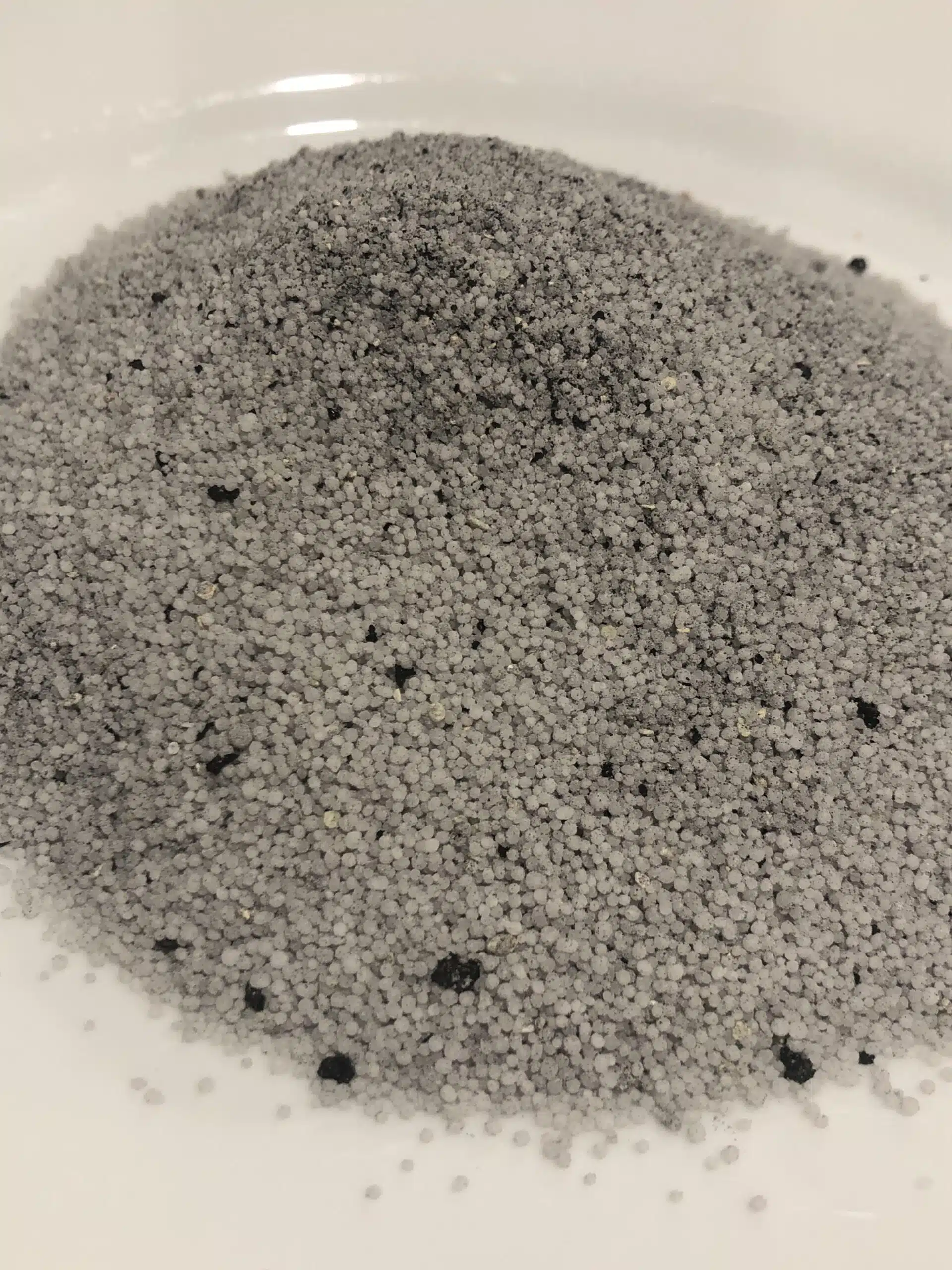
Fertilizer burn is a salt problem. Mineral fertilizers pull water out of grass tissue when they are too concentrated, as Purdue Extension explains. UMass flags soluble nitrogen above 2 lb per 1,000 sq ft as a foliar burn risk, and a concentrated nitrogen spray can scorch leaves even below that. Keep liquids safe with a few rules:
- Spray in the cool part of the day. UConn recommends morning or evening for foliar feeding; heat plus fertilizer on the leaf is what scorches.
- Water in anything nitrogen-heavy. Follow the label. Heavy Hitter calls for 1/4–1/2 inch. Iron, kelp and humic sprays can stay on the leaf for a while. We timed ours ahead of rain so they got leaf contact and were washed in within a day. See fertilizing before or after rain.
- Pull back in summer. For cool-season grass, the spoon-feeding plan cuts or drops nitrogen from June to August and switches to iron, micronutrients and humic. Brown or drought-dormant turf gets nothing.
- Go easy on iron. Stacking iron products can turn grass black, and iron sulfate stains concrete. Our roundup notes CoRoN will mark patios and vinyl fencing, so rinse hardscape right away.
- Respect the calendar. UConn’s window for Connecticut lawns is no fertilizer before April 15 or after mid-October, and the most important feeding is around Labor Day, per UMass.

Liquid doesn’t get a pass on phosphorus and runoff rules.
In Massachusetts, a lawn fertilizer with more than 0.67% available phosphate counts as a phosphorus-containing fertilizer, whether it is in a bag or a jug. A liquid like 18-3-6 qualifies. Under the state plant nutrient rules, you can apply it only when a soil test from the last three years shows a need, or when you are establishing, patching or renovating turf. Connecticut has a similar soil-test rule for established lawns. On an established New England lawn, choose a 0-phosphorus liquid unless your soil test says otherwise.
Spraying doesn’t exempt you from the setbacks either. In Massachusetts, stay 20 feet from surface water when broadcasting, or 10 feet with a targeted spray or drop spreader, and 100 feet from public drinking-water reservoirs. 330 CMR 31.05 also bans applications to frozen, snow-covered or saturated soil, and any overspray that lands on a driveway or walk has to be cleaned up completely. If a hose-end sprayer drifts onto the street, that is runoff.
Liquid lawn fertilizer FAQs
Is liquid fertilizer better than granular?
Not overall. Liquid is faster and more precise, while granular, especially slow-release, is cheaper per pound of nitrogen and lasts longer. Most cool-season programs use granular for the main spring and fall feedings and liquid for spoon-feeds, iron and biostimulants in between.
How often should I apply liquid fertilizer?
At spoon-feed rates of 0.1–0.5 lb N per 1,000 sq ft, every 1–2 weeks in the growing season. At label rates, follow the product interval. Heavy Hitter, for example, is every 4 weeks.
Can liquid fertilizer burn my lawn?
Yes, if the mix is too strong or you spray in heat. Keep any single pass at or under 1 lb of soluble N per 1,000 sq ft (UConn), spray in the morning or evening, and water in nitrogen-heavy products as the label directs.
Is a hose-end sprayer accurate enough?
For kelp, humic acid and ready-to-spray jugs, yes. For measured nitrogen, a calibrated backpack sprayer is far more consistent, because hose-end output changes with water pressure and walking speed.
Should I water in liquid fertilizer?
Water in nitrogen and potassium products per the label. Heavy Hitter calls for 1/4–1/2 inch. Iron and micronutrient sprays are meant to be absorbed partly through the leaf, so let them dry first.
Do I need chelated iron in a liquid?
Not for a foliar spray. Chelates protect iron in high-pH soil. Sprayed on the leaf, plain iron sulfate works and costs less. See our chelated iron guide.
Related guides
Sources: UMass: Understanding a Turf Fertilizer Label · UMass Turf BMPs: Soil & Nutrient Management · UConn: Suggested Fertilizer Practices for Lawns · UConn: Foliar Fertilization · Penn State: How to Calibrate a Backpack Sprayer · Pennsylvania Dept. of Agriculture: Fertilizer Rules for Homeowners · Mass. Plant Nutrient Regulations Fact Sheet · 330 CMR 31.05 · Purdue: Fertilizer Application, Don’t Get Burned
