
Lawn care · Fertilizer
Slow-release is a number on the label, not a promise on the bag
Slow-release lawn fertilizer holds part of its nitrogen in a form grass can’t use right away, such as coated urea, methylene urea or organic matter, and lets it out over weeks to months. To check a bag, divide the water-insoluble or coated nitrogen by total nitrogen. UMass wants at least 25% slow-release for cool-season lawns in spring and fall, and 50% or more in summer.
SPRING & FALL
25%+ slow-release N
SUMMER
50%+ slow-release N (75% preferred)
YEARLY N (KBG, TTTF, PRG)
2–4 lb per 1,000 sq ft
MILORGANITE
58% slow-release (3.5 of 6% N)
“Slow release” is printed on bags that are 100% slow-release and on bags that are mostly quick-release urea with a light coating on a few prills. The difference shows up in how long the color lasts, how easily the product burns, and how much nitrogen leaves your yard in the next heavy rain. This guide explains what makes nitrogen slow, how to read the percentage off any label, and how to time it on a Northeast cool-season lawn. For the overall feeding calendar, see when to fertilize your lawn.
What makes nitrogen slow-release
Every slow-release source holds nitrogen back in one of two ways: a physical coating, or a chemical or organic form that soil microbes have to break down. Penn State Extension describes how each one behaves, and the trigger matters, because it decides when your lawn actually gets fed.
| Type | How it releases | What speeds it up or slows it down | Where you’ll see it |
|---|---|---|---|
| Polymer-coated urea (PCU) | Nitrogen moves out through a plastic coating. | Temperature and moisture; thicker coatings release more slowly. | Premium granular blends; listed as coated urea on the label |
| Sulfur-coated urea (SCU) | Water cracks the sulfur shell and the urea dissolves. | Soil moisture; cracked or chipped prills release fast. | Value blends; adds sulfur too |
| Methylene urea / ureaform | Microbes break down long urea chains. | Warm, moist soil speeds it up; cold soil stalls it. | Shows up as water-insoluble N (WIN) |
| Natural organics | Microbes decompose biosolids, feather meal or soybean meal. | Entirely temperature and moisture dependent. | Milorganite 6-4-0, Jonathan Green Organic 10-0-1, Bio-Nite in Yard Mastery blends |
| Stabilized urea (not slow-release) | Urea is fully soluble; an additive like NBPT just slows nitrogen loss to the air. | Still a quick-release feed. | The Andersons 24-0-8 (with NBPT), per our roundup; also see urea vs ammonium sulfate |
Why this matters in New England: microbe-driven sources (methylene urea and organics like Milorganite) release slowly in cold April soil and speed up as it warms. If you want fast color in early spring or late fall, a microbe-dependent product will lag. A coated urea or a partly quick-release blend will respond sooner.
How to read the slow-release percentage on a label
- Find total nitrogen, the first number in the N-P-K ratio.
- In the guaranteed analysis, find the slow part: water-insoluble nitrogen (WIN), “slowly available” nitrogen, or a line for coated or methylene urea.
- Divide the slow part by total N. UMass uses the example of 9% WIN in an 18% product: 9 ÷ 18 = 50% slow-release.
- Compare that result with the season. You need 25% or more in spring and fall and 50% or more in summer, per UMass turf BMPs. UConn notes that products with at least 40% WIN feed steadily and leach less.
| Product (LawnPhix-reviewed) | N-P-K | Slow-release share | Where we got it |
|---|---|---|---|
| Milorganite | 6-4-0 | About 58% (3.5% WIN of 6% N) | Milorganite spec sheet; Ironite vs Milorganite |
| Carbon Phix | 21-0-12 | 60% | Carbon Phix / roundup |
| Yard Mastery Flagship | 24-0-6 | 25% | Yard Mastery products |
| Yard Mastery Freedom | 17-7-6 | 25% per label | Freedom 17-7-6 |
| Yard Mastery Stress Blend | 7-0-20 | 100% | Yard Mastery products |
When to use slow-release vs quick-release
SLOW-RELEASE
Summer feeding
UMass wants 50% or more slow-release (75% preferred) during summer stress. Our roundup calls Milorganite non-burning, and we use half rates of it in July for clients who want to feed.
SLOW-RELEASE
Busy schedules and sandy soil
Fewer, longer-lasting feedings. Sources that release slowly also lose less nitrogen to leaching, per UConn. That matters near wells and ponds.
SLOW-RELEASE
Fall pre-stress conditioning
UMass sets a minimum of 50% slow-release for the fall feeding that prepares turf for the next summer.
QUICK-RELEASE
New seed and repairs
Seedlings need nutrients right away. A starter fertilizer like Yard Mastery 12-12-12 uses quick ammonium sulfate plus phosphorus, which Massachusetts allows when you are establishing turf.
QUICK-RELEASE
Cold-soil color
Early spring and late fall, when microbes are slow. Small quick doses or a liquid fertilizer respond faster than organics.
Rates and timing for cool-season lawns
Target 2–4 lb of nitrogen per 1,000 sq ft per year for Kentucky bluegrass, perennial ryegrass and tall fescue, and 0–2 lb for fine fescue (UMass). If you leave clippings on the lawn, UConn says about 2 lb a year is usually enough. Split that total across these windows:
| Window | Example feeding (LawnPhix pages) | Slow-release share | Notes |
|---|---|---|---|
| Late spring (May) | Yard Mastery Flagship 24-0-6 at 3 lb per 1,000 sq ft, about 0.72 lb N | 25%+ | UConn names May and early September as the ideal times. In Connecticut, nothing before April 15. |
| Summer (irrigated lawns only) | Half-rate Milorganite, about 0.38 lb N | 50–75%+ | Never on brown or drought-dormant turf. |
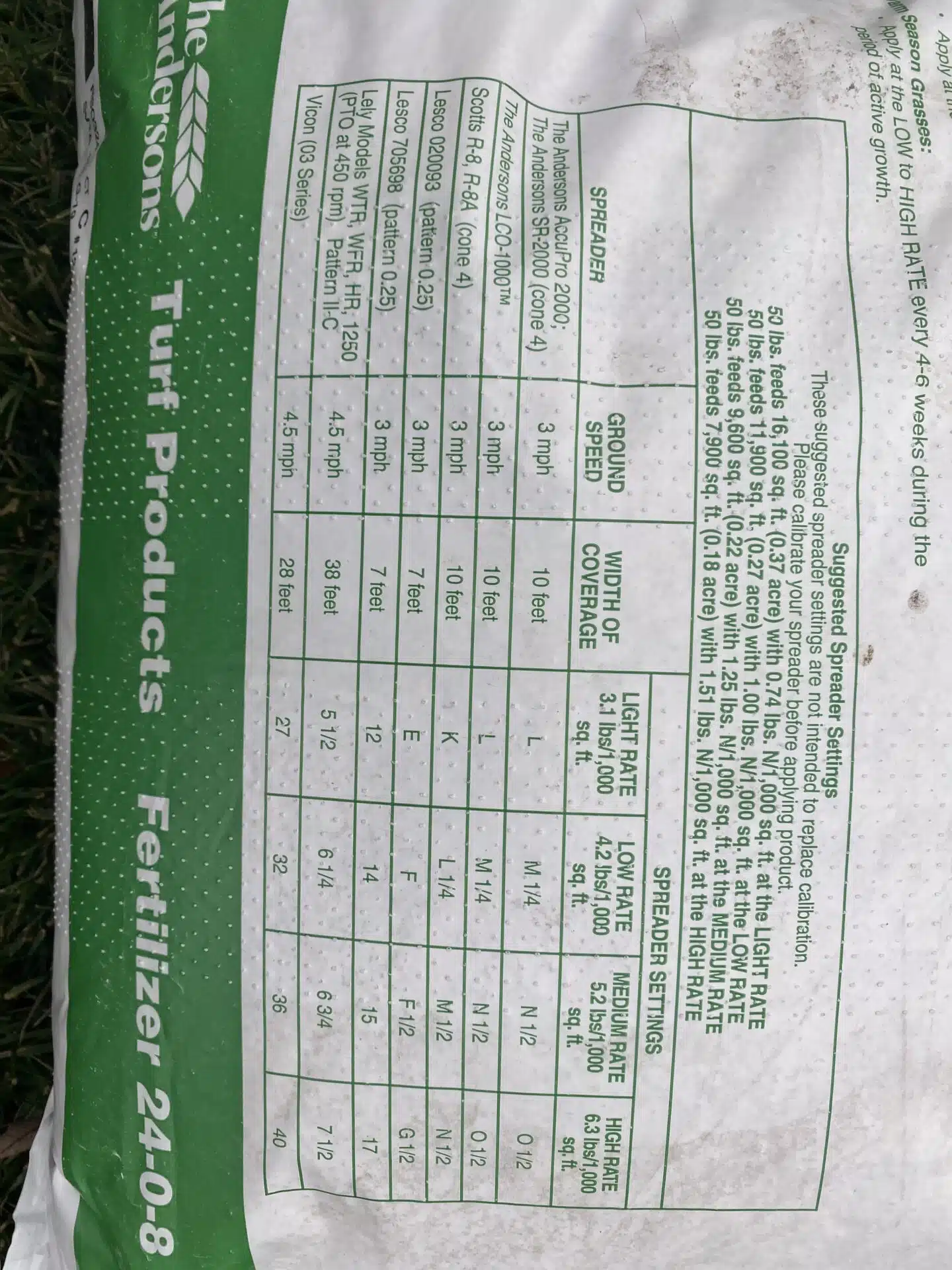
| Labor Day | The Andersons 24-0-8 at 3.1 lb, about 0.75 lb N | 25%+ | The most important cool-season feeding, per UMass. See fall fertilizer timing. |
| Late fall | Label rate, at most 1 lb soluble N | Lower share is fine | UMass times it after the last mowing, while turf is still green. Connecticut ends at mid-October, and New Jersey homeowners stop November 15. |
Per-application caps keep any single feeding in check. UConn’s rule is never more than 1 lb of water-soluble N per 1,000 sq ft at once; slow-release products can go higher if the label allows. Pennsylvania law limits homeowners to 0.7 lb of plant-available N and 0.9 lb of total N per 1,000 sq ft per application, unless the product is an enhanced-efficiency (slow-release) fertilizer. New Jersey requires every turf fertilizer to contain at least 20% slow-release nitrogen.
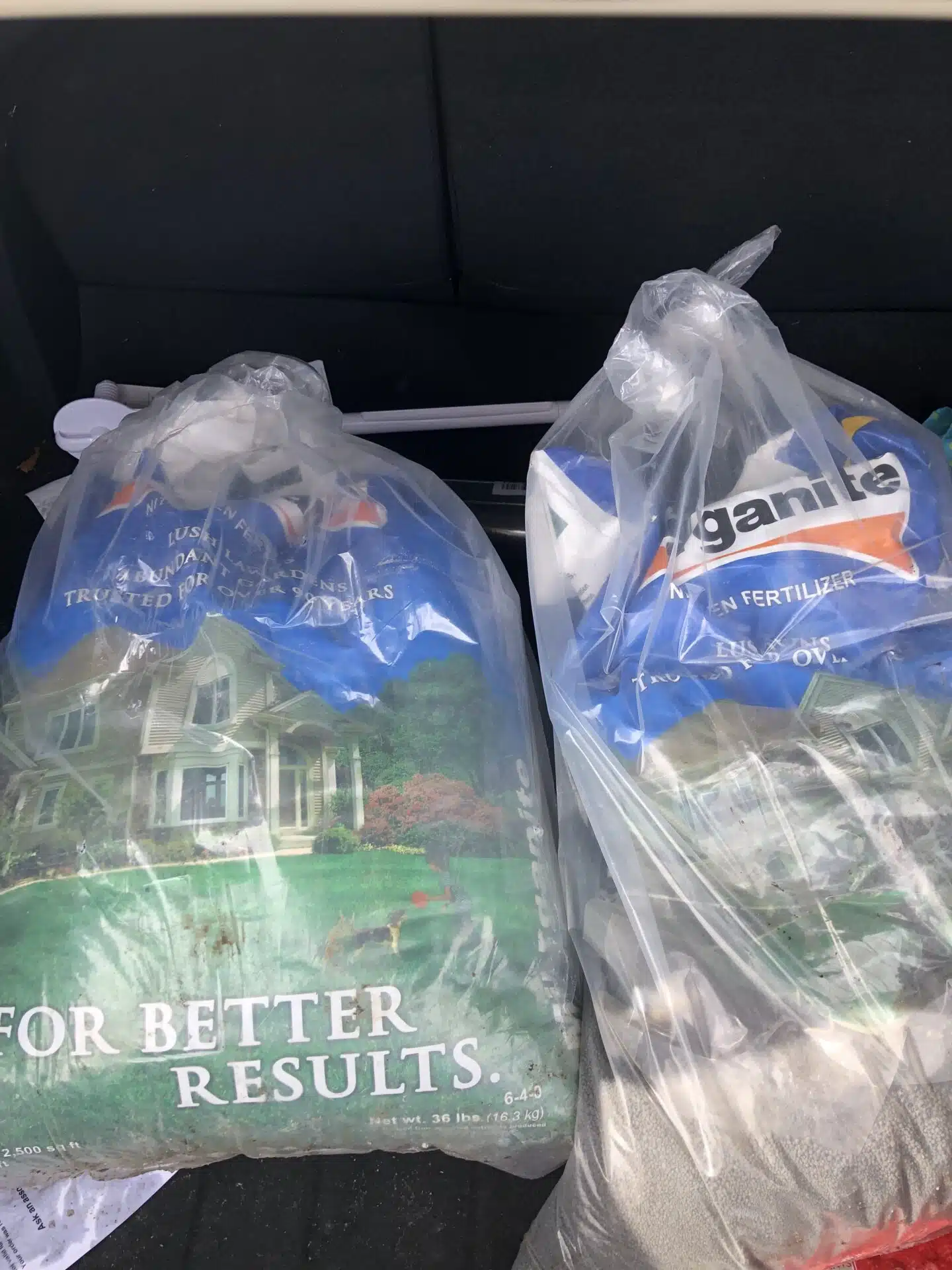
Do the math before you fill the hopper. A 32 lb bag of Milorganite has 1.92 lb of nitrogen (32 × 6%). Over its 2,500 sq ft coverage, that is 0.77 lb N per 1,000 sq ft. The lawn fertilizer calculator and nitrogen calculator work this out for any bag, and the lawn size calculator gives you the square footage. Set your spreader from the bag, then check the coverage against what you actually spread. Our spreader reviews cover the models we use.
Slow-release doesn’t make extra fertilizer safe, and organic doesn’t mean phosphorus-free.
Doubling the bag rate because “it’s slow-release” still doubles the nitrogen, and the quick-release part of most blends hits all at once. Stay inside the per-application limits above and the 2–4 lb yearly range. Don’t feed frozen, snow-covered, saturated, or dormant brown turf, all of which Massachusetts prohibits under 330 CMR 31.05. Sweep any granules off driveways and walks back onto the lawn.
Milorganite is 6-4-0, and that 4 is phosphate. Massachusetts limits phosphorus on established lawns to what a soil test from the last three years supports, and it holds organic sources like biosolids to UMass maintenance phosphorus rates (330 CMR 31.05). Connecticut has a similar soil-test rule. In the Northeast, get a soil test before making a phosphorus-bearing organic your main slow-release source. Otherwise, pick a 0-phosphorus option from our Milorganite alternatives list. Broadcast no closer than 20 feet to surface water in Massachusetts, or 10 feet with a drop spreader or deflector.
Slow-release lawn fertilizer FAQs
Is Milorganite a slow-release fertilizer?
Mostly. Of its 6% nitrogen, 3.5% is water-insoluble and slowly available, so about 58% is slow-release. It feeds for up to about 10 weeks, depending on soil temperature, because microbes do the releasing.
How long does slow-release fertilizer last?
Penn State says slow-release sources feed over several weeks to several months. Coated products depend on temperature and moisture; methylene urea and organics depend on microbes, so they run slower in cool soil.
Can slow-release fertilizer burn grass?
The slow portion rarely does, which is why we call Milorganite non-burning. The quick-release portion of a blend can still burn if you overapply it or spill it. Clean up spills and stay within the label rate.
What percent slow-release should I look for?
For cool-season lawns, at least 25% in spring and fall and at least 50% in summer, per UMass. In New Jersey, every turf product must contain at least 20%.
Is slow-release better for new grass seed?
No. New seed needs nutrients available right away, so a quick-release starter fertilizer is the better tool at seeding. Switch to slow-release once the new grass is established.
Is slow-release worth the extra cost?
Usually, for summer feedings and lawns near water. Slow-release costs more per pound of nitrogen, but you make fewer applications, risk less burn, and lose less nitrogen to leaching.
Related guides
Sources: UMass Turf BMPs: Soil & Nutrient Management · UMass: Understanding a Turf Fertilizer Label · Penn State: Turfgrass Fertilization Guide · UConn: Suggested Fertilizer Practices for Lawns · Pennsylvania Dept. of Agriculture: Fertilizer Rules for Homeowners · Rutgers NJ Water Savers: NJ Fertilizer Law · Mass. Plant Nutrient Regulations Fact Sheet · 330 CMR 31.05 · Milorganite Specifications
