
The short answer
A hornet nest low enough to treat from the ground, away from doors and paths, can be handled with a twenty-foot jet aerosol at full dark. Most aren’t. They typically build eight feet up or higher, defend a radius of several yards rather than a few feet, and pursue a retreating target — which makes a ladder the worst possible position to be in.
Nest
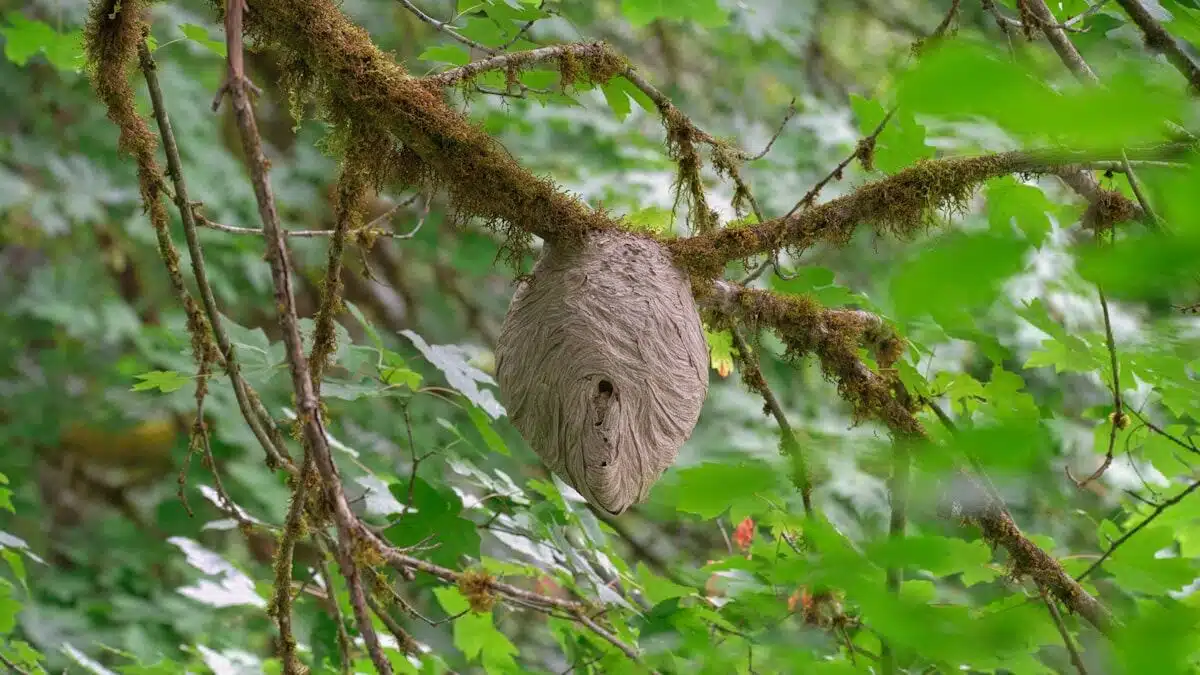
Enclosed grey football
Defence radius
Yards, not feet
They pursue
Yes, unlike paper wasps
Typical height
Eight feet or more
Is it actually hornets?
Three nests that get called the same thing.
This page
Bald-faced hornets
Enclosed grey paper football with one opening near the bottom. Black and white markings. Defends widely and pursues. Several hundred insects by late summer.
Easier
Paper wasps
Open umbrella nest with visible cells. Twenty to thirty insects, defensive only within a few feet. A much more manageable job.
Don’t
Yellow jackets
No visible nest, just traffic at a hole in ground, wall or decking. Thousands of insects, and dust rather than aerosol.
Different
European hornets
Larger, brown and yellow, nesting in hollow trees or wall cavities and active at night. Cavity nesting means the yellow jacket rules apply.
Why the pursuit changes the calculation
Paper wasps defend the nest. Bald-faced hornets defend an area, and they follow a target moving away. Your retreat matters more than your approach — and a ladder, where retreating is slow and awkward, is the wrong place to be entirely.
It’s also why aerosol range matters more here. A ten-foot can on a twelve-foot nest leaves you inside the defence radius of an alerted colony with nowhere useful to go.
The seasonal question worth asking
These are annual colonies. Everything except next year’s queens dies at the first hard frost and the nest is never reused. A nest high in a tree, away from paths and doors, discovered in September, will be gone by winter at no cost and no risk. A nest over a door or beside a play area is a different matter regardless of month.
Only if it’s low and clear
Ground level, away from paths, unobstructed retreat. If any is missing, don’t.
Confirm it’s reachable from the ground
Not from a ladder. If you’d need to climb, this stops being a homeowner job regardless of how the rest looks.
Buy a twenty-foot jet aerosol
Range matters more here than with paper wasps, because the defence radius is larger.
Plan the retreat first
Clear ground, no obstacles, nothing to trip on in the dark. They follow, so where you’re going matters.
Full dark, cool night if possible
An hour after sunset minimum. Activity drops with temperature.
Red-filtered torch
White light draws them up the beam. Cellophane over the lens solves it.
Spray the opening, then leave
Sustained into the entrance at the base. Don’t stay to watch, and don’t come back tonight.
Check from a distance after 24 hours
Traffic means a second treatment, not a closer look.
Should you attempt it?
Where this stops being a DIY job
Anything above head height. A ladder removes your retreat, and these pursue. That combination is how people get stung repeatedly rather than once.
Any nest in a cavity — a wall, a hollow tree, decking. That’s a dust job with a sealing sequence, not an aerosol one.
A known sting allergy in the household. A colony of several hundred can deliver many stings quickly. Not a cost comparison.
What a professional does differently
Equipment
Suit and distance applicator
Most of what you’re paying for on an elevated nest.
Product
Matches it to the nest type
Aerial gets aerosol, cavity gets dust. The wrong one scatters a colony.
Timing
Works after dark too
Anyone treating a hornet nest at midday is making it harder than it needs to be.
Common questions
Are hornets more dangerous than wasps?
They defend a wider area and they pursue, which makes them harder to deal with. You’re more likely to receive several stings rather than one.
Can I remove a hornet nest myself?
Only if it’s reachable from the ground, away from doors and paths, with a clear retreat. Most are eight feet up or higher, which rules it out.
Will a hornet nest be used again next year?
No. Annual colonies die at the first hard frost and the nest is never reused. One high in a tree away from everything can simply be left.
What time of day should I treat a hornet nest?
Full dark, at least an hour after sunset, on a cool night if you can choose. Use a torch with red cellophane over the lens.
Above head height, or near a door?
A low nest on clear ground with a proper retreat is attemptable with the right can and full dark. Height usually decides against it here — because unlike paper wasps, these follow you down.
Call (720) 389-2293
Calling connects you with a pest control company serving your area. We’re paid for that referral, which is how these guides stay free.