
The short answer
Yellow jackets nest in cavities — underground, in wall voids, under decking. Aerosol sprayed at an opening treats the entrance and not the colony, which then comes out. Insecticidal dust works because they carry it in on their bodies. A ground nest in open lawn, treated with dust at full dark, is sometimes a homeowner job. A nest inside a wall is never one.
Product
Dust, not aerosol
Timing
Full dark
Ground nest
Sometimes yours
Wall nest
Never
Where is the nest?
You may not see a nest at all — follow the traffic instead.
Sometimes yours
In the ground, open lawn
Steady traffic in and out of a hole in turf or a bank. Dust at full dark, from a distance, with a clear retreat. Doable with care and the right product.
Don’t
In a wall or soffit
Traffic at a gap in siding or a soffit join. Treating the entrance drives them inward, and inward is your house. This is the one that goes badly.
Don’t
Under decking or a step
Confined, no retreat, and you’re standing on their roof. The combination that produces multiple stings.
Different insect
Aerial grey football
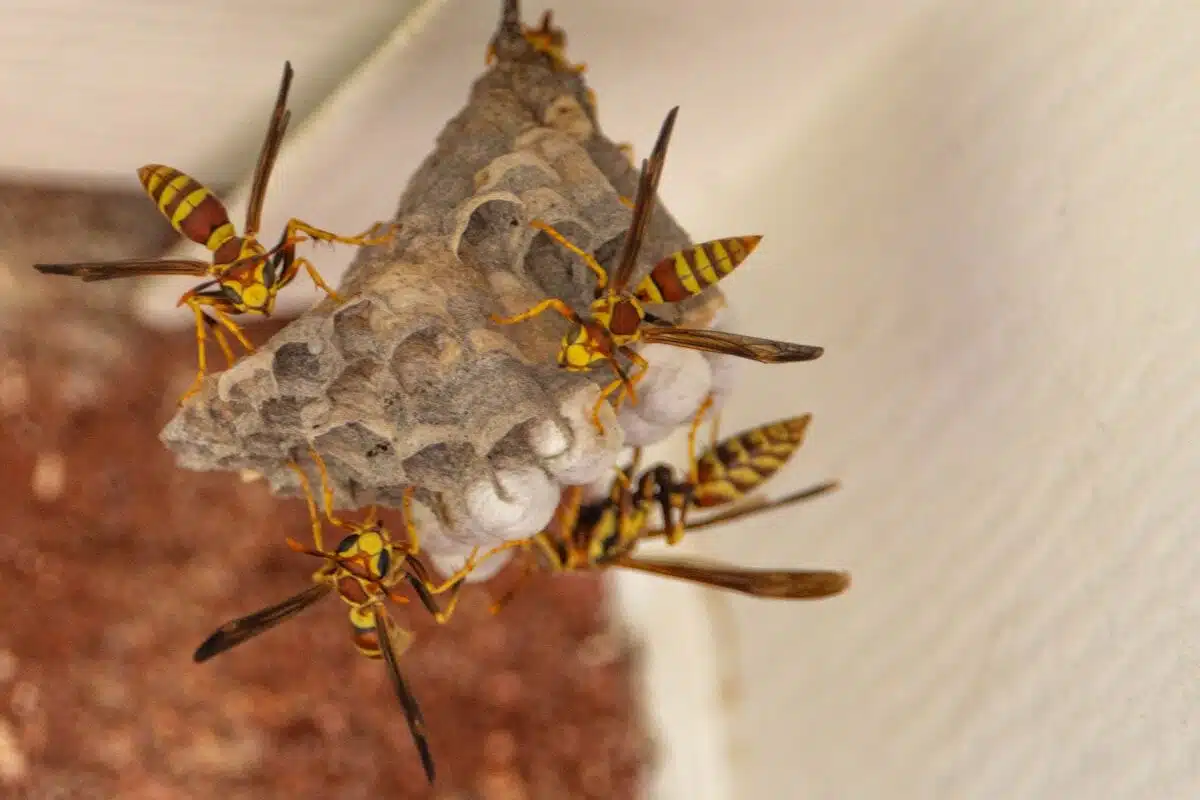
That’s bald-faced hornets, not yellow jackets. Different approach — see the wasp guide.
Why aerosol is the wrong product
A cavity nest has an entrance and then a colony somewhere behind it. Aerosol sprayed at the entrance coats the entrance. The insects inside are unaffected and the ones outside are now alerted, which is the worst possible combination.
Insecticidal dust works differently: applied at the opening, foragers walk through it and carry it into the nest on their bodies, distributing it through the colony. Slower over hours, and it reaches what you can’t.
Late summer is the dangerous window
A colony founded by one queen in spring is at maximum population by August — several thousand insects — and at its most defensive. It stays that way until the first hard frost. A nest that was unnoticeable in June is a serious proposition in September, and that’s when most incidents happen.
Ground nest, with care
Only for a nest in open lawn with a clear retreat. Not for anything in a structure.
Mark the entrance in daylight
A stake a few feet away, not at the hole. You need to find it in the dark without a torch on the opening.
Buy insecticidal dust
Not aerosol. With a puffer applicator so you can apply from a distance rather than standing over it.
Wait for full dark
An hour after sunset at minimum. Cool nights are better — activity drops with temperature.
Plan the retreat first
Know exactly where you’re walking afterwards, and make sure it’s clear ground rather than round a corner.
Puff dust at the opening and leave
Don’t block the hole. They need to walk through it and carry the dust in.
Check in daylight after 48 hours
From a distance. Traffic means it needs a second application, not a closer look.
Fill the hole once traffic stops
Not before. Blocking an active nest sends them looking for another exit.
Where the nest is decides everything
Where this stops being a DIY job
Any nest inside a wall, soffit or floor void. Treating the entrance drives them further in rather than out, and further in is your house. This needs dusting the cavity and sealing only after traffic stops — an order of operations, not a product.
Anyone in the household with a known sting allergy. A yellow jacket colony can deliver many stings quickly. This is not a cost comparison.
Any nest where you can’t retreat cleanly. Under a deck, beside a doorway, on a slope, up a ladder. The retreat matters more than the treatment.
What a professional does differently
Product
Dust for cavities
Not aerosol. Anyone spraying at a wall opening is about to make it worse.
Sequence
Seals after, never before
Traffic has to stop before a cavity closes.
Equipment
Suit and distance applicator
Which is most of what you’re paying for on a large late-season colony.
Common questions
Can I spray a yellow jacket nest?
Not effectively. They nest in cavities, so aerosol coats the entrance and leaves the colony untouched. Insecticidal dust works because they carry it inside.
How do I find a yellow jacket nest?
Follow the traffic rather than looking for a nest. Steady coming and going at a hole in the ground, a gap in siding or a soffit join marks the entrance.
Why are yellow jackets worse in late summer?
A colony founded by one queen in spring reaches maximum population by August and stays at peak defensiveness until the first hard frost.
What if the nest is in my wall?
Don’t treat the entrance yourself. It drives them inward, and inward is your house. The cavity needs dusting and sealing only after traffic stops.
In a wall, under a deck, or late in the season?
A ground nest in open lawn, dusted at full dark with a clear retreat, is genuinely doable. A cavity in a structure is the one where getting the sequence wrong puts several thousand insects in the room instead of the garden.
Call (720) 389-2293
Calling connects you with a pest control company serving your area. We’re paid for that referral, which is how these guides stay free.