
Home › Services › Wildlife Removal
Skunk Removal
Two quite different skunk problems get treated as one. Digging in the lawn is a food problem you can often solve without touching the animal. Denning under a structure isn’t.
Advertising disclosure: calls are routed to an independent local provider. We’re paid a referral fee for the call. You pay the provider, never us.
The short answer
Small cone-shaped pits about 3–5 inches across, appearing in a lawn overnight, are a skunk hunting grubs and other insects (UC IPM). It takes far fewer grubs to draw a skunk than to hurt the grass, so count them before you buy anything. Denning under a deck, shed or porch is a different problem: that’s shelter rather than food, and it needs exclusion done in the right season and the right order.
Lawn pits
3–5 in cones — grubs
Enough to draw skunks
4–5 grubs per sq ft
Kits
Litters of 4–6
Spray range
Up to 6–10 ft
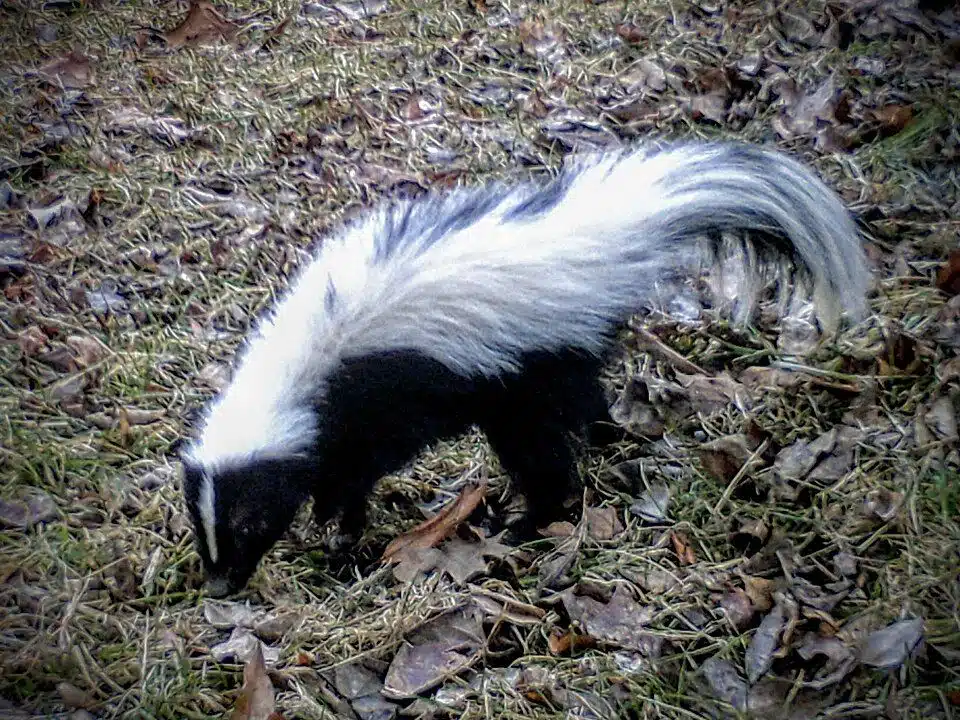
Digging or denning?
Two problems, two answers, and one of them you can usually solve yourself.
Solve the cause
Cone pits in the lawn
Small conical holes 3–5 inches across, appearing overnight in open turf. Skunks eat insects, grubs and earthworms along with fallen fruit, pet food and garbage (UC IPM). Deal with the grubs and the reason for the visits goes.
Needs exclusion
Under a deck or shed
A dug entry against a foundation, skirting pushed aside, or a strong smell near ground level. In towns, skunks den under decks, porches, sheds and buildings, in old burrows or ones they dig (UC IPM). Shelter rather than food, and it doesn’t resolve on its own.
Different animal
Damage up high
Torn soffit or a roofline entry points to a climber, usually a raccoon job. For other lawn diggers, see armadillo removal.
Also grubs
Sod rolled back
Skunks sometimes roll back sections of sod too (UC IPM), as raccoons do. Either way, the cause underneath is the same and so is the grub count.
The grub connection, with numbers
Skunks and raccoons dig lawns for what’s under the turf rather than the turf itself. Here’s the number nobody mentions: UMass Extension notes that skunks can cause damage with just 4 or 5 grubs per square foot, while an irrigated lawn mowed high with light traffic may tolerate 25–30 before the grass itself suffers. So a lawn that looks healthy can still have enough grubs to keep a skunk coming back.
UMass’s sampling method: cut three sides of a 6-inch square (a quarter of a square foot), 4–6 inches deep, flip the sod back, break up the soil and roots with a trowel and count the C-shaped larvae. Replace the sod and water it. Multiply by four for a per-square-foot figure. One or two grubs in a single 6-inch sample puts you at or above the level skunks respond to. Turf thresholds depend on the beetle: UMass lists 8–15 per square foot for Japanese beetle grubs but 2–4 for May beetle grubs, so get the grub identified if you’re treating for the lawn’s sake.
Why they rarely spray
Skunks give a clear sequence of warnings first: they stamp their front feet rapidly, hiss, and arch the tail over the back (UC IPM). They can spray as far as 6–10 feet, and UC IPM notes one may not react to a person more than 10 feet away who stays quiet and still. At the stamping stage, stop, keep quiet, then move off slowly.
If a pet does get sprayed, UC IPM’s mix is 1 quart of 3% hydrogen peroxide, 1/4 cup of baking soda and 1 teaspoon of liquid soap, made fresh and never stored, because it gives off oxygen. Keep it out of the eyes, rinse the animal thoroughly, and dilute any leftover before it goes down the drain.
Dealing with the digging, and closing dens (the DIY method)
Ground-level work, and it addresses the actual cause.
Count the grubs
Take several 6-inch samples in and around the damaged areas, as above. A count that works out to 4 or more per square foot confirms the diagnosis before you spend anything.
Treat at the right time
Some grub products are preventive and some curative, and they don’t swap (UMass Extension). Our guide to when to apply grub control covers the timing.
Remove other food
Pet food, fallen fruit, berries and unsecured garbage, all on UC IPM’s list of what skunks eat.
Skip the repellents
UC IPM rates commercial skunk repellents “not very effective.” An ammonia-soaked rag has some reported success, but strong-smelling repellents don’t belong under a building people live in. A floodlight aimed at a den entry can help move a skunk on.
Close off den sites
Cover openings under decks, porches and sheds with 1/4-inch hardware cloth, buried at least 6 inches where there’s soil (UC IPM). The same mesh keeps out rats and mice. Before sealing, lay flour 1/8 inch thick at the entrance and check for prints soon after dark.
Use a one-way door, not in kit season
A flap of 1/2-inch hardware cloth hinged at the top, loose on three sides and bigger than the hole, lets a skunk out but not back (UC IPM). Kits too young to walk can’t use it, so don’t fit one from April through August (our estimate from the breeding dates, below).
Which problem is it?
Striped skunks breed mainly in February and March, carry for about 9 weeks and have 4–6 kits, which start following their mother on nightly rounds at about 2–3 months (UC IPM). UC IPM gives no birth or travel dates, so this window is our own arithmetic: February–March breeding plus about 9 weeks puts births around early April to early June, and 2–3 months after that puts kits trailing their mother from about early June to early September. So assume a den may hold young that can’t walk out on their own from April through August. In cold regions skunks may also share communal dens in winter.
Trapping and moving them: rules vary by state
Example: California. Skunks are nongame mammals there, and an owner or tenant may remove one that’s causing damage or a threat, by legal means. Relocating one needs written permission from the California Department of Fish and Wildlife, which UC IPM calls unlikely because of rabies. It also advises that inexperienced people hire help, that enclosed plastic box traps cut the spray risk compared with wire cages, and that drowning is neither acceptable nor legal.
Example: Connecticut. Relocating skunks, raccoons and foxes is prohibited outright. Homeowners can’t trap outside regulated seasons unless the animal is actively damaging property or an obvious health threat, and the state’s first recommendation is eviction with harassment or one-way doors, then animal-proofing (Connecticut DEEP). Check your own state wildlife agency before setting any trap.
Where this stops being a DIY job
Denning under a structure from April through August. Kits too young to walk can’t follow the mother out or use a one-way door, and UC IPM notes they may need to be removed by other means. Sealing at that point kills them where you can’t reach them.
A den under a slab, foundation or occupied living space rather than a deck. The question becomes structural, and strong repellents can’t be used there.
Flour shows prints night after night, or the skunk has to be trapped. If a one-way door hasn’t worked or your state limits homeowner trapping, the remaining options need someone who can legally trap and dispose of the animal.
A grub count under 4 per square foot and the digging continues. Grubs aren’t the draw, and the attraction is somewhere else on the property.
Any bite or scratch
Skunks are among the animals most often found with rabies in the US (CDC). Wash the wound right away with soap and water and get medical care urgently; UC IPM also says to notify your local health department. Once rabies symptoms appear the disease is nearly always fatal, and treatment given promptly after exposure is nearly 100% effective (CDC). This is a doctor or the health department, never a wildlife company and never any number on this page. Keep dogs and cats vaccinated.
What a competent operator does
Diagnoses
Checks for grubs first
Because lawn digging often has a lawn-care answer rather than a wildlife one.
Seasons
Asks about kits
Spring exclusion without checking is the mistake that can’t be undone. Ask where a trapped skunk goes, and whether that’s legal in your state.
Excludes
Buries the wire
1/4-inch hardware cloth at least 6 inches into the soil, or they dig straight under it.
What it costs. The provider prices the work for your property before you agree. Before you hire, see vetting a contractor.
Common questions
Why is a skunk digging up my lawn?
Grubs and other insects. Cone-shaped pits 3–5 inches across are a skunk foraging (UC IPM), and as few as 4 or 5 grubs per square foot can be enough to draw one (UMass Extension).
How do I keep skunks out from under my deck?
Cover the openings with 1/4-inch hardware cloth buried at least 6 inches. Confirm the skunk is out first with a flour test or a one-way door, and don’t do it while there may be kits.
Will a skunk spray me?
Rarely without warning. They stamp their front feet, hiss, then arch the tail. They can spray 6–10 feet, so stay quiet, keep more than 10 feet away and move off slowly.
Are skunks dangerous?
They’re a rabies vector, so any bite or scratch means soap and water, then urgent medical care. Be very cautious of a skunk that seems tame, listless or is wandering in daylight. Otherwise they’re avoidant and give clear warnings.
Can I trap a skunk and release it somewhere else?
Usually not. It varies by state: California requires written permission from its wildlife department, which is unlikely to be given, and Connecticut prohibits relocating skunks (Connecticut DEEP).
Under the deck, or spring with young?
Counting the grubs and treating them properly solves most of the digging, and that’s genuinely yours. Denning under a structure — especially in kit season — is where the sequence and your state’s rules matter more than the method.
Call (484) 878-3487
Related
Sources: UC IPM Pest Notes: Skunks · UMass Extension, Turf BMPs: Insect management · CDC: About rabies · Connecticut DEEP, Common wildlife conflicts