
Lawn Care · Grass Types
Tall fescue is the most drought-resistant grass for a Northeast lawn
Turf-type tall fescue stays green longest in a dry spell because its roots go deepest. Fine fescues get by on the least water and fertilizer. Kentucky bluegrass browns out sooner, then recovers from dormancy when rain returns. Bermuda, zoysia and buffalograss are tougher still, but they are warm-season grasses for the South and Plains, not New England.

DEEPEST ROOTS
Tall fescue (UMass: very deep)
NO WATER FOR 2–4 WEEKS
Lawn turns straw-colored
DORMANT-LAWN WATERING
≤½ inch every 3–4 weeks
MOW COOL-SEASON GRASS
3–4 inches
“Drought tolerant” on a seed bag can mean three different things, and picking the right grass depends on which one you need. This page ranks the cool-season grasses you can actually grow in New England, explains what each one does when the rain stops, and says what not to do while the lawn is brown. For general grass-type background, see our guide to choosing grass seed.
Drought tolerance vs drought avoidance vs dormancy
Turf scientists split “drought resistance” into separate strategies (UMass Extension; UMass Hort Notes 2026):
AVOIDANCE
Stays green longer
The grass delays drying out, mainly by rooting deeper and losing water more slowly, so it keeps growing (slowly) through a dry spell. Tall fescue is the textbook avoider.
TOLERANCE
Survives being dry
The plant browns sooner but has the physiology to ride out a long stretch without water and come back. UMass calls the fine fescues good “tolerators”.
DORMANCY
Shuts down to protect the crown
Growth stops, leaves and roots die back, and the lawn goes straw-colored while the crown stays alive. Kentucky bluegrass is known for going dormant and recovering once it cools and rains.
If you want a lawn that stays green without a sprinkler, you want an avoider: tall fescue. If you are fine with a brown July as long as the lawn comes back, a bluegrass or fine fescue lawn that goes dormant is a legitimate, water-saving choice.
Cool-season grasses ranked for drought
Rooting depth and avoidance ratings come from UMass Extension’s 2026 turf dormancy article. Drought behavior and fertility needs come from Penn State Extension and UMass turfgrass selection.
| Grass | Roots / avoidance | In a drought, and the trade-off |
|---|---|---|
| Turf-type tall fescue | Very deep roots; high to very high avoidance | Penn State calls it the most heat- and drought-tolerant cool-season grass. It stays green longest between rains. Trade-off: Bunch grass that will not fill bare spots; prone to brown patch and Pythium (UMass). |
| Perennial ryegrass | Intermediate to deep roots; medium-high avoidance | Only moderately drought tolerant (Penn State). Trade-off: Poor shade tolerance; no rhizomes, so thin areas stay thin. |
| Kentucky bluegrass | Shallow to intermediate roots; medium avoidance | Goes semi-dormant in hot, dry weather and recovers quickly once it cools (Penn State). Rhizomes rebuild thin areas. Trade-off: Needs more nitrogen (Penn State: 2–4 lb N per 1,000 sq ft a year) and poor in shade. |
| Fine fescues | Intermediate roots; medium avoidance | Brown early but tolerate droughty, infertile soil and recover (UMass, Penn State). Trade-off: Poor traffic tolerance. Best for low-input and dry shade. |
| Rough bluegrass (Poa trivialis) | Very shallow roots; very low avoidance | Declines in hot, dry months (Penn State). Trade-off: A shade-and-wet grass. Keep it out of seed for dry sites. |

First-hand: in our Black Beauty Heavy Traffic review, a tall fescue and ryegrass blend mowed at 3 inches in cool weather and up to 4 inches in summer rarely needed watering, even in the full-sun parts of the yard. That is tall fescue’s deep rooting at work. We also saw the downside in our GCI tall fescue test: more fungus in a wet season.
Which drought-tolerant grass to plant
SUNNY, NO IRRIGATION
Turf-type tall fescue blend
The best pick if you want green through a dry August without running a sprinkler. Buy a blend of named cultivars; our cool-season grass seed buying guide covers how to read the label.
DRY SHADE OR LOW UPKEEP
Fine fescue mix
Lives on little water and 1–2 lb of nitrogen a year (UMass). It will brown in a long drought and come back, but it will not take daily foot traffic. See best grass for shade.
IRRIGATED, OR OK WITH A BROWN SPELL
Kentucky bluegrass mix
Uses water at a medium rate and goes dormant when it runs short. It comes back from rhizomes and self-repairs well, so a short summer dormancy is not a disaster.
What about Bermuda, zoysia and buffalograss?
These warm-season grasses handle heat and drought better than any cool-season grass, but they are a poor fit for most of New England. Penn State says zoysia suits only southern Pennsylvania and stays brown from fall until late spring or early summer (Penn State). Buffalograss is native to the western and central Great Plains and does best in low-rainfall, full-sun sites (buffalo grass lawn guide). Bermuda is heat-loving and drought tolerant, and it is also hard to get rid of once it spreads into lawns and garden beds. If you live in the transition zone or South, start with zoysia grass care or how to get Bermuda grass to spread.
How to make any lawn more drought-resistant
- Water deep and less often. Most turf needs 1–1.5 inches a week, rain included (UMass). Water early in the morning (best time to water grass), and avoid light daily sprinkling, which keeps roots shallow (overwatering).
- Mow high. Oklahoma State recommends 3–4 inches for cool-season grass and taking no more than a third of the blade at once (OSU HLA-6476; the one-third rule).
- Go easy on nitrogen before summer. OSU says to keep quick-release nitrogen to 1 lb N per 1,000 sq ft or less before and during hot, dry periods, because extra top growth comes at the roots’ expense.
- Fix compaction in fall. Core aeration lets roots go deeper; for cool-season lawns OSU puts it in early to mid autumn (core aeration and overseeding).
- Watch for early wilt. Folded leaves, a blue-gray cast and footprints that stay pressed down are the first signs, per OSU (why grass turns blue). Treatments for a stressed lawn are in drought stress lawn.
Dormant or dead? Pick a lane
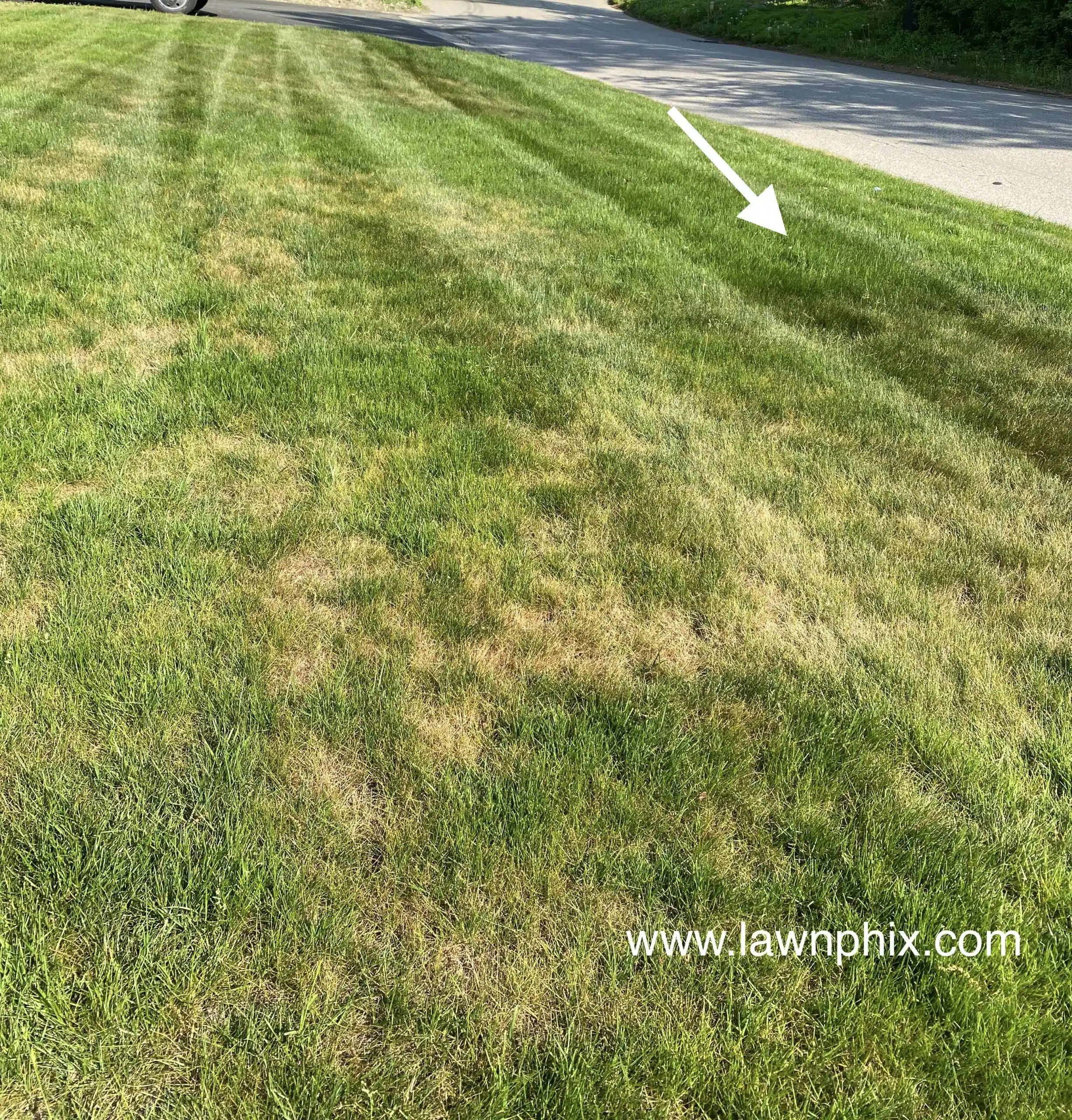
Without rain or irrigation, cool-season turf turns straw-colored in 2–4 weeks (UMass). Most of it comes back. But UMass also warns that after 45–60 or more days with little rain, you should expect only about 70% recovery, and full green-up can take two weeks or more after the rain returns.
The mistake is half-watering: running the sprinkler just enough to green the lawn up, then stopping. UMass Hort Notes says that cycling drains the plant’s reserves. Either keep watering fully, or let the lawn go dormant and give it a survival drink of no more than ½ inch every 3–4 weeks to keep crowns hydrated without waking the grass up (UMass Hort Notes 2026). Purdue gives a similar ¼–½ inch every four weeks (Purdue Turfgrass).
Stop: don’t feed, spray, seed or mow a drought-dormant lawn.
Fertilizer: Massachusetts law prohibits putting nutrients on drought-dormant or otherwise brown turf (UMass Hort Notes). Purdue adds that drought-stressed grass will not take up nitrogen until rain returns.
Weed killers: Purdue notes herbicides do not work well on drought-stressed weeds and can injure drought-stressed turf (Purdue). Our drought stress guide also says to hold off once temperatures pass 80°F. Skip pre-emergents while the lawn is recovering, too; OSU notes they restrict rooting.
Seed: Do not seed into dry, dormant turf. Wait for rain and the fall window (about the third week of August to the third week of September in Massachusetts, per UMass), then overseed whatever did not come back.
Traffic and mowing: Keep feet, mowers and equipment off as much as you can, because crushed crowns are what kills dormant grass. As UMass puts it, if it isn’t growing, you shouldn’t be mowing.
Drought-tolerant grass FAQs
What is the most drought-tolerant grass for New England?
Turf-type tall fescue. It roots deepest of the cool-season grasses and stays green longest between rains. Fine fescues are the low-input alternative if you can accept some summer browning.
Is Kentucky bluegrass drought tolerant?
It has decent drought tolerance by going dormant rather than staying green. Its shallower roots mean it browns sooner than tall fescue, but it recovers quickly when weather cools and rhizomes fill thin spots.
Will my brown lawn come back?
Usually, if the crowns survived. Most lawns come back from a few weeks of dormancy, but UMass expects only about 70% recovery after 45–60+ dry days. Overseed what stays bare in late summer.
Should I water a dormant lawn?
Either water it fully or not at all. If you let it go dormant, a survival soak of no more than half an inch every 3–4 weeks keeps the crowns alive without forcing a green-up.
Can I grow Bermuda or zoysia in Massachusetts?
Not well. Both are warm-season grasses that go brown for most of a New England year. They make sense in the transition zone and further south.
Related guides
Sources: UMass Hort Notes 2026 Vol. 37:4, All About Turf Dormancy · UMass Extension: Management Tips to Improve Turfgrass Drought Survival · UMass Extension: Turf Irrigation and Water Conservation · UMass Extension: Turfgrass Selection · UMass Extension: Establishment, Renovation & Repair · Penn State Extension: Turfgrass Species for Pennsylvania · Purdue Turfgrass Science: Dealing with Drought · Oklahoma State HLA-6476: Preparing Your Lawn for Drought
