
Lawn Care · Grassy Weeds
Look at the center: goosegrass is silvery-white and flat, crabgrass is not.
Goosegrass and crabgrass are both summer annual grass weeds, but goosegrass is darker green, grows as a tight flat rosette with a whitish, flattened center, folds its new leaves instead of rolling them, never roots at the stem joints, and carries zipper-like seed spikes. It also sprouts two to four weeks after crabgrass and favors compacted, high-traffic soil. That matters for control: a spring pre-emergent timed only for crabgrass can run out before goosegrass finishes germinating, and quinclorac, a go-to crabgrass killer, does not control goosegrass.
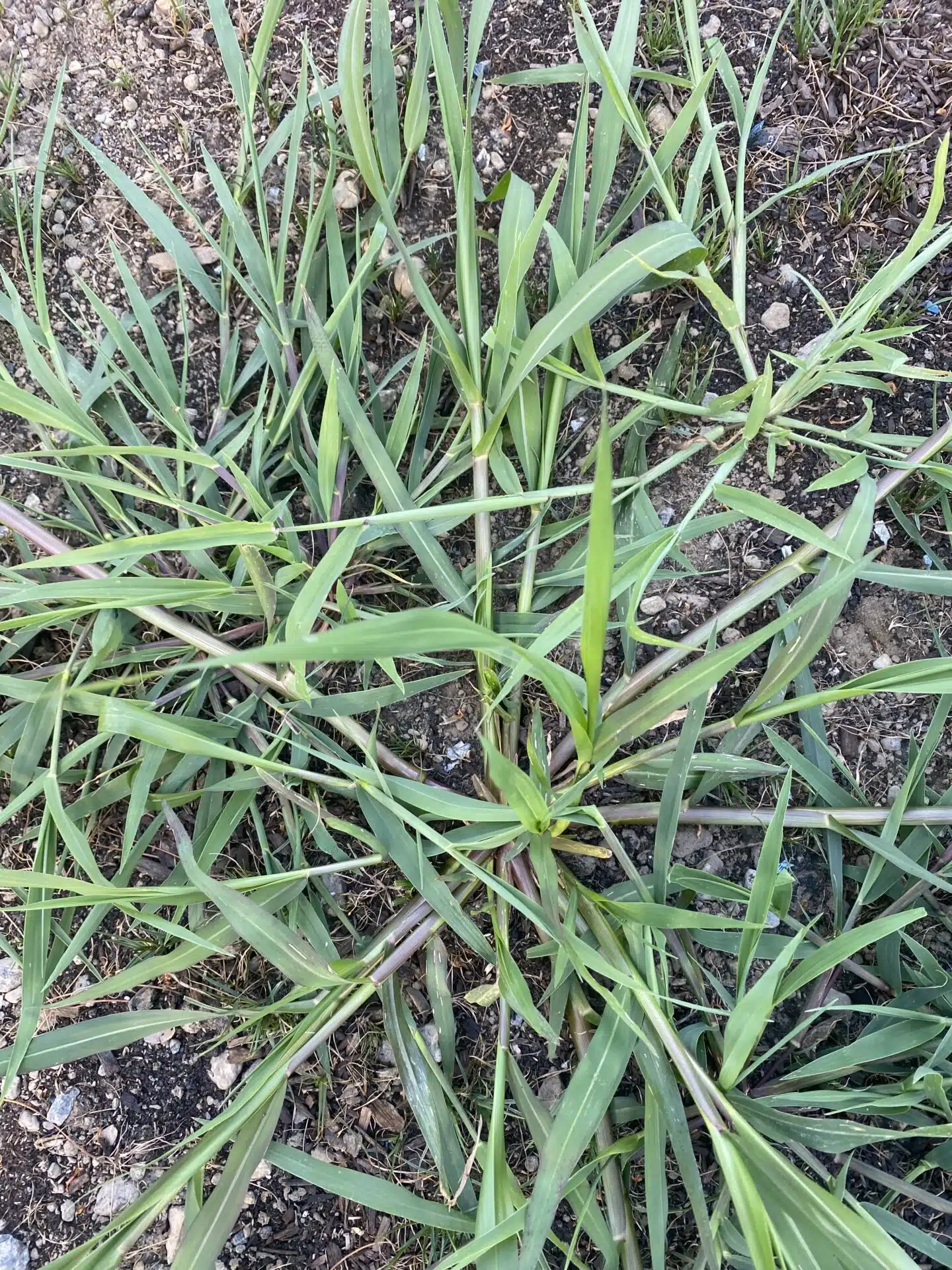
FASTEST TELL
Whitish, flattened center on goosegrass
GOOSEGRASS EMERGES
2–4 weeks after crabgrass
GERMINATION SOIL TEMP
60–65°F goosegrass, 53–58°F crabgrass
QUINCLORAC ON GOOSEGRASS
No control (Purdue)
Goosegrass vs crabgrass: side-by-side identification
Goosegrass (Eleusine indica) looks enough like crabgrass (Digitaria species) that Purdue and Kansas State both note its other common name, “silver crabgrass.” Pull up a suspect plant, look straight down at the crown, and check a leaf where it meets the stem. The traits below come from the extension pages linked in each row.
| Trait | Goosegrass | Crabgrass |
|---|---|---|
| Color | Medium to dark green blades (Penn State) | Yellowish-green, standing out against darker cool-season turf (UMass) |
| Center of the plant | Flattened stem bases that turn white or silver; a wagon-wheel look from above (NC State) | Round green stems with swollen nodes (Purdue PPDL); sheaths often purple-veined on large crabgrass |
| New leaf in the bud | Folded | Rolled (Purdue) |
| Ligule | Short membrane, about 0.6–1 mm, hairy on the back and sometimes fringed with short hairs | Taller membrane, about 1–3 mm, toothed or wavy (NC State) |
| Growth habit | Tight, flat rosette from one growing point; does not root at the nodes | Sprawling stems that can root at the lower nodes, so one plant keeps widening (NC State) |
| Seedhead | 2–7 thick spikes from one point, each with two rows of seeds that look like a zipper; July to September | Thin, finger-like spikes; on large crabgrass they arise from different points near the top of the stalk |
| Germination | Soil at 60–65°F; at least two weeks after crabgrass (NC State), 3–4 weeks after in Pennsylvania | Soil at 53–58°F at 4 inches, March to early May in North Carolina |
| Where it grows | Compacted soil, worn paths, sidewalk edges, closely mowed or thin turf | Thin, open turf, low mowing, light frequent watering, summer feeding |
| Quinclorac | Does not control it (Purdue) | A standard post-emergent option in cool-season lawns |
If your plant is pale, hairy and spreading, start with our guide to what crabgrass looks like, which covers large and smooth crabgrass by growth stage. If it does not fit either column, it may be one of the perennials in weeds that look like grass.
The three checks that settle it
- Look down at the crown. Purdue describes goosegrass sheaths as flattened and white to silver, especially at the base. Purdue’s plant diagnostic lab calls it a white, flattened rosette at the center of the plant (Purdue PPDL). Crabgrass has round green stems at the center with swollen joints.
- Tug a stem. Crabgrass stems that touch the soil root at the nodes, so the plant is anchored in several places. NC State specifically notes that goosegrass does not root at the nodes; it comes up from a single point.
- Wait for the seedhead if you can. From July to September in Pennsylvania, goosegrass produces stout spikes with two rows of seeds lined up like a zipper (Penn State). Kansas State counts 2 to 10 flattened spikes from a common point (K-State). Crabgrass spikes are thinner and more finger-like.
Timing is a clue too. Goosegrass that shows up in early summer in a spot that was clean in May, especially along a walkway or in a worn play area, fits its later germination. Penn State notes that goosegrass tolerates mowing at half an inch or less, so it is also common in closely cut turf.
Why goosegrass points to compacted soil
Crabgrass moves into any thin lawn. Goosegrass is more specific about where it lives. NC State TurfFiles lists compacted soil, heavy traffic and close mowing as the conditions it does well in, and says a severe infestation may mean the soil needs aerating.
Purdue finds it in compacted soil next to sidewalks and cart paths and in soil disturbed during summer, and notes it is less common in the northern Midwest (Michigan, Minnesota and Wisconsin). Purdue’s sports-turf article adds poorly drained ground to the list. In practice, a lawn with crabgrass scattered through thin areas and goosegrass concentrated along the driveway edge has two different problems.
Pre-emergent timing: one spring application may not cover both
Both weeds are annuals that come back from seed, so a pre-emergent does most of the work. The catch is the calendar. Penn State says goosegrass emerges about three to four weeks after crabgrass and needs warmer soil, which makes it hard to control both with a single application. Pennsylvania crabgrass applications run from mid-March to late April; for goosegrass, Penn State says the pre-emergent should be down before the daily high soil temperature at 2 inches reaches 62–65°F, and that a second application 6 to 8 weeks after the first is often needed.
- Actives. Penn State reports good control of both weeds from prodiamine, pendimethalin and dithiopyr. Those are the actives in Prodiamine 65 WDG, Pendulum 2G and Dimension 2EW.
- Oxadiazon and the split rate. Purdue rates oxadiazon the most consistent goosegrass pre-emergent. Under heavy pressure, Purdue suggests applying half the oxadiazon rate at normal crabgrass timing (generally before April 15 in the Midwest), then a second application 60 days later. Penn State notes oxadiazon is not allowed on residential properties in Pennsylvania, so check your state before buying it, and follow the label for rates and yearly limits.
- Dithiopyr as the second shot. Penn State points out that dithiopyr also kills crabgrass up to the one-tiller stage, which is why it is often the second application. It does not control goosegrass that has already come up.
Our picks for the first spring round are in the best crabgrass preventers.
Post-emergent options for each weed
Once plants are up, the herbicide list splits. The table shows active ingredients the extension sources name. Rates, surfactants and grass-safety limits come from the product label, so check that both the weed and your lawn grass are listed before you spray.
| Active ingredient | Goosegrass | Crabgrass | Notes |
|---|---|---|---|
| Fenoxaprop (Acclaim Extra) | Yes | Yes | Purdue calls it probably the best current option. Rate rises with tiller count per the label. Can stress some Kentucky bluegrass; not for bermuda lawns. |
| Mesotrione (Tenacity) | Young plants | Yes | Penn State says it works best on goosegrass with fewer than four tillers. Injures bermuda and zoysia. |
| Topramezone (Pylex) | Yes | Check label | Professional product. Penn State: not on bermuda or zoysia. |
| Quinclorac (Drive XLR8, Quinclorac 75 DF) | No | Yes | Purdue is blunt: quinclorac will not control goosegrass. |
| Foramsulfuron; thiencarbazone + foramsulfuron + halosulfuron | Yes, in bermuda | Check label | Purdue’s options for bermudagrass, sold as Revolver and Tribute Total. |
For a cool-season lawn with both weeds, a fenoxaprop product such as Acclaim Extra is the option that handles both, including tillered plants, and it is the grass-only specialist in our guide to the best crabgrass killers. Penn State gives its label range by growth stage and warns against using it on cool-season turf under drought stress. Purdue notes multiple applications may be needed on tillered goosegrass and says to skip post-emergent sprays on drought- or heat-stressed turf. Treat while plants are small; Purdue’s sports-turf article says dependable post-emergent options for goosegrass are still lacking.
For a handful of plants, hand removal is the simplest fix. Penn State suggests pulling or troweling out small infestations, and Purdue recommends cutting low populations out with a knife.
Fix the soil, not just the weed
Because goosegrass is a compaction weed, the long-term fix is cultural. Penn State recommends core aerating to relieve compaction, adding organic matter to clay soil, cutting back foot and vehicle traffic, and thickening the turf with fertilizer, drought-time watering and well-adapted grass. K-State adds: core aerate while the turf is actively growing, keep traffic off wet soil, and avoid light frequent watering, summer fertilizing and scalping. Our guide to core aeration and overseeding covers the process.
Much of that overlaps with crabgrass prevention. UMass recommends mowing cool-season lawns at 2 to 3 inches, watering deeply about once a week and skipping summer fertilizer, and warns that a heavy crabgrass seed bank takes several seasons to wear down.
Stop re-spraying the same strip along the walkway.
If goosegrass keeps coming back in the same compacted spots every summer, another round of herbicide is treating the symptom. NC State reads a severe infestation as a sign the soil needs aerating, and Purdue says relieving compaction, poor drainage and thin turf matters as much as the spray. Aerate those areas while the grass is growing, reroute the traffic if you can, and reseed. And if you have been spraying quinclorac at goosegrass, stop: Purdue says it will not control it.
If you would rather hand off a mixed goosegrass and crabgrass problem, our lawn weed control page connects you with a lawn care company serving your area.
Goosegrass vs crabgrass FAQs
Is goosegrass a type of crabgrass?
No. It is sometimes called silver crabgrass, but goosegrass is Eleusine indica and crabgrass is a Digitaria species. Both are summer annual grasses that return from seed each year.
Will a crabgrass killer kill goosegrass?
It depends on the active ingredient. Purdue says quinclorac will not control goosegrass. Fenoxaprop (Acclaim Extra) and mesotrione (Tenacity) are listed by Purdue and Penn State for goosegrass in cool-season turf, and work best on young plants.
Why did goosegrass show up after my crabgrass preventer?
It germinates later, at soil temperatures around 60–65°F. Penn State says a second pre-emergent application 6 to 8 weeks after the first is often needed for goosegrass, because an early-spring application can wear off before it sprouts.
Does goosegrass root at the nodes like crabgrass?
No. NC State and Kansas State both note goosegrass stems do not root at the nodes. It grows from a single crown, while crabgrass stems root where they touch the soil.
Does goosegrass die in winter?
Yes. Like crabgrass, it is a summer annual. The plant dies at the end of the season and next year’s plants come from seed it dropped between July and September.
Related guides
Sources: NC State TurfFiles: Goosegrass · NC State TurfFiles: Smooth crabgrass · NC State TurfFiles: Large crabgrass · Penn State Extension: Goosegrass · Purdue Turfgrass Science: Goosegrass · Purdue: Goosegrass control is difficult in sports and golf turf · Purdue PPDL: Grassy weeds · K-State Turf: Goosegrass · UMass Extension: Biology and Management of Crabgrass
