
Crabgrass · Identification
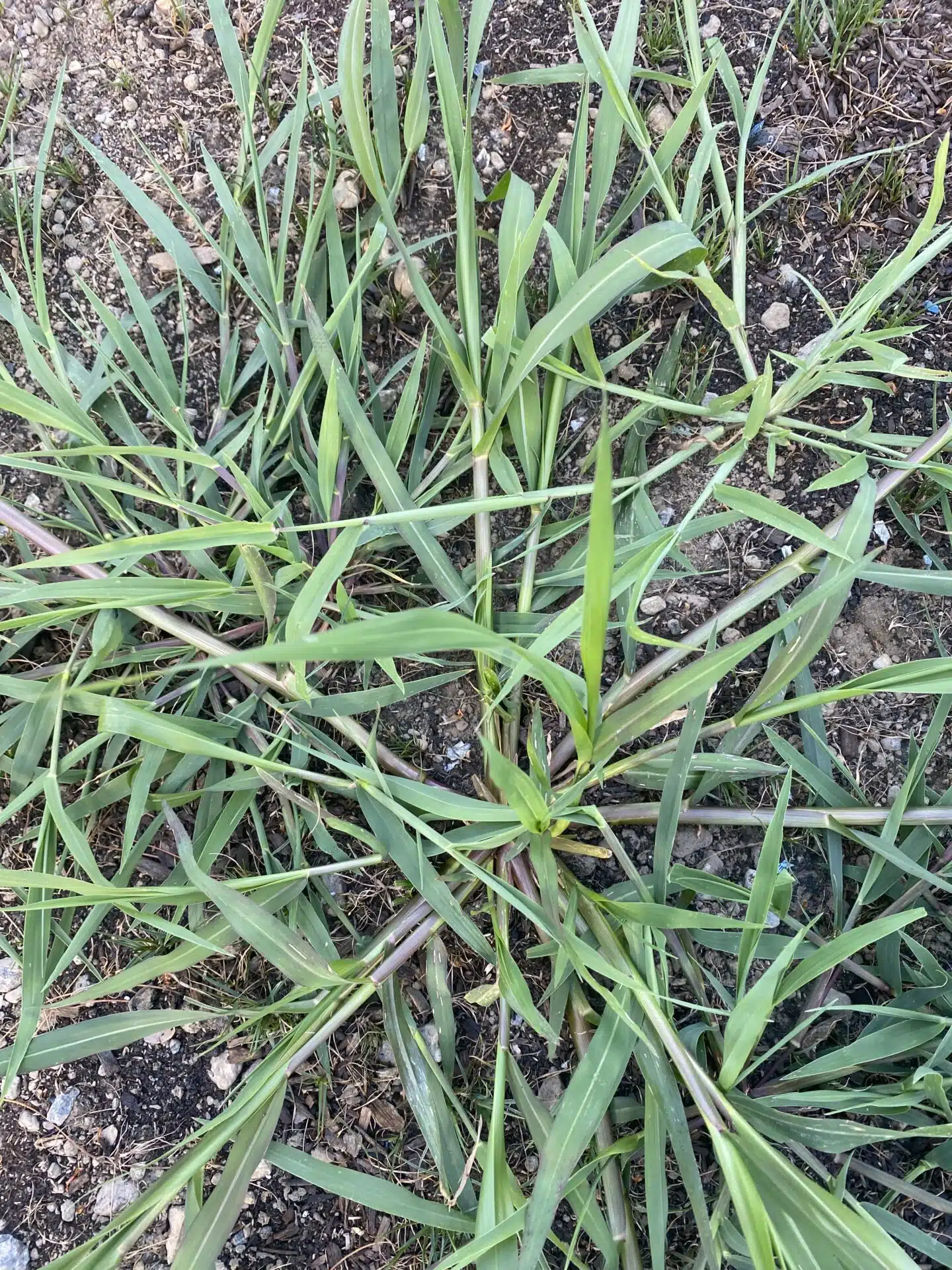
Crabgrass is the pale, flat, star-shaped clump that shows up in summer.
Crabgrass is a summer annual grassy weed. Look for light green blades wider than your lawn grass, growing flat and spreading out from one center like crab legs. Large crabgrass is hairy; smooth crabgrass is hairless with a purple base. By late summer it sends up finger-like seed heads, then turns purplish-brown and dies at the first frost.
GERMINATES
Soil at 55°F for 4–5 days
IN MASSACHUSETTS
Late April to early May
SEEDS PER PLANT
Up to about 150,000
DIES
First frost, Oct–Nov
How to identify crabgrass: 6 tells
Crabgrass is easiest to spot in July and August, when it stands out against cool-season turf. Check a suspect clump for these features, drawn from UMass Extension, Penn State Extension and Rutgers.
COLOR
Lighter green than your lawn
Crabgrass is a lime or yellow-green that looks washed out next to bluegrass or tall fescue, and its blades are coarser and wider.
SHAPE
Flat, spreading star
Stems (tillers) grow outward from a single crown and lie almost flat under regular mowing. Mow higher and they turn more upright.
NEW LEAVES
Rolled, not folded
New leaves come out rolled. Unlike quackgrass, there are no claw-like auricles where the blade meets the stem.
HAIRS
Hairy or smooth
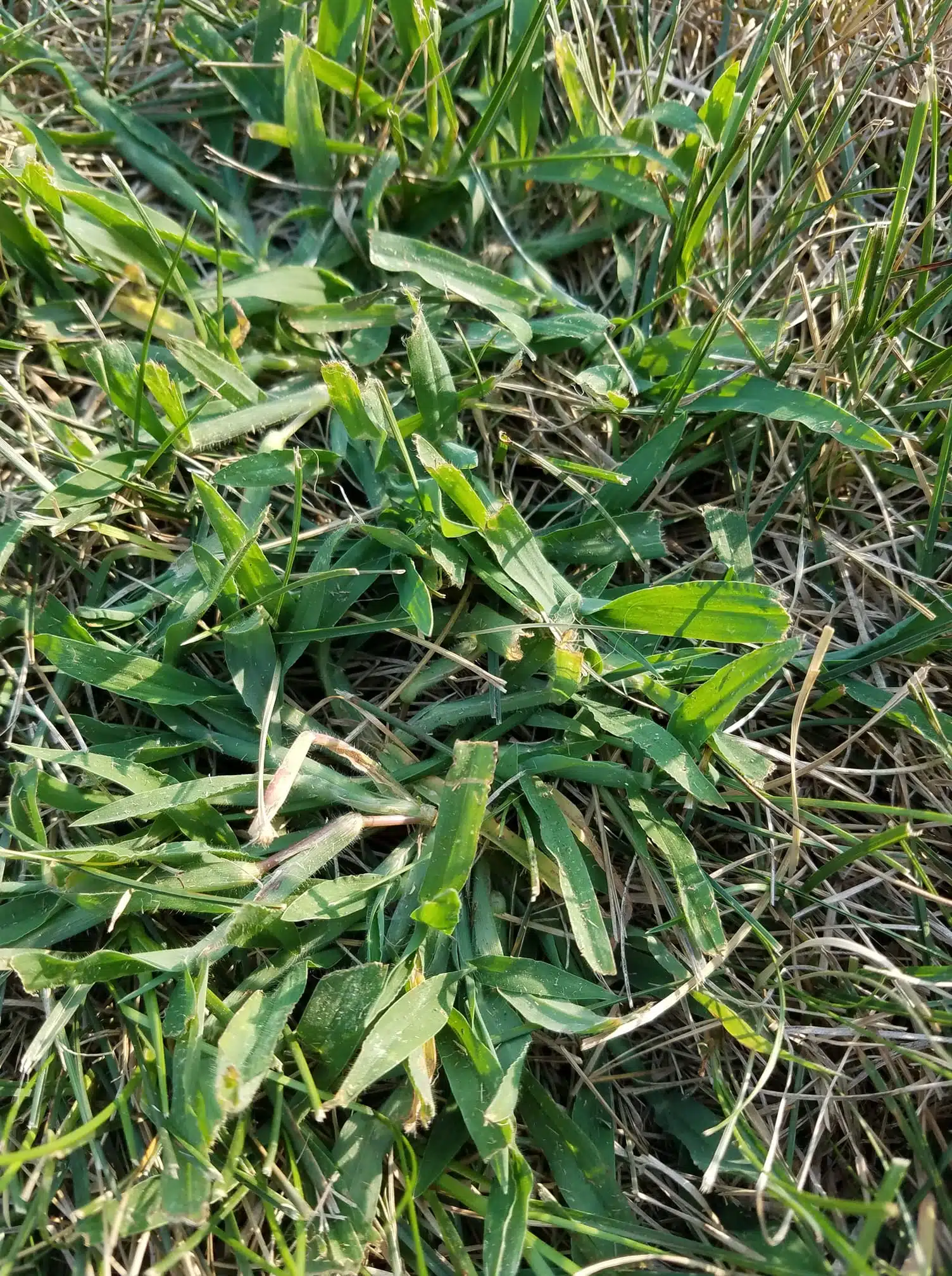
Large crabgrass has long hairs on both sides of the blade and on the sheath. Smooth crabgrass is hairless and purplish at the base.
ROOTING
Roots where stems touch soil
Large crabgrass stems root at the nodes as they spread, so one plant keeps widening through the summer.
SEED HEADS
Fingers in a V
From midsummer, thin finger-like spikes fan out from the top of a stalk, usually 3 to 5. UMass counts up to 10 on large crabgrass.
What crabgrass looks like at each growth stage
Crabgrass changes shape a lot over one season, and the stage you see tells you what still works. The timing below is for southern New England.
| Stage | When (New England) | What you see | What still works |
|---|---|---|---|
| Seedling | Late April to June | A single light-green blade, wider and shorter than turf seedlings, often in thin or bare spots and along driveways | A post-emergent spray, easy kill |
| Tillering | Mid to late June into July | New shoots branch out from the base; the plant starts to look like a small, flat tuft | Post-emergent; easier before multiple tillers |
| Mature | July to August | A low, flat star or mat of stems spreading out from one crown, rooting at nodes | Quinclorac with MSO, or hand-pulling |
| Seed heads | Midsummer to frost | Thin, finger-like spikes in a V on top of stalks; purplish as they ripen | Pull before seed drops; spraying gets harder |
| Fall decline | September to first frost | Leaves and stems turn reddish-purple, then brown; the plant dies and leaves a bare spot | Nothing; it dies on its own. Plan for spring |
The seedling and tillering timing comes from Penn State and Rutgers, which note that crabgrass starts tillering fast in mid to late June and that plants are much easier to kill before early July. LawnPhix has had quinclorac with methylated seed oil kill crabgrass up to the five-tiller stage (quinclorac guide).

Large crabgrass vs smooth crabgrass
Two species cause most lawn problems in the Northeast, and Rutgers notes that smooth crabgrass is the more common of the two in the region. Both are controlled the same way, so the split matters mainly for ID.
| Feature | Large crabgrass | Smooth crabgrass |
|---|---|---|
| Hairs | Dense long hairs on blades and sheaths | Hairless or nearly so |
| Color at the base | Seedling sheaths tinged purple | Purple at the base |
| Spread | Sprawling; stems root at the nodes | Tufted, more compact |
| Ligule | Membranous, jagged at the tip | Membranous, smooth edge |
Crabgrass look-alikes
Most “crabgrass” reported in early spring is something else, because crabgrass seedlings don’t emerge until the soil warms in late April or May. A grassy weed that stays green through winter, or one that comes back from the same roots every year, isn’t crabgrass. Here’s how to sort out the common mix-ups:
| Look-alike | How it differs from crabgrass | Full comparison |
|---|---|---|
| Nutsedge | Not a grass. Triangular stem, shiny yellow-green leaves in threes, grows faster than the lawn and comes back from underground tubers | Nutsedge vs crabgrass |
| Quackgrass | Perennial with long white rhizomes, green early in spring, and clasping auricles at the collar that crabgrass lacks | Crabgrass vs quackgrass |
| Bermudagrass | Perennial with fine blades and wiry runners above and below ground; goes tan in winter, then greens up again | Crabgrass vs Bermuda grass |
| Dallisgrass | Perennial clump that returns from the same crown; tall seed stalks with spikes spaced along the stem | Crabgrass vs dallisgrass |
| Annual bluegrass (Poa annua) | Bright green tufts that flower in spring, the opposite season from crabgrass | Poa annua control |

When crabgrass appears in New England
Crabgrass seed sits in the soil all winter. UMass Extension says it starts germinating once the soil surface holds at 55°F for four or five days in a row, which in Massachusetts usually lands in late April or early May, around the time forsythia is in full bloom. That matches the 55°F trigger in our quinclorac guide and crabgrass lifecycle guide.
Germination doesn’t stop there. Penn State finds new seedlings coming up through mid-June, with some as late as July, which is why a single early-spring preventer can let a second flush through.
The timing tell: if you can see a grassy weed in March or early April, it’s not this year’s crabgrass. If a pale, flat clump appears in a thin spot in June or July, and wasn’t there in May, it almost certainly is.
Found crabgrass? What to do next
MAY TO JULY
Kill it while it’s young
Spot-spray with a selective crabgrass killer while plants are small. See our tested picks in the best crabgrass killers.
JULY TO SEPTEMBER
Spray or pull mature plants
Quinclorac with MSO still works on bigger plants. For a few clumps, pull them before seed drops with a crabgrass removal tool.
NEXT SPRING
Prevent the next crop
A pre-emergent applied before soil hits 55°F stops seedlings. See when to apply crabgrass preventer and the best crabgrass preventers.
Purple, seeded crabgrass in September doesn’t need herbicide.
Once crabgrass turns reddish-purple and its seed heads have ripened, the seed for next year is already in the soil, and the first frost will kill the plant anyway (see when does crabgrass die). Spraying it then mostly wastes product. Put that effort into overseeding the bare spots it leaves while fall seeding weather lasts, and into a preventer next spring. One catch: most crabgrass preventers also stop grass seed from coming up, so read preventing weeds in new grass before you combine the two.
FAQ
Does crabgrass come back every year?
Not the same plant. Crabgrass is an annual that dies at frost, but a single plant can produce up to about 150,000 seeds (UMass), and those sprout the next spring. That’s why it seems to return in the same spots.
What does crabgrass look like in early spring?
Nothing yet. In New England it doesn’t germinate until the soil reaches about 55°F, usually late April or early May. A green grassy weed in March is more likely quackgrass, Poa annua or a clump of tall fescue.
Why is my crabgrass turning purple?
That’s the normal end of its life cycle. Seed heads and stems take on a purplish to reddish-brown color in late summer and fall before frost kills the plant.
Does crabgrass spread by runners?
Mostly by seed. Large crabgrass stems also root where their nodes touch the soil, so a single plant can widen into a patch, but it has no underground rhizomes like quackgrass.
Is it worth pulling crabgrass by hand?
For a few plants, yes, ideally before seed heads form and after rain when the soil is soft. For a lawn full of it, a selective post-emergent is faster.
Related guides
Sources: UMass Extension: Biology and Management of Crabgrass · UMass Extension: Large Crabgrass ID · Penn State Extension: Smooth and Large Crabgrass · Rutgers NJAES FS1308: Crabgrass Control in Lawns
