
Pests · Organic grub control
Milky spore works on one grub, slowly, and often not in cold Northeast soil
Milky spore (Paenibacillus popilliae) is a bacterium that infects only Japanese beetle grubs. Does it work? In the Northeast, extension services call the results inconsistent. UNH says northern New England soils are too cold for it, and field trials found commercial spores didn’t reduce grubs. Even where it takes hold, it needs years, and it does nothing to oriental beetle or chafer grubs.
WHAT IT IS
A soil bacterium, P. popilliae
GRUBS IT KILLS
Japanese beetle only
TIME TO WORK
Several months to 3–5 years
NORTHEAST VERDICT
Inconsistent
What milky spore is
Milky spore causes milky disease, an infection that disrupts the digestive system of Japanese beetle grubs (UMass). A grub swallows spores while feeding on roots. The bacteria multiply inside it, and it dies and releases more spores into the soil. The spores build up over time through that cycle, which is why it’s sold as a one-time, long-term treatment and not a quick fix.
It’s a biological control, not a chemical one. UMass lists milky spore and insect-killing nematodes as labeled for white grubs with no known impact on bees (UMass). That’s why LawnPhix used it in 2013 when renovating an older house with a newborn and two dogs (products page).
Which grubs milky spore affects
Only Japanese beetle grubs. UMass says there’s no evidence it works on any other grub species (UMass). That’s a real limitation in New England, where lawns commonly carry oriental beetle, European chafer and masked chafer grubs too. The wave of grub breakthroughs LawnPhix saw in 2023 was mainly oriental beetle (products page), and milky spore would have done nothing about them.
UNH says you need a positive ID that your grubs are Japanese beetle larvae before you rely on milky spore (UNH). Your county extension office or a lab can help. Our Japanese beetle guide covers the adult and its life cycle.

Does milky spore work? What Northeast research says
Here’s what regional extension services and field research found:
| Source | What they found |
|---|---|
| UMass Extension | Results are inconsistent in the Northeast. Turf managers report more success in the sandy soils of southeastern Massachusetts. It may take several months to start working and can stay effective for 3–5 years. |
| UConn | Control can be inconsistent in the Northeast, and soil type and temperature affect it. It’s most reliable near the Connecticut coast, when a whole neighborhood applies it. |
| UNH Extension | Spring soils in northern New England are too cold for milky spore to work. It may do better in warmer spots in southern New Hampshire and takes several years. |
| Penn State | Cooler fall soils mean less grub feeding, so grubs swallow fewer spores than they do farther south. |
| Cornell Cooperative Extension | Milky spore products don’t survive cold winters very well. |
| Univ. of Kentucky field trials (1995) | Over several years on two golf courses, neither commercial product raised milky disease levels or reduced grub numbers. |
| Univ. of Illinois | Spores develop best with soil at 60–70°F. Results may take 3–5 years in cooler climates. |
The honest answer: milky spore isn’t a scam, and it does infect Japanese beetle grubs. But none of the Northeast extension sources above calls it reliable lawn grub control. Your odds are best in warm, sandy soil with Japanese beetle as the main grub and your neighbors treating too. In heavier, colder soils in central or northern New England, expect little.
How long milky spore takes to work
Expect seasons, not weeks. UMass says several months at minimum (UMass). Illinois puts it at 3–5 years in cooler climates (Illinois). Retail listings promise more: one powder label claims it kills grubs in about 3 weeks and keeps working for up to 20 years (product listing). Our products page cites the same 20-year figure after six applications over two years. The extension estimates are the ones to plan around.
That timeline is why LawnPhix chose not to rely on it again. In 2019 we moved into a house with grub damage the two previous summers. There wasn’t time for milky spore to build up, so we used Acelepryn (LawnPhix).
How to apply milky spore
- Powder: one level teaspoon every 4 feet, in rows 4 feet apart. Then water gently for about 15 minutes. A 10 oz container treats 2,500 sq ft (label directions).
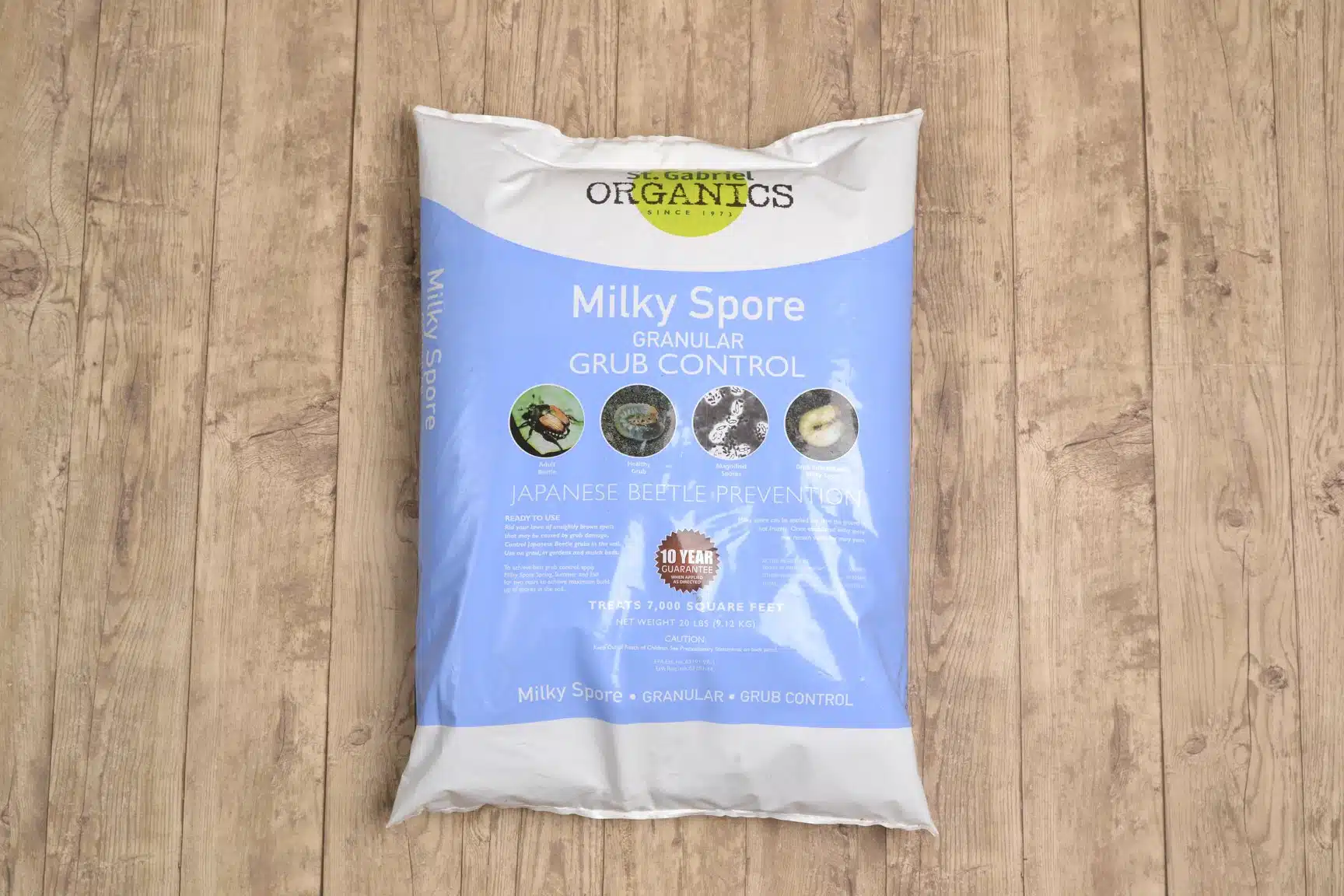
- Granular: use a broadcast spreader. A 20 lb bag covers 7,000 sq ft (LawnPhix). Measure your lawn first with the lawn size calculator.
- Timing: any time the ground isn’t frozen, ideally spring or late summer to early fall, while grubs are feeding near the surface. Skip late fall, when grubs move deeper (label directions).
- Go wide: UConn says results are most reliable when a whole neighborhood applies it (UConn).
- Don’t double up: MSU Extension says there’s no need to use milky spore and a conventional grub product together (MSU via Ask Extension).
Milky spore vs beneficial nematodes vs chemical grub control
| Option | Grubs controlled | New England timing | Speed | Notes |
|---|---|---|---|---|
| Milky spore | Japanese beetle only | Ground not frozen; spring or late summer | Months to years | Inconsistent in the Northeast (UConn) |
| Beneficial nematodes (Heterorhabditis bacteriophora) | Japanese beetle, oriental beetle, European chafer | 1st–2nd week of August in CT (UConn); mid-Aug to early Sept (UMass) | Weeks | Water in 0.25–0.5″. Sunlight kills them, so apply on cloudy days or early/late (UNH) |
| Chlorantraniliprole (Acelepryn, GrubEx) | All white grub species | Mid-April to early June | Preventive, season-long | No activity against bees (UMass) |
| Imidacloprid (Merit) | Most, not Asiatic garden beetle | Mid-June to early August | Preventive | Licensed-only in MA and ME. See imidacloprid |
| Trichlorfon (Dylox) | Active grubs of all species | When grubs are over threshold | 1–3 days | Curative; most effective in late Aug to early Sept while grubs are small (Penn State) |
If you want an organic option that covers more than one grub species, nematodes are the better bet. Results with them can be inconsistent too (Cornell CCE). For timing on the chemical options, see when to apply grub control.
When milky spore is worth it
WORTH TRYING
You have confirmed Japanese beetle grubs
Especially in sandy southeastern Massachusetts or coastal Connecticut soil. Neighbors are willing to treat too, there’s no damage this year, and you’re happy to wait several seasons.
SKIP IT
You need grub control this year
Damage is active now, your grubs are oriental beetle or chafers, or you’re in colder central or northern New England. Choose a preventive or a curative instead.
If skunks are already tearing up the lawn, milky spore won’t save this season.
UMass notes that turf skunks are digging can be lost at just 4–5 grubs per square foot (UMass BMP). Milky spore needs months to years. For active damage, sample the turf first using our grub guide. Then use a curative product or nematodes, and plan prevention for next spring.
Milky spore FAQs
Does milky spore work?
On Japanese beetle grubs, sometimes. In the Northeast, UMass and UConn both call results inconsistent (UConn), and Kentucky field trials found no reduction in grubs (Redmond & Potter). It works best in warm, sandy soil.
How long does milky spore take to work?
Several months at minimum, and often 3–5 years in cooler climates (Illinois). Don’t count on it for the current season.
Does milky spore kill other grubs, like oriental beetle or European chafer?
No. UMass found no evidence it works against any grub except the Japanese beetle (UMass).
Can I use milky spore with GrubEx or other grub control?
MSU Extension says there’s no need to combine them (MSU). Also, milky spore spreads through grubs that eat it, so a lawn kept grub-free by a preventive gives it little to work with.
Is milky spore safe for bees?
UMass lists it among grub controls with no known impact on bees (UMass).
Related guides
Sources: UMass: Turf IPM, insect management · UMass: Japanese beetle · UMass: Grub control, neonicotinoids and bees · UMass: White grub insecticides · UMass BMP 11: Insect management · UConn: Grub problems in turf · UNH Extension: Treating grubs · Penn State: White grubs · Cornell CCE Monroe: Lawn care basics · Redmond & Potter 1995, J. Econ. Entomol. · Univ. of Illinois: Milky spore disease · MSU via Ask Extension · Milky spore powder label directions
