
Pests · Grub control
Imidacloprid only stops grubs that hatch after it’s in the soil
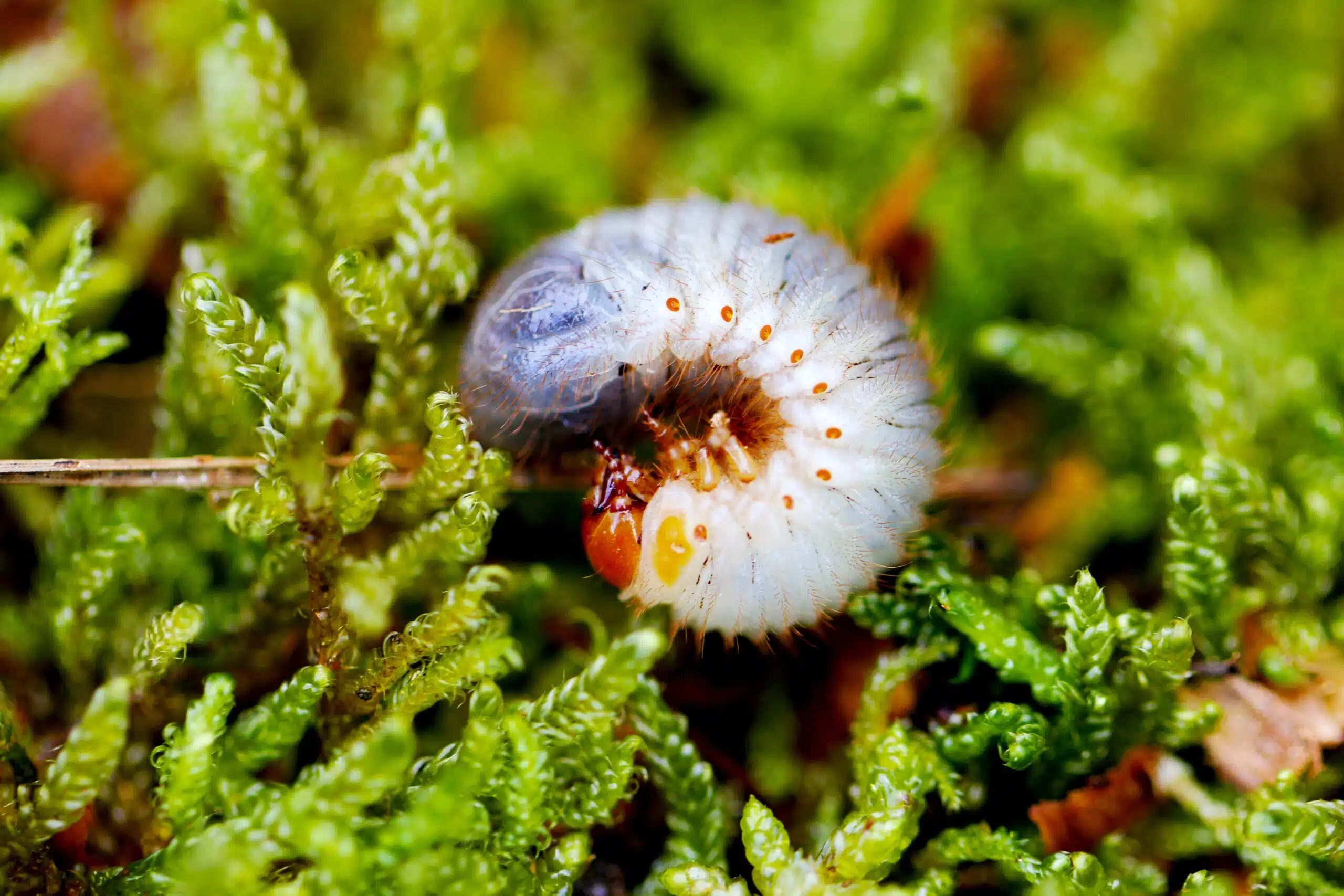
Imidacloprid (Merit, BioAdvanced Season-Long) is a preventive, systemic grub insecticide. It kills young grubs as they hatch, not the fat ones you dig up in spring or fall. In New England, UMass puts the window at mid-June to early August. Water it in the same day, and check your state first: Massachusetts and Maine homeowners can no longer use it on lawns.
TYPE
Preventive, systemic (neonicotinoid)
NEW ENGLAND WINDOW
Mid-June to early August
WATER IN
At least 0.25″ right after
HOMEOWNER USE
Licensed-only in MA and ME
How imidacloprid works on grubs
Imidacloprid is a neonicotinoid. Grass roots take it up, and it stays active in the root zone for weeks to months. That’s why it’s sold as “season-long” grub control. It also works more slowly than most turf insecticides, per UMass Extension’s turf IPM guide. You’re putting down a barrier for grubs that haven’t hatched yet. You’re not killing the ones already there.
Two limits matter. First, neonicotinoids do little or nothing against the large, mature grubs you find in spring and fall (UMass). Second, imidacloprid doesn’t control Asiatic garden beetle grubs at all, and applications made before early June may not last into the late-summer grub season (UMass white grub fact sheet). One side benefit is that imidacloprid also suppresses chinch bugs, which Acelepryn does not. Our grub timing guide covers that trade-off.
When to apply imidacloprid in the Northeast
Most labels say to apply when beetles are laying eggs, or before eggs hatch. In New England, Japanese beetle adults start emerging in late June or early July, peak around August 1, and their eggs hatch 10–14 days after they’re laid (UMass Japanese beetle fact sheet). That’s why the regional windows sit in early to mid-summer, much later than the spring window for GrubEx-type products:
| Source | Recommended imidacloprid window |
|---|---|
| UMass Extension | Mid-June to early August in most years |
| UNH Extension | Mid-June to early August |
| UConn Home & Garden | Around mid-June through mid-July |
| Penn State Extension | Late June to early August |
| LawnPhix (Massachusetts) | June, if you missed the early-May Acelepryn window |
Retail bags can be looser. BioAdvanced’s Season-Long product says May through mid-August (label summary). In New England, a May application is the one UMass warns may run out before the grubs arrive. Aim for the second half of June.
Water it in the same day
Imidacloprid does nothing while it sits on the grass blades. It has to get through the thatch to the roots. UMass says to water in at least 0.25 inch right after application without puddling (UMass). They also recommend granular products, watered in quickly and thoroughly enough to clear the turf canopy (UMass). The Imidacloprid 2F label says to irrigate if no rain falls within 24 hours. Don’t mow until it’s been watered in.
Imidacloprid rates: follow the label
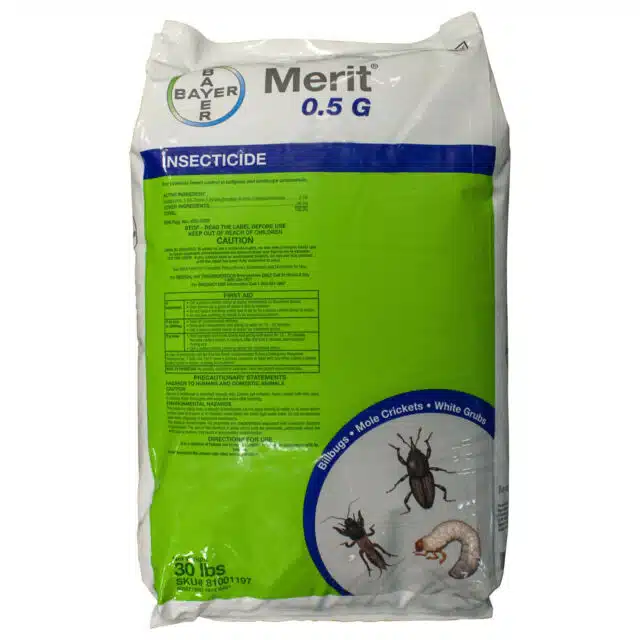
Rates depend on the product’s strength, so always read your bag. Here’s what three common labels say. Measure your lawn first with the lawn size calculator so you buy the right amount.
| Product | Imidacloprid | Grub rate (label) | Who can buy it |
|---|---|---|---|
| Merit 0.5 G | 0.5% granular | 1.4–1.8 lb per 1,000 sq ft (60–80 lb/acre); max 80 lb/acre per year | Pro product |
| Imidacloprid 2F | Liquid concentrate | 0.46–0.6 fl oz per 1,000 sq ft | Pro product |
| BioAdvanced Season-Long Grub Control Plus Turf Revitalizer | 0.25% + 6-0-1 fertilizer | 12 lb bag treats up to 5,000 sq ft | Retail; not sold in CT or VT, licensed-only in MA, ME, NY, RI |
Example: a 5,000 sq ft lawn at the Merit 0.5 G label rate needs 7–9 lb of product.
Imidacloprid vs chlorantraniliprole vs trichlorfon
These three active ingredients cover most grub products on the shelf. Two are preventive and one is curative, and each has a different New England window:
| Imidacloprid | Chlorantraniliprole | Trichlorfon | |
|---|---|---|---|
| Brands | Merit, BioAdvanced Season-Long | Acelepryn, Scotts GrubEx | Dylox, BioAdvanced 24-Hour Grub Killer Plus |
| Job | Preventive | Preventive | Curative (kills active grubs) |
| UMass window | Mid-June to early August | Mid-April to early June | When a sample is over threshold |
| Speed / persistence | Slow; active for weeks to months | Takes 60–90 days to dissipate in soil | Kills in 1–3 days; breaks down in 7–10 |
| Gaps | Asiatic garden beetle; large grubs | Effective on all white grub species | Seldom more than 50% control once grubs are full-size (often mid-Sept) |
| Bees | Hazard if blooms are present | No activity against bees | Follow label |
| Massachusetts | Licensed applicators only (since July 2022) | Available to homeowners | Not allowed on school grounds |
Sources for the table: UMass white grub fact sheet, UMass grub control and bees, UMass turf IPM.
Our take: LawnPhix switched to chlorantraniliprole (Acelepryn) in 2021. Our lawn had grub damage in 2021 after a Merit application, documented on our grub control products page. In a 2023 reader poll, 64% of imidacloprid-treated lawns reported grub damage, against 14% for chlorantraniliprole (poll results). That’s a self-reported poll, not a trial. Still, if you can apply in April or May, chlorantraniliprole is the better choice. If you’re comparing big-box bags, see GrubEx vs Bayer.

Protecting bees when you use imidacloprid
The risk to bees comes from flowers in the lawn, not the grass. UMass advises against applying neonicotinoids while clover or other forage plants are in bloom. They also suggest applying in the evening, at night or early in the morning, when fewer bees are foraging (UMass). Their IPM guide adds ground ivy to the list of flowers to watch for (UMass).
Mowing helps. In a University of Kentucky study, bumble bee colonies foraging on treated, flowering white clover gained weight more slowly and produced no new queens. Once the plots were mown and the clover reflowered, the residues no longer harmed the colonies. That study used clothianidin, a closely related neonicotinoid (Larson, Redmond & Potter, 2013). So mow off clover and dandelion heads before you spread, then water in. The same study found no harm to the colonies from chlorantraniliprole. Lots of clover? See getting rid of clover.
Who can still use imidacloprid: New England and New York rules
| State | Imidacloprid on lawns (as of Oct 2026) |
|---|---|
| Massachusetts | State restricted use since July 1, 2022 for lawn, turf, trees, shrubs and gardens. Homeowners can’t buy or apply it; licensed applicators can. Flea and tick products are exempt (UMass). |
| Maine | Prohibited for everyone in outdoor residential landscapes, with narrow exceptions. Sold only to licensed applicators (Maine BPC). |
| Vermont | Neonicotinoids labeled for outdoor use are registered as restricted use. Use on ornamental plants is banned (Act 182). |
| Connecticut | Not available for homeowner use (UConn). A ban on lawns and golf courses is scheduled to start in October 2027 (CT Public). |
| Rhode Island | Outdoor neonicotinoids are restricted to certified applicators (PCT). |
| New York | The Birds and Bees Protection Act is set to ban neonicotinoids on turf and outdoor ornamentals from January 1, 2027 (TurfNet). |
| New Hampshire | Check with the NH Division of Pesticide Control before you buy. |
These rules are changing, so confirm the current rules with your state pesticide agency before you buy.
Don’t reach for imidacloprid just because the bag is on the shelf.
In Massachusetts and Maine it’s off-limits to homeowners on lawns, and rules in CT, VT, RI and NY are tightening. Where it’s still legal, never spread it over blooming clover or dandelions. Mow the flowers off first and water it in the same day. And if it’s already August and the turf is peeling back, imidacloprid won’t save this season. That’s a job for a curative like trichlorfon. See grub killers.
Advertising disclosure: calls are routed to an independent local provider. We’re paid a referral fee for the call. You pay the provider, never us.
Imidacloprid grub control FAQs
Does imidacloprid kill grubs that are already in the lawn?
Not well. It’s a preventive that targets newly hatched grubs. UMass notes neonicotinoids have little or no effect on the large grubs present in spring and fall (UMass). For active damage, use a curative like trichlorfon.
Can I apply imidacloprid in April or May?
You can, but in New England it may wear off before the grubs hatch. UMass found early applications may not stay active long enough to control grubs that start feeding in July and August (UMass). If you want to treat in spring, chlorantraniliprole is the better fit.
Is GrubEx imidacloprid?
No. Scotts GrubEx contains chlorantraniliprole (0.08%), the same active ingredient as Acelepryn (GrubEx vs Bayer). Check the active ingredient on any bag before you buy.
Can homeowners in Massachusetts still buy imidacloprid for grubs?
No. Since July 1, 2022, neonicotinoid products labeled for lawns, turf and ornamentals are state restricted use in Massachusetts. Only licensed or certified applicators can buy and apply them (UMass).
Does imidacloprid also control chinch bugs?
Yes, it suppresses them, and that’s one thing chlorantraniliprole doesn’t do. If you switch to Acelepryn, keep an eye out for chinch bugs.
Related guides
Sources: UMass: Current insecticide approaches for white grub control · UMass: Grub control in lawns, neonicotinoids and bees · UMass: Turf IPM, insect management · UMass: Japanese beetle · UMass: Neonicotinoid registration change in MA · UNH Extension: Treating grubs · UConn: Grub problems in turf · Penn State: White grubs · Larson et al. 2013, PLOS ONE · Maine BPC: Neonicotinoids · Vermont Act 182 · CT Public: CT neonicotinoid law · PCT: Rhode Island neonic restriction · TurfNet: NY neonicotinoid ban · EPA label: Imidacloprid 2F · Merit 0.5 G label summary · BioAdvanced Season-Long label summary
