
Lawn Care · Grass Types
Kentucky bluegrass is the slow starter that repairs itself.
Kentucky bluegrass seed grows the cold-hardiest lawn in the Northeast, and it’s the only common lawn grass that spreads underground to fill its own bare spots. The trade-off: it takes two to three weeks to sprout and wants full sun, steady water and more nitrogen than tall fescue. Sow 3–4 lb per 1,000 sq ft on bare soil from late August to mid-September.

GERMINATION
About 2–3 weeks
SEED RATE, NEW LAWN
3–4 lb per 1,000 sq ft
SUN
Full sun; poor in shade
BEST SEEDING WINDOW (MA)
3rd week Aug to 3rd week Sept
What Kentucky bluegrass does well
Kentucky bluegrass (Poa pratensis) has a fine to medium leaf, a dark green color and a boat-shaped leaf tip. It’s the backbone of the standard Northeast sun mix, for three reasons.
It spreads and repairs itself
Bluegrass sends out rhizomes, underground stems that run sideways and come up as new shoots. That’s what lets it knit a dog spot, a divot or a thin strip back together without reseeding. Penn State Extension credits the rhizomes with its strong recuperative ability, and UMass Extension rates its recovery from traffic as good, against poor for tall fescue and perennial ryegrass. UMass notes the same habit makes it a good sod-former.
It handles New England winters
UMass rates Kentucky bluegrass excellent for cold tolerance, the best of the common lawn grasses. In its winter injury fact sheet, UMass notes that bluegrass can sit under ice for 150 days or more, roughly twice as long as perennial ryegrass can. If your lawn has low spots where ice sheets over every winter, bluegrass is the grass most likely to come back.
It bounces back from summer dormancy
In a long hot, dry spell, bluegrass goes semi-dormant and turns straw-colored instead of dying, then greens up again when it cools down and rain returns (UMass). That’s a feature, not a failure, but it does mean an unwatered bluegrass lawn will look brown in a dry August. See drought stress in lawns for how to carry it through.
The trade-offs: sun, water, nitrogen and patience
- Sun. UMass rates its shade tolerance poor; it does best in open, sunny, well-drained spots. Under trees, use fine fescue or tall fescue instead (see best grass for shade).
- Water. It browns out sooner than tall fescue in a drought. If you won’t water in summer, a tall fescue blend with a little bluegrass is the safer bet.
- Nitrogen. UMass puts it at 2–4 lb of nitrogen per 1,000 sq ft per season, at the high end for cool-season lawns, and it can build thatch.
- Disease. The ones to know are leaf spot and melting out, dollar spot, stripe smut, necrotic ring spot and summer patch. Newer cultivars carry better resistance, which is a big reason to buy named varieties (more below).
- Patience. It’s the slowest cool-season grass to establish. Penn State says emergence can take up to two weeks, and in our guide to choosing grass seed we put it at about 21 days, against 5–7 for ryegrass and about 14 for tall fescue. Full cover takes the rest of the season.
Kentucky bluegrass vs tall fescue vs perennial ryegrass
Most Northeast lawns are some mix of these three. Ratings are from UMass Extension’s turfgrass selection tables; germination times are from our grass seed guide.
| Trait | Kentucky bluegrass | Tall fescue | Perennial ryegrass |
|---|---|---|---|
| Germination | About 21 days | About 14 days | 5–7 days |
| Spreads to fill gaps | Yes, by rhizomes | Barely (bunch type) | No (bunch type) |
| Recovery from damage | Good | Poor | Poor |
| Wear | Fair | Excellent | Excellent |
| Cold hardiness | Excellent | Fair | Fair |
| Drought | Good (goes dormant) | Excellent | Good |
| Shade | Poor | Fair | Poor |
Read across the rows and the pattern is clear: bluegrass is the repair crew, tall fescue and ryegrass take the beating. That’s why the best Northeast lawns usually blend them.
Mixing Kentucky bluegrass with tall fescue
A tall fescue lawn can’t fill its own holes. A little bluegrass in the mix gives it that ability without giving up tall fescue’s drought and wear tolerance. UMass says a tall fescue mix should be at least 80% tall fescue by weight, with bluegrass or ryegrass making up the rest. Rutgers lands on 85–95% tall fescue and 5–15% bluegrass, because tall fescue lacks the rhizomes needed to spread sideways. Jonathan Green’s Black Beauty Ultra, for example, is 80% tall fescue, 10% bluegrass and 10% ryegrass by weight, per our grass seed guide.
Why 10% bluegrass is more than it sounds
Seed blends are measured by weight, not seed count. UMass counts about 2,177,000 Kentucky bluegrass seeds per pound against about 227,000 for tall fescue (UMass seeding rate fact sheet), so a pound of bluegrass holds nearly ten times as many seeds. In a 90/10 tall fescue and bluegrass blend, that works out to roughly 218,000 bluegrass seeds and 204,000 tall fescue seeds per pound: about half the seeds in the bag are bluegrass. That’s why the bluegrass share stays small. Push it much higher and the bluegrass, not the tall fescue, ends up running the lawn.
What about rhizomatous tall fescue (RTF)?
Some tall fescue cultivars produce short rhizomes and are sold as RTF. Purdue points out that they’re still tall fescue, not a new species, and Penn State describes tall fescue as mainly bunch-type with only occasional short rhizomes. RTF can help at the margins, but it won’t fill in like bluegrass. If self-repair is the goal, adding 5–15% Kentucky bluegrass is the proven route.
Which mix fits your yard
| Your yard | Seed to buy | Why |
|---|---|---|
| Full sun, irrigated, you want a dense, self-repairing lawn | Bluegrass-led sun mix: 65–75% KBG, 10–20% perennial ryegrass, about 15% fine fescue (UMass) | Bluegrass fills in; ryegrass covers the soil while it’s slow to start |
| Full sun, little or no watering, kids or dogs | Tall fescue blend with 5–20% bluegrass | Tall fescue handles drought and wear; bluegrass patches the holes |
| Low spots where ice sits all winter | Bluegrass-led mix | Best ice and cold tolerance of the lawn grasses |
| Shade under trees | Not bluegrass; fine fescue or tall fescue | UMass rates bluegrass shade tolerance poor |
| Patching an existing bluegrass lawn | A straight bluegrass blend, or bluegrass with a little ryegrass | Match what’s already growing so the patch blends in |
How much Kentucky bluegrass seed to use
These are LawnPhix’s standard rates from how much grass seed do I need. They’re far lower than for tall fescue or ryegrass because each pound holds so many more seeds. For a blend, follow the rate on the bag.
| Job | Kentucky bluegrass (lb per 1,000 sq ft) |
|---|---|
| New lawn on bare soil | 3–4 |
| Overseeding a thin lawn | 2–3 |
| Overseeding a healthy lawn | 1–2 |
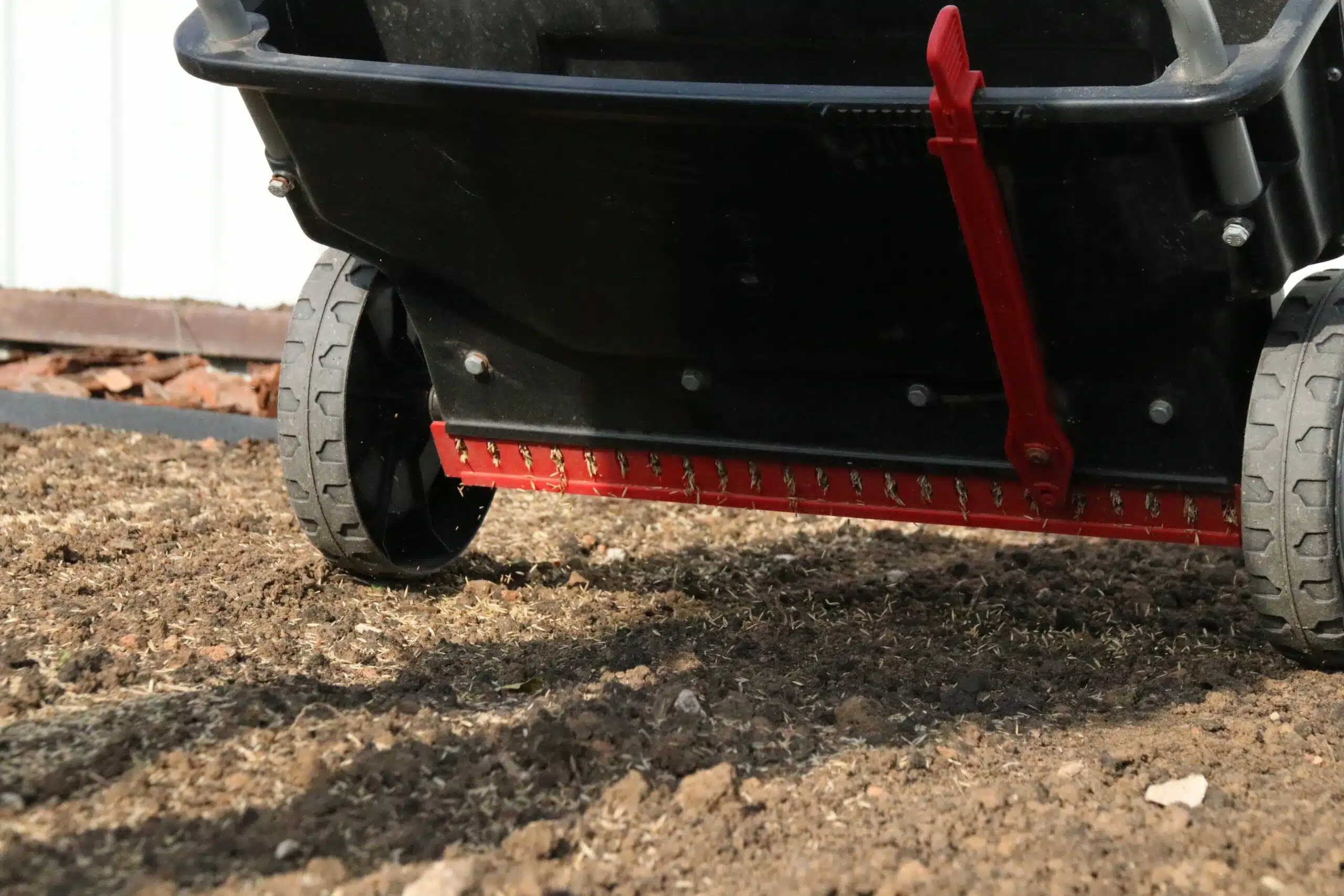
Worked example: a 5,000 sq ft bare-soil lawn at 3–4 lb per 1,000 needs 15–20 lb of straight bluegrass. The grass seed calculator does the math for any size. UMass suggests raising rates by up to 50% when conditions are poor, but don’t go much past that: UMass warns that very heavy seeding produces a crowd of weak young plants that are slow to mature.
When to plant Kentucky bluegrass seed in New England
UMass Extension puts the best seeding window at about the third week of August to the third week of September. Cool-season roots grow best with soil at 50–65°F and shoots with air at 60–75°F, and late-summer seedlings get two cool growing spells, fall and the next spring, before they face summer stress.
Bluegrass needs the early half of that window more than any other grass. With two to three weeks just to sprout, a bluegrass seeding in early September has far more time to build roots before frost than one put down at the end of the month. Keep the top of the soil moist the whole time; our watering guide for grass seed has the schedule, and a starter fertilizer at seeding helps young bluegrass along.
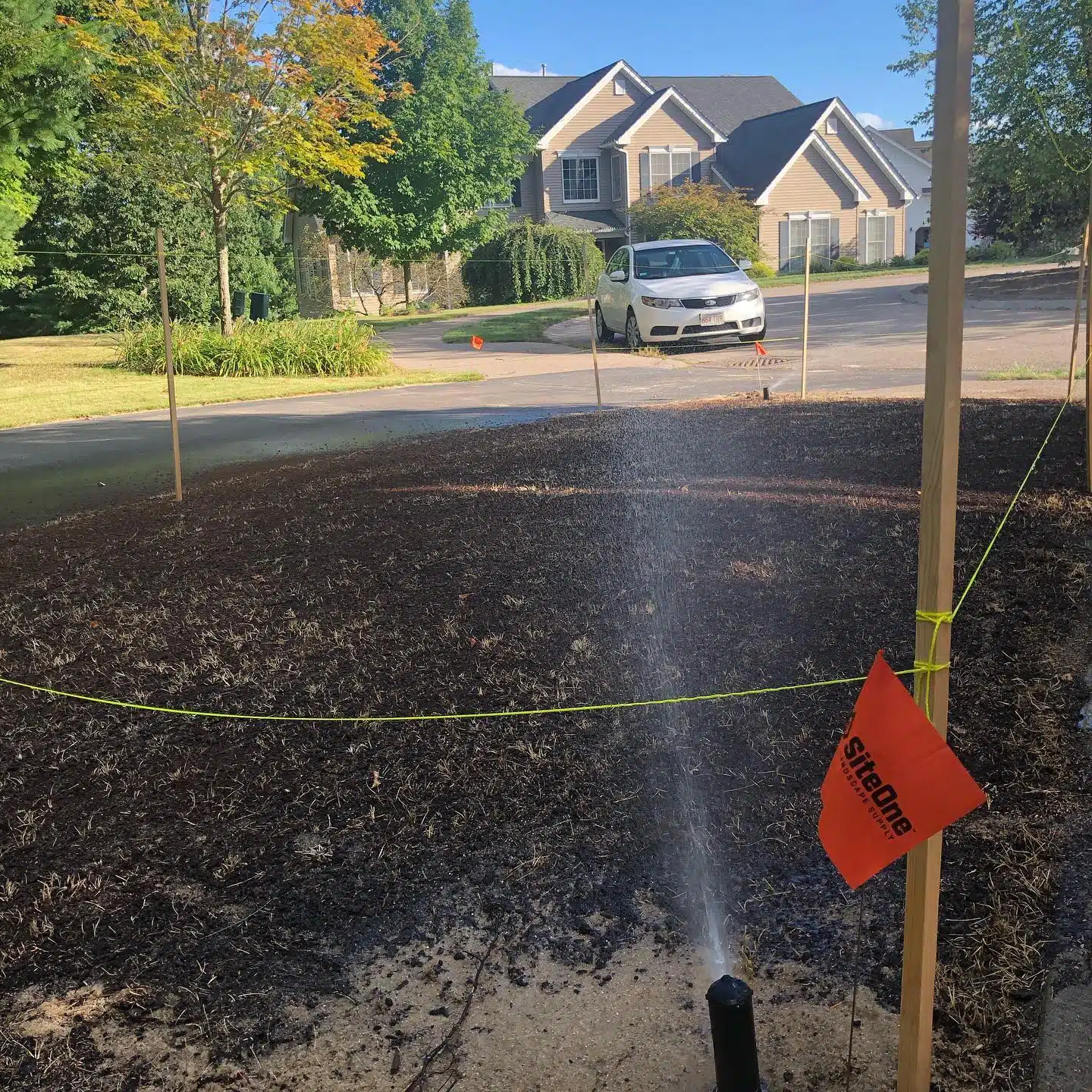
- Spring. Workable but second best: UMass notes spring seedings get only one good growing period before summer. Standard crabgrass preventers stop grass seed too; LawnPhix uses Tenacity (mesotrione), which is seed-safe (see our Tenacity review and the spring seeding guide).
- Dormant seeding. Seeding once soil falls below about 40–45°F so the seed sprouts next spring. UMass calls it a fallback that can’t be counted on every time. Bluegrass’s slow start makes it less likely than ryegrass to sprout during a winter thaw.
Don’t sow straight bluegrass late, or into shade.
Two mistakes undo bluegrass seedings. One is starting in late September or October, when the seed takes most of a month to come up and the seedlings go into winter small and thin. If you’ve missed mid-September, wait for dormant seeding or spring. The other is seeding it under trees, where UMass rates its shade tolerance poor. It may come up, but it won’t hold. Mixing in perennial ryegrass won’t fix either: the ryegrass comes up fast, then the bluegrass in the gaps still fails.
Buying Kentucky bluegrass seed: named varieties beat “common”
Kentucky bluegrass cultivars vary more than most grasses. UMass sorts them into groups with very different strengths; here are the ones you’ll see on seed tags, summarized from the UMass bluegrass cultivar fact sheet.
| Type | Strengths | Watch for | Example cultivars |
|---|---|---|---|
| Compact-Midnight | Very dark green, good heat tolerance | Late spring green-up, powdery mildew | Midnight, Award, Total Eclipse |
| Compact-America | Bright dark green, fine and dense, better in shade | Fair wear tolerance | America, Showcase, Brilliant |
| Aggressive | Fast lateral spread, very wear tolerant | — | Northstar, Mystic |
| Bellevue | Early spring green-up, good winter color | — | Bellevue, Freedom, Parade |
| Mid-Atlantic | Deep roots, good summer stress tolerance | — | Preakness, Plush |
| Common | Cheap | Poor winter color and performance, poor wear | Kenblue, Park, Newport |
- Buy a blend of several cultivars. Penn State suggests 3–5 bluegrass varieties in a blend, so one disease or stress can’t take out the whole lawn. Mixing types (say, a Compact-Midnight with a Mid-Atlantic) spreads the risk further.
- Look up the names. The National Turfgrass Evaluation Program (NTEP) trials cultivars side by side, and UMass calls its data extensive and reliable. Check how your tag’s varieties rated at a Northeast site.
- Check the tag. Penn State sets minimums of 90% purity and 80% germination for bluegrass seed. Scan the other-crop and weed lines for annual or rough bluegrass; our Poa trivialis and Poa annua guides explain why you don’t want either.
LawnPhix hasn’t run a side-by-side test of straight bluegrass seed. Our hands-on seed reviews are tall fescue-based; the Black Beauty vs GCI review covers two of them.
Kentucky bluegrass seed FAQs
How long does Kentucky bluegrass seed take to germinate?
Expect about two to three weeks in late-summer conditions: Penn State says up to two weeks for emergence, and our seed guide puts it at about 21 days. Keep the seedbed moist the whole time; see how long grass takes to grow.
Does Kentucky bluegrass spread?
Yes. It spreads by rhizomes, underground stems that send up new shoots, so it fills thin spots on its own. Tall fescue and perennial ryegrass are bunch grasses and mostly don’t.
Can you mix Kentucky bluegrass with tall fescue?
Yes, and it’s one of the best Northeast combinations. Keep bluegrass to about 5–20% by weight; because its seeds are so small, even 10% by weight is about half the seeds in the bag.
How much Kentucky bluegrass seed per 1,000 square feet?
3–4 lb for a new lawn, 2–3 lb to overseed a thin lawn and 1–2 lb to overseed a healthy one, per LawnPhix’s seeding-rate table.
Will Kentucky bluegrass grow in shade?
Not well. UMass rates its shade tolerance poor. Compact-America types are somewhat better, but for real shade use fine fescue; see our shade grass guide.
Why is bluegrass seed so expensive per pound?
Each pound holds about ten times as many seeds as tall fescue or ryegrass, so you sow far less of it. A 3–4 lb rate for a new bluegrass lawn compares with 8–10 lb for tall fescue.
Related guides
Sources: UMass Extension: Turfgrass Selection · UMass: Establishment, Renovation & Repair · UMass: Selection of Grasses · UMass: Characteristics of Kentucky Bluegrass Cultivars · UMass: Seeding Rate Considerations · UMass: Winter Injuries of Cool-Season Turf in New England · Penn State: Turfgrass Species for Pennsylvania · Penn State: Turfgrass Seed and Seed Mixtures · Rutgers: Tall Fescue Varieties for New Jersey (FS990) · Purdue: Fine Fescues, Understanding the Differences · NTEP
