
Lawn Weeds
Broadleaf weeds are the easiest lawn weeds to kill, if you spray at the right time
Broadleaf weeds are lawn weeds with wide leaves, a net of branching veins and, usually, showy flowers: dandelion, clover, violets, creeping charlie and the rest. Selective herbicides such as 2,4-D, dicamba, mecoprop and triclopyr kill them without killing the grass. In Northeast lawns, the best time to spray them is late September through October.

LEAF
Wide, with a net of veins
BEST WINDOW (NORTHEAST)
Late Sept–Oct, then May
MAIN ACTIVES
2,4-D, dicamba, MCPP, triclopyr
RESULTS
Wilting in ~48 hrs, dead in 7–14 days
This guide is part of our common lawn weeds series. It covers how to tell a broadleaf weed from a grassy weed or a sedge, the 13 broadleaf weeds Northeast lawns see most, which herbicide each one needs, and when to spray. If what you have looks more like grass, go to weeds that look like grass.
Broadleaf vs grassy vs sedge: how to tell them apart
Sort the weed into its group before you buy anything. Each group needs a different herbicide, and a broadleaf killer does almost nothing to a grassy weed or a sedge. Penn State Extension uses the leaf, the stem and the flowers to tell the groups apart. The control column lists the ingredients UMass Extension names for each group in cool-season turf.
| Group | Leaves | Stem | Flowers | Examples | Selective control |
|---|---|---|---|---|---|
| Broadleaf | Wider, with one main vein and a net of smaller veins branching off it | Round or square, often branched | Usually showy: yellow, white, purple | Dandelion, clover, violet, ground ivy | 2,4-D, MCPP (mecoprop), dicamba, triclopyr, fluroxypyr |
| Grassy | Long and narrow, veins running side by side | Round, hollow between the joints | Seedheads, no petals | Crabgrass, quackgrass, poa annua | Quinclorac, fenoxaprop, mesotrione; prodiamine or dithiopyr before they sprout |
| Sedge | Grass-like but stiff and shiny, in sets of three | Triangular and solid | Spiky or ball-shaped seedheads | Yellow nutsedge, kyllinga | Halosulfuron, sulfentrazone, bentazon, mesotrione |
A quick field test is to roll the stem between your thumb and finger. A stem with three edges is a sedge. A round stem with narrow, parallel-veined leaves is a grass. Anything with a broad leaf and a branching vein pattern is a broadleaf weed. Broadleaf plantain is the exception: its leaves are broad, but their ribs run nearly parallel.
Life cycle matters too, because it decides when spraying works. Rutgers describes annual weeds as plants that grow from seed, flower, set seed and die within a year. Perennials can go dormant for a season but come back from the roots for years. Winter annuals such as henbit, chickweed and hairy bittercress sprout in fall and flower in spring. Summer annuals such as spurge, purslane and black medic sprout in late spring and die at frost.
13 common broadleaf lawn weeds in the Northeast
Each card gives the clues that tell the weed apart from its look-alikes and links to the full LawnPhix guide for that weed. The photos are from the LawnPhix library.

PERENNIAL
Dandelion
A flat rosette of deeply toothed leaves, yellow flowers on hollow stems that bleed milky sap, then white puffball seedheads. The long taproot regrows if you snap it off instead of pulling it whole.

PERENNIAL
White clover
Three rounded leaflets, often with a pale chevron, white globe-shaped flowers, and stems that creep and root as they spread. Clover is a sign of a lawn short on nitrogen. Some owners keep it on purpose; see our clover lawn guide.

PERENNIAL
Oxalis (yellow woodsorrel)
Looks like clover, but each of the three leaflets is heart-shaped and folds along its crease in heat or at night. Small five-petal yellow flowers and upright, okra-like seed pods. Compare the two in oxalis vs clover.

SUMMER ANNUAL
Black medic
Clover-like leaves, but the middle leaflet sits on its own short stalk. Tiny yellow ball-shaped flowers turn into black seed pods. It trails out from one root and favours thin, low-nitrogen soil.
SUMMER ANNUAL
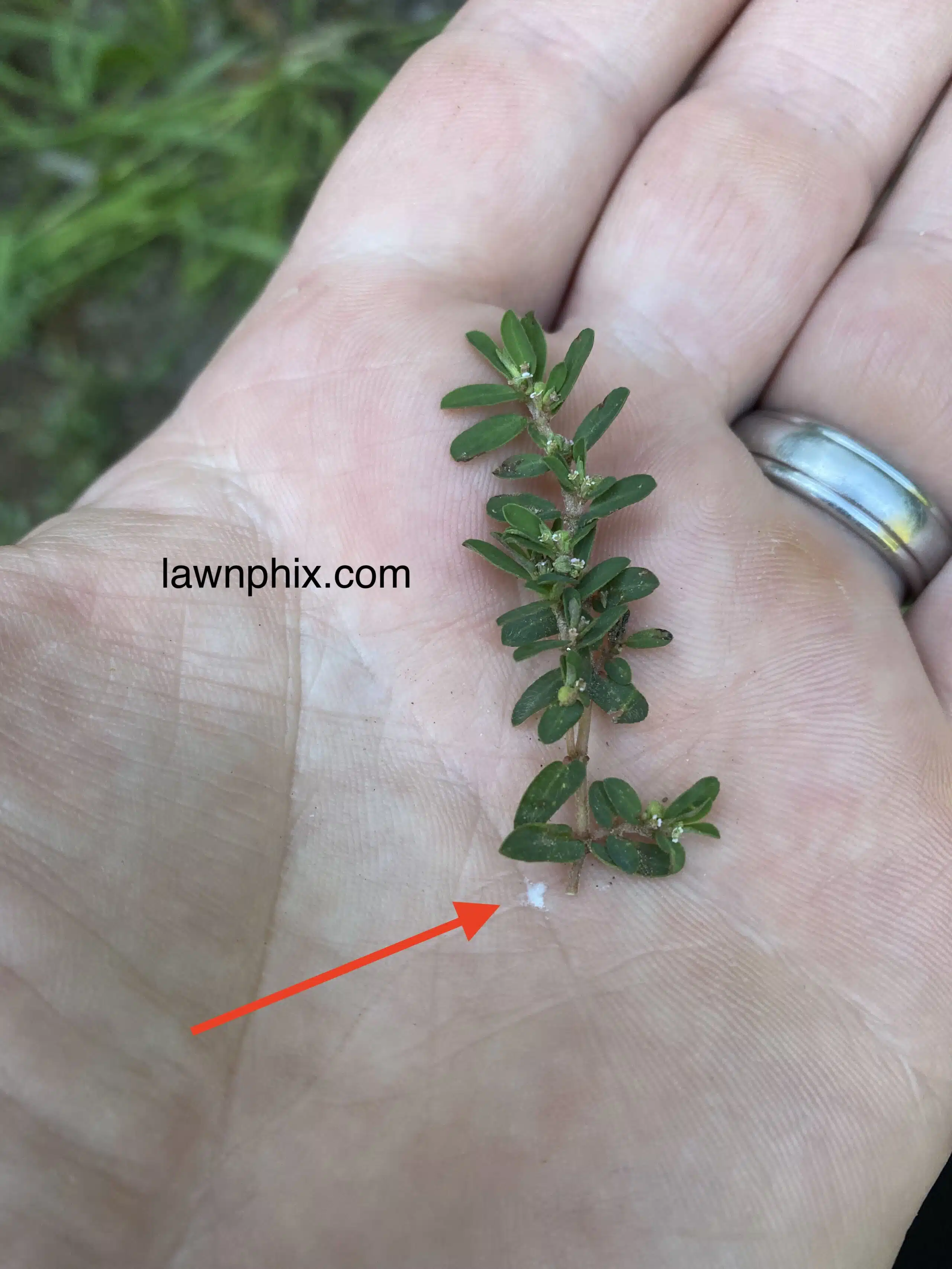
Spotted spurge
A flat mat radiating from a single root, small oval leaves often marked with a reddish spot, and milky sap when a stem is snapped. It shows up along hot driveway and sidewalk edges in mid-summer.

SUMMER ANNUAL
Purslane
Thick, fleshy, paddle-shaped leaves on reddish stems, with clear sap rather than spurge’s milky sap. LawnPhix’s weed profiles note its seed can stay viable in soil for more than 20 years. See spurge vs purslane.

WINTER ANNUAL
Henbit
Square stems, round scalloped leaves that wrap the stem in tiers, and small purple tube-shaped flowers in early spring. Easily confused with purple deadnettle; see henbit vs purple deadnettle.

PERENNIAL
Creeping charlie (ground ivy)
A mint-family creeper with square stems that root at every joint, round scalloped leaves and small purple-blue flowers in spring. It smells minty when mowed and favours shade and damp soil. See henbit vs creeping charlie.

PERENNIAL
Wild violet
Heart-shaped, slightly waxy leaves with purple or white flowers in early spring, spreading from thick underground rhizomes. It is common in shady lawns and is one of the hardest broadleaf weeds to kill.

WINTER ANNUAL
Common chickweed
Low, tangled mats of small pointed-oval leaves in pairs, with tiny white star flowers whose petals are split almost to the base. It grows through the cool months in moist, shaded or thin spots.

WINTER ANNUAL
Hairy bittercress
A small rosette of leaves made of rounded leaflets, with tiny white flowers on wiry stems in very early spring. LawnPhix’s weed profiles note its pods can fling seed as far as 16 feet, so get it before it pods.

ANNUAL
Horseweed
One upright stem crowded with narrow, hairy leaves, usually in thin or newly seeded areas. Regular mowing keeps it from bolting. LawnPhix’s 2,4-D guide notes 2,4-D worked very well on it.
PERENNIAL
Broadleaf plantain
A rosette of broad, oval leaves with heavy ribs running almost parallel, and pencil-thin seed spikes in summer. It is common in hard, compacted soil and high-traffic edges. It is listed among the most common Massachusetts lawn weeds in our common lawn weeds guide; there is no stand-alone LawnPhix plantain guide yet.
Want to identify a weed by its flower instead? Start with weeds with yellow flowers, weeds with white flowers or weeds with purple flowers.
Which herbicide kills which broadleaf weed
Most lawn broadleaf killers are blends. As LawnPhix’s 2,4-D guide explains, a classic “3-way” combines 2,4-D, dicamba and MCPP (mecoprop). SpeedZone adds carfentrazone to make a 4-way, and OnDeck is a 2-way with 2,4-D and dicamba. A 3-way handles most of the list above. A few weeds need triclopyr, which is the ingredient to look for when a standard 3-way leaves survivors. The notes below are from Rutgers’ cool-season lawn fact sheet unless marked.
| Weed | What usually works | Notes |
|---|---|---|
| Dandelion, plantain, henbit, chickweed, hairy bittercress, horseweed | Standard 3-way (2,4-D + dicamba + MCPP) | Easiest group. Hit winter annuals while they are small in fall. |
| White clover | A product with triclopyr; quinclorac also controls clover | May need two applications 4–6 weeks apart. |
| Wild violet, creeping charlie | Triclopyr | Resist standard blends. Plan on repeat passes and a fall program. |
| Oxalis | Triclopyr | Quinclorac does a poor job on it. |
| Black medic | Triclopyr or dicamba | A legume like clover. Feeding the lawn helps. |
| Spotted spurge | Two or three of 2,4-D, dicamba and triclopyr | Harder than most annuals. It also pulls up easily by hand. |
| Purslane | Treat young plants | Mature plants are much tougher, per LawnPhix’s weed profiles. |
For tough fall weeds, LawnPhix tank-mixes OnDeck (2,4-D and dicamba) with Triclopyr 4 and a non-ionic surfactant, and lowers the tank water to about pH 5.0 with citric acid. The full recipe is in fall is the best time to control lawn weeds. For product picks, see our best weed killers for lawns.
When to spray broadleaf weeds: fall beats spring
UMass Extension recommends spraying broadleaf weeds in fall and spring, while both weeds and turf are actively growing, and never while cool-season grass is heat- or drought-stressed. Rutgers puts the best Northeast windows at late September through October, and again in May. Fall wins for two reasons. Perennials like clover, violets and ground ivy are sending food down to their roots, so the herbicide goes down with it. And fall is also when you seed and fertilize, so the lawn fills the gaps the weeds leave.
Winter annuals are the other fall target. Henbit, chickweed and bittercress sprout in autumn and are small and easy to kill then. By the time they flower in spring, they are close to dying on their own, and they have already set seed.
Spray-day rules
- Skip the spray if it will be above 85°F. Both LawnPhix’s 2,4-D guide and Rutgers give that limit.
- Don’t mow for 2 days before or after spraying, and give the spray 4–6 hours to dry before rain or irrigation (LawnPhix 2,4-D guide).
- Expect wilting and discoloration within about 48 hours and dead weeds in 7–14 days. LawnPhix allows a second round 2–3 weeks after the first. Rutgers notes clover may need a 4–6 week gap between passes, so follow the product label.
- On new grass, wait until it has been mowed at least three times (UMass, Rutgers). LawnPhix’s rule of thumb is 6 weeks after germination.
- Don’t spray within 4 weeks before you plan to seed or overseed (LawnPhix 2,4-D guide).
Cultural control: a thick lawn is the long-term fix
Herbicide clears today’s weeds. Turf density stops next year’s. Most broadleaf weeds need open, sunny soil to sprout, and a thick lawn doesn’t leave them any.
- Mow high. Rutgers recommends mowing at the top of the range, 3–4 inches for most cool-season lawns, so the grass shades out weed seedlings.
- Feed the lawn. Clover and black medic move in where nitrogen is low. A regular program (see when to fertilize your lawn) takes away their advantage.
- Overseed thin spots in fall. Every bare patch is a seedbed. See how to overseed a lawn.
- Fix shade and wet spots. Violets, creeping charlie and chickweed favour shade and damp soil. Thin the canopy or switch to a shade-tolerant grass.
- Pull the easy ones. Spurge and young purslane come up whole. Dandelions need the whole taproot out. For spray-free options, see homemade weed killer and pet-safe weed killer.
Three times a broadleaf weed killer is the wrong tool
1. The weed isn’t a broadleaf. Nutsedge, crabgrass, quackgrass and wild onion look nothing like dandelions, but people spray them with the same jug and wait for a result that never comes. Check the stem first, and if it’s grass-like, use our weeds that look like grass guide. 2. The lawn is stressed. July spurge is tempting to spray, but heat- or drought-stressed cool-season grass is exactly when UMass and Rutgers say not to. Pull it, or wait for September. 3. The grass is brand new. Seedlings need three mowings before a broadleaf spray, and the spray needs a 4-week gap before you seed. Get the order wrong and you kill the lawn you just paid for.
Broadleaf weeds FAQ
What is the difference between broadleaf weeds and grassy weeds?
Broadleaf weeds have wider leaves with a net of branching veins and usually showy flowers. Grassy weeds have narrow leaves with parallel veins and round, hollow stems, just like lawn grass. That difference is why a broadleaf herbicide can kill a dandelion and leave the grass alone, but does nothing to crabgrass.
When is the best time to kill broadleaf weeds?
In Northeast lawns, late September through October is the best window, with May as the second-best. Perennial weeds are pulling food into their roots in fall, so the herbicide goes down with it, and winter annuals are still small.
Will broadleaf weed killer kill my grass?
A selective broadleaf herbicide used at label rates won’t kill established cool-season grass. The risks are spraying in heat above 85°F, on drought-stressed turf, or on new seedlings that haven’t been mowed three times.
How long does broadleaf weed killer take to work?
With 2,4-D blends, weeds usually twist and discolor within about 48 hours and die in 7–14 days. Tough perennials like clover, violets and creeping charlie often need a second pass.
Why won’t clover and violets die after I spray?
A standard 2,4-D, dicamba and MCPP blend often only sets them back. Rutgers lists triclopyr as the most effective ingredient for white clover, violets and ground ivy, and clover may need two applications 4–6 weeks apart.
Is clover a broadleaf weed?
Yes. White clover is a perennial broadleaf weed, and so are its look-alikes oxalis and black medic. Some homeowners now choose to keep clover for its color and the nitrogen it adds; that trade-off is covered in our clover lawn guide.
Related guides
WEED ID HUB
19 common lawn weeds
Profiles of the weeds Northeast lawns see most, broadleaf and grassy.
GRASSY WEEDS
Weeds that look like grass
Crabgrass, nutsedge, quackgrass, poa and the rest, with ID clues.
TIMING
Fall is the best time to control lawn weeds
The LawnPhix fall tank mix and the weeds to target.
HERBICIDES
How long does 2,4-D take to work?
Timelines, rainfast times and mowing rules for 2,4-D blends.
Sources: UMass Extension, Weed management with herbicides (turf) · Rutgers NJAES FS385, Broadleaf weed control in cool-season lawns · Penn State Extension, Weed management in turf
